


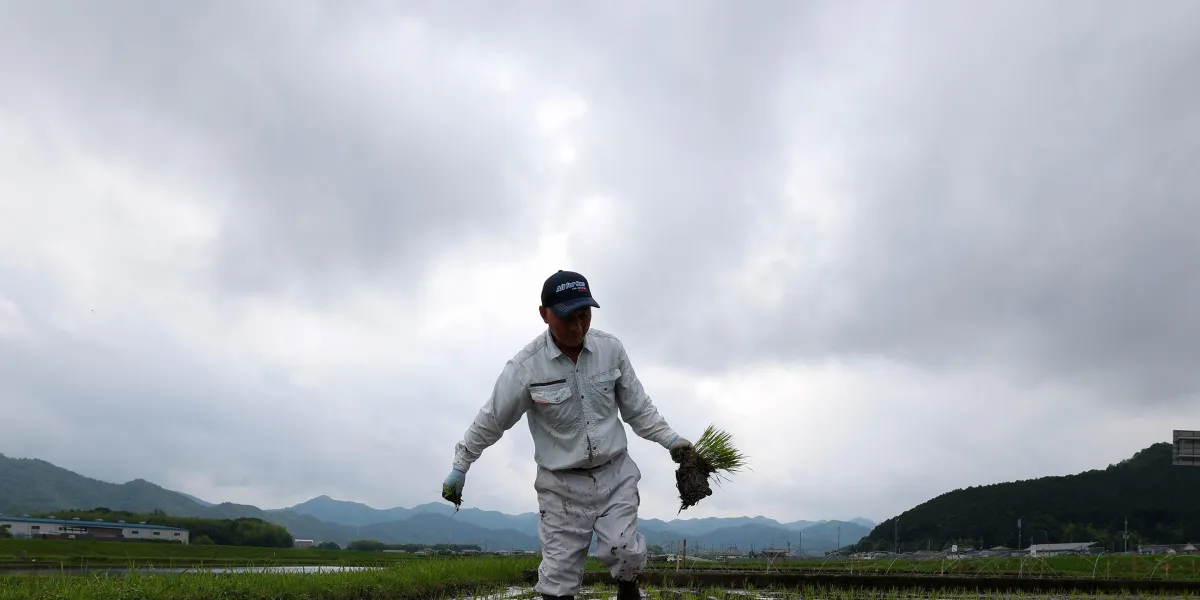
Japan’s rice shortage has turned into a record surplus within two years, prompting the government to buy 210,000 tons from the market to prevent prices falling further.
The reversal follows a crop damaged by extreme heat and drought in 2023, a subsequent national shortage and a surge in prices that contributed to the resignation of an agriculture minister. By mid-2026, private stocks had recovered to 2.43 million tons, with the agriculture ministry forecasting that the surplus will increase further into 2027.
Ryosuke Inoue, a visiting fellow at the CSIS Japan Chair in Washington, said the scale of the change had surprised experts. “Every expert is actually surprised by this fluctuation,” he said.
The initial shortage was driven by damage to rice during the grain-filling stage, reducing the volume classified as sellable, top-grade produce. Demand also rose as tourism surged and consumers bought additional supplies after an earthquake warning.
Private stocks fell from their usual level of about two million tons to roughly 1.5 million tons. The price of a five-kilogram bag rose from about ¥2,000 (£10.30; $13) in early 2024 to a peak of ¥4,300 (£22; $27) in 2025.
The government released emergency reserves that year for the first time since the reserve system was established in 1995. The stocks had generally been held for natural disasters, and the timing of their release became controversial.
“People said the government should have released the rice much more quickly,” Mr Inoue said.
Japan’s rice surplus follows a rush to increase production
High prices encouraged farmers to expand production. Supply then overshot demand, sending private stocks sharply higher and pushing prices back towards ¥3,300 (£17; $21) for five kilograms.
Mr Inoue said prices could continue falling towards 2022 and 2023 levels, or lower. The government’s purchase of 210,000 tons is intended to replenish reserves depleted during the shortage and support the market as supplies build.
He said the volatility had also exposed weaknesses in Japan’s rice distribution system. “Many distributors are trying to maximize their profit, and even the government doesn’t know how the rice was distributed from the farmers to the final consumers,” he said.
Japan produces nearly all the rice it consumes and exports very little. It already imports rice from the United States under a World Trade Organisation duty-free quota of 770,000 tons a year, with roughly half of that volume historically sourced from the US.
Rice became a point of tension in trade discussions between Tokyo and Washington during the shortage. A US-Japan trade agreement in 2025 required Japan to increase its purchases of US rice by 75%, a rise that Mr Inoue said was still working through the system and would continue into 2026 and beyond.
The longer-term outlook is complicated by the age and scale of Japan’s farming workforce. The average rice farmer is 67.7 years old, while only 1.2% are under 30. Japan has about 500,000 rice farms across 3.4 million acres, compared with around 1,100 rice farms covering roughly 512,000 acres in California.
Mr Inoue said the central issue was not simply the number of farmers leaving the industry, but whether their land could be taken over. Much of Japan’s rice is grown in mountainous areas that are unattractive to new operators, and abandoned fields can be difficult to return to production.
He has proposed a system modelled on the US Price Loss Coverage programme, under which farmers would receive support when prices fell below a level covering their costs. He estimates that threshold at about ¥2,800 (£14.40; $18) per five kilograms.
“I think now is the time,” Mr Inoue said, arguing that a safety net combined with freer market conditions would be preferable to production caps and the current cycle of shortages and oversupply.
Climate pressures are expected to continue testing the system. A drought across western Japan this year, described by some meteorologists as comparable with the country’s worst in more than 30 years, has already been linked to falling yields in official data.
Summer temperatures were also well above the long-term trend between 2023 and 2025, encouraging farmers to adopt heat-tolerant varieties. Their use has been rising, although such strains still account for less than 20% of total plantings.
