


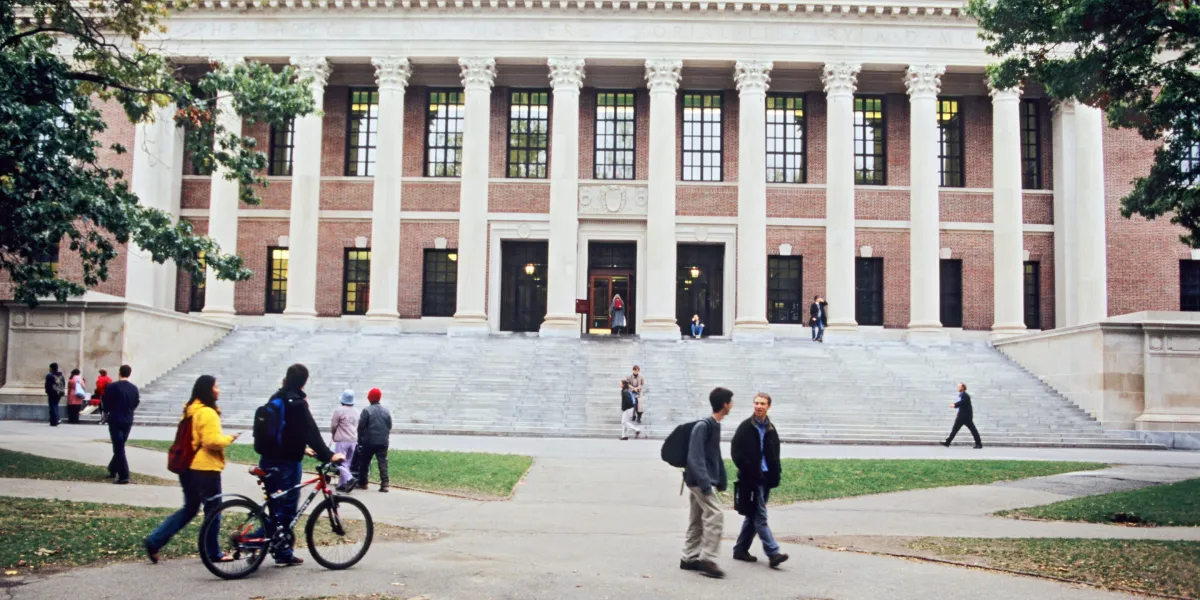
Harvard is facing renewed scrutiny over its legacy and donor admissions practices, three years after the US Supreme Court struck down race-conscious admissions and civil rights groups challenged preferences for applicants with family or financial connections to the university.
The university has a little-known admissions route known as the Z-List, under which a small number of applicants are offered places on condition that they wait a year before enrolling. The scheme is not advertised on Harvard’s admissions website and does not appear as an option on the Common Application.
Critics have argued that the route has historically benefited children of wealthy donors, prominent alumni and heads of state, including some whose academic records may have made admission through the standard process unlikely.
Harvard’s legacy admissions system has also come under pressure. Legacy applicants are children of former students, and the practice has been questioned since the Supreme Court ruled in June 2023 that Harvard and the University of North Carolina could no longer consider race in admissions.
A former University of Pennsylvania admissions officer, now a senior admissions consultant at Ivy Coach, said the continued use of legacy preferences was difficult to reconcile with the court’s decision. The author argued that universities should not favour applicants because of their parents while being prohibited from considering an applicant’s race.
At some universities, legacy students are understood to account for roughly the same proportion of a class as first-generation students. Institutions regularly publicise their first-generation admissions figures, but are less likely to disclose the share of students admitted with a legacy advantage, the commentary said.
Following the Supreme Court ruling, civil rights groups filed a federal complaint challenging Harvard’s legacy and donor preferences. The US Department of Education then opened a civil rights investigation, after which Harvard said publicly that it was reviewing aspects of its admissions practices.
Three years on, the university is apparently still considering whether parental connections should influence admission. Figures cited in the commentary show that, between 2009 and 2015, about 34 per cent of applicants whose parents attended Harvard were admitted, compared with roughly 6 per cent of applicants without a legacy connection.
Harvard and other elite universities have long been associated with the view that alumni loyalty can support philanthropic giving. The commentary acknowledged that donations help fund financial aid and research, but argued that universities should be more open about the point at which financial considerations affect admissions.
Johns Hopkins ended its legacy preference before the Supreme Court’s ruling. In 2018, alumnus Michael Bloomberg gave the university $1.8 billion for undergraduate financial aid, enabling it to become permanently need-blind. The commentary contrasted that donation with admissions preferences sought for the donor’s family.
It argued that any consideration of donors should be limited to exceptionally large gifts that create substantial opportunities for other students, rather than being extended to applicants simply because a parent attended the university.
The issue also raises questions about the relationship between charitable donations and preferential admissions, according to the commentary. Federal tax rules on “quid pro quo contributions” generally limit the deductible portion of a charitable payment when the donor receives goods or services in return, although legacy admissions have not been declared unlawful under the tax code.
California has banned legacy and donor preferences at private non-profit universities taking part in state-funded financial aid programmes. Stanford withdrew from those programmes and replaced the funding from its endowment rather than give up its ability to consider alumni and donor connections.
The Harvard debate is being watched beyond Cambridge, Massachusetts, because of the university’s influence over its peers. The commentary called for broad legacy preferences to be abolished, with any exception for transformational philanthropy made explicit and kept exceedingly rare.
