


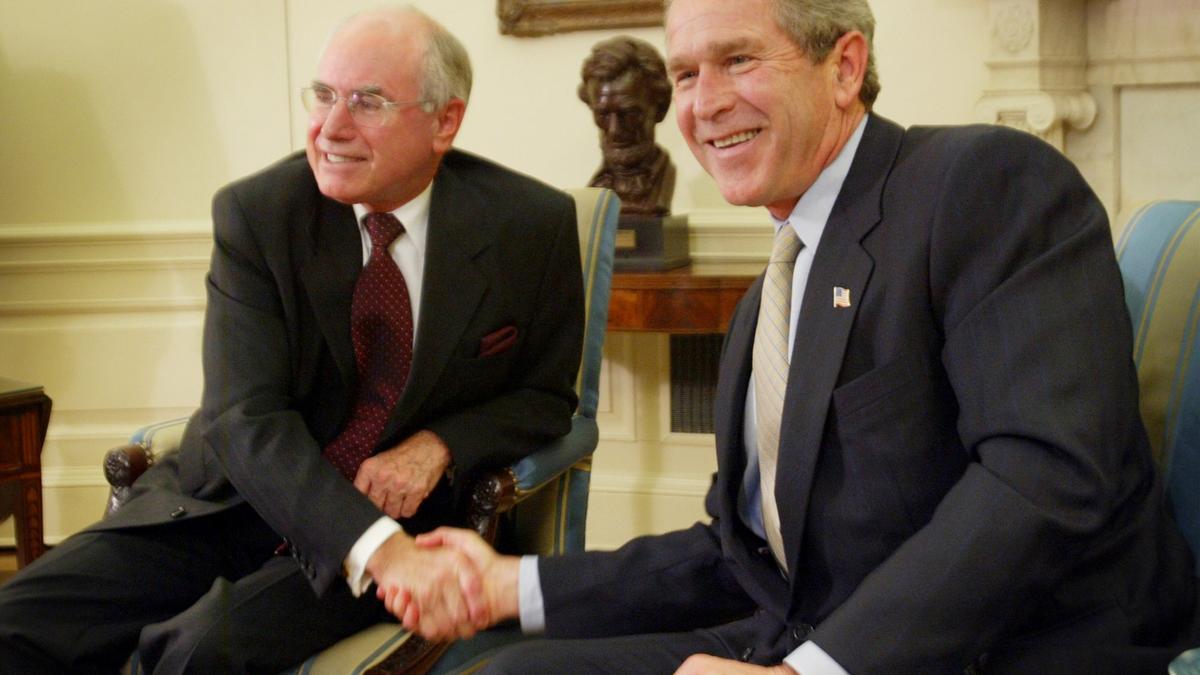
Former Australian prime minister John Howard has said reliable intelligence showing that Saddam Hussein did not possess weapons of mass destruction would probably have stopped the invasion of Iraq, describing the hypothetical evidence as “a game changer”.
His comments come as the 25th anniversary of the September 11 attacks approaches, and shed new light on how quickly Iraq entered discussions in Washington after the destruction of the World Trade Centre and the attack on the Pentagon.
Howard was in Washington on September 11, 2001, and received a briefing in a secure bunker beneath the Australian embassy from ambassador Michael Thawley, his former international adviser.
Thawley had been in contact with officials in the White House West Wing, where senior figures were dealing with the deadliest terrorist attack ever carried out on the American mainland.
According to Howard, Thawley said the initial US response was expected to focus on al-Qaeda and that Osama bin Laden had been identified as a likely figure behind the attacks.
“The other thing he said to me was he thought this might bring Iraq back onto the table,” Howard recalled.
The remark was made within hours of the attacks, despite the absence of evidence linking Saddam’s regime to the hijackings or the destruction in New York and Washington.
Howard said he never believed Saddam Hussein was directly responsible for September 11. However, he shared the Bush administration’s concern that Iraq might possess chemical or biological weapons which could eventually fall into the hands of terrorist groups.
John Howard and the Iraq intelligence
On March 18, 2003, Howard announced that Australia would join George W Bush’s “Coalition of the Willing” in invading Iraq. The decision rested on intelligence which he still regards as compelling evidence that Saddam was concealing a stockpile of weapons of mass destruction.
Those weapons were not found. Subsequent investigations concluded that Iraq’s prohibited weapons programmes had been dismantled years before the invasion, exposing serious failures in the intelligence used by the United States, Britain and Australia.
The 9/11 Commission also found that there was no compelling case that Iraq had planned or carried out the attacks, and no confirmed evidence that Saddam had co-operated with bin Laden in developing unconventional weapons.
Despite the failure of the intelligence, Howard rejected the suggestion that he had been deliberately deceived by British or American agencies.
“‘Misled’ implies deliberate deceit,” he said. “No. We weren’t deliberately deceived.”
His position echoes the argument he has maintained since the invasion: that the intelligence was wrong, but that governments acted on what they believed to be credible assessments rather than knowingly fabricating a case for war.
Howard has also pointed to Tony Blair’s decision to commit British forces as evidence against the theory that the invasion was simply an ideological project devised by the Bush administration.
But when asked to consider what might have happened if the intelligence had accurately shown that Saddam did not possess weapons of mass destruction, the former prime minister accepted that the course of events could have changed fundamentally.
“If we’d had evidence that strong against the likelihood he possessed them, I think that would have given us pause to think hard about whether to go ahead,” he said.
“That would have been, to my mind and in retrospect, a game changer.”
Howard’s reflection amounts to an acknowledgement that, without the flawed intelligence, the invasion of Iraq may never have taken place. The conflict unleashed years of sectarian violence and helped reshape the political and security landscape of the Middle East.
It also leaves open a wider question about the consequences of decisions taken in the immediate aftermath of September 11, when the shock of the attacks created pressure for a far-reaching response and Iraq was being discussed in Washington almost from the outset.
