


The Government’s decision to impose sanctions on Israeli settlements in the occupied West Bank has triggered a sharp diplomatic confrontation with Israel and renewed warnings that Britain risks damaging a longstanding security and trading relationship.
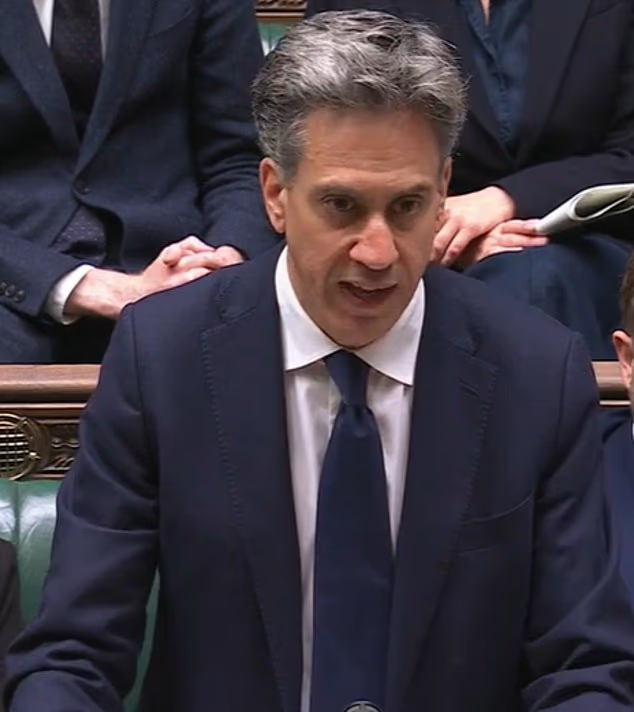
Foreign Secretary Ed Miliband announced the measures in the House of Commons on Tuesday, saying Britain would ban imports from settlements and introduce sanctions against companies and individuals involved in construction, infrastructure, finance and property development linked to settlement expansion.
The restrictions are expected to come into force within six to nine months. The Government said they would target settlements and those facilitating their expansion, rather than Israel as a whole, and insisted that trade with Israel within its internationally recognised borders would continue.
Israel responded by announcing the closure of Britain’s consulate in East Jerusalem. British personnel are also being removed from a US-led centre involved in coordinating the Gaza ceasefire, while Israel said it would end British training for Palestinian Authority security forces in the West Bank.
The retaliatory measures have raised concerns about the impact on Britain’s diplomatic reach in the region and on security co-operation with Israel, a country with which the UK has shared intelligence and defence links for decades.
Sanctions have exposed a widening split over Israel
Mr Miliband said the decision was prompted by settlement expansion, settler violence and Israel’s approval of plans for more than 1,200 homes in the E1 area east of Jerusalem. Britain, France and Canada said the development threatened the viability of a future Palestinian state by cutting across the West Bank.
In a joint statement, the three countries said they would take targeted action against settlement activity while reiterating their support for Israel’s security and for a two-state solution.
Mr Miliband also announced further sanctions against extremist settlers and said the Government would refuse export licences for arms or other goods that materially contributed to the occupation. He described the measures as a “comprehensive sanctions regime” focused on settlement expansion and said he opposed the wider Boycott, Divestment and Sanctions campaign against Israel.
The Foreign Secretary acknowledged Israel’s right to defend itself against Hamas and condemned the October 7 attacks. But he said Britain could not ignore the humanitarian crisis in Gaza or what he called the unlawful conduct of the Israeli government in the West Bank.
He said the policy was consistent with Britain’s national interest, arguing that lasting stability in the Middle East depended on preserving the possibility of a negotiated settlement.
Critics, however, accused the Government of jeopardising Britain’s interests for a largely symbolic foreign-policy gesture. Conservative leader Kemi Badenoch described Prime Minister Andy Burnham as “Corbyn in all but name”, while former prime minister Liz Truss called the Government an “Islamist-appeasing disgrace”.
The criticism has focused particularly on the risk that action directed at settlements could become, in practice, a wider boycott of Israel. Ministers have rejected that interpretation, stressing that goods produced inside Israel itself will not be covered by the ban.
The measures have also prompted concern over potential economic consequences. UK-Israel trade was worth billions of pounds last year, while Israeli companies operate in sectors including pharmaceuticals, technology, defence and medical equipment. Supporters of the sanctions argue that the restrictions are narrowly drawn and necessary to discourage settlement expansion; opponents say they risk undermining commercial and security co-operation without changing Israeli policy.
Washington has so far adopted a more measured position than some of the rhetoric surrounding the dispute suggested. US Secretary of State Marco Rubio said the administration had been informed of the British decision and shared the goal of stability, while declining to condemn the move.
The White House also distanced itself from comments by its ambassador to Israel, Mike Huckabee, who had accused the British Government of discriminating against Jewish people. US officials told Axios that the ambassador’s remarks had not been co-ordinated with the White House or State Department.
Mr Burnham briefed President Donald Trump before the announcement, according to the report, but Mr Trump did not ask the Prime Minister to abandon the policy. That has eased immediate fears of an American retaliation, although the move is still likely to complicate Britain’s relations with both Washington and Jerusalem.
The dispute comes after Britain recognised a Palestinian state last year and suspended a number of arms licences connected to Israel’s military campaign in Gaza. Ministers say the latest measures represent a further attempt to protect a two-state solution; critics say they amount to an increasingly one-sided approach to the conflict.
The Government now faces the challenge of enforcing the new restrictions while preserving diplomatic access, intelligence links and economic ties with Israel. The closure of the British consulate in Jerusalem marks the clearest immediate cost of the policy and signals how far relations have deteriorated.
