


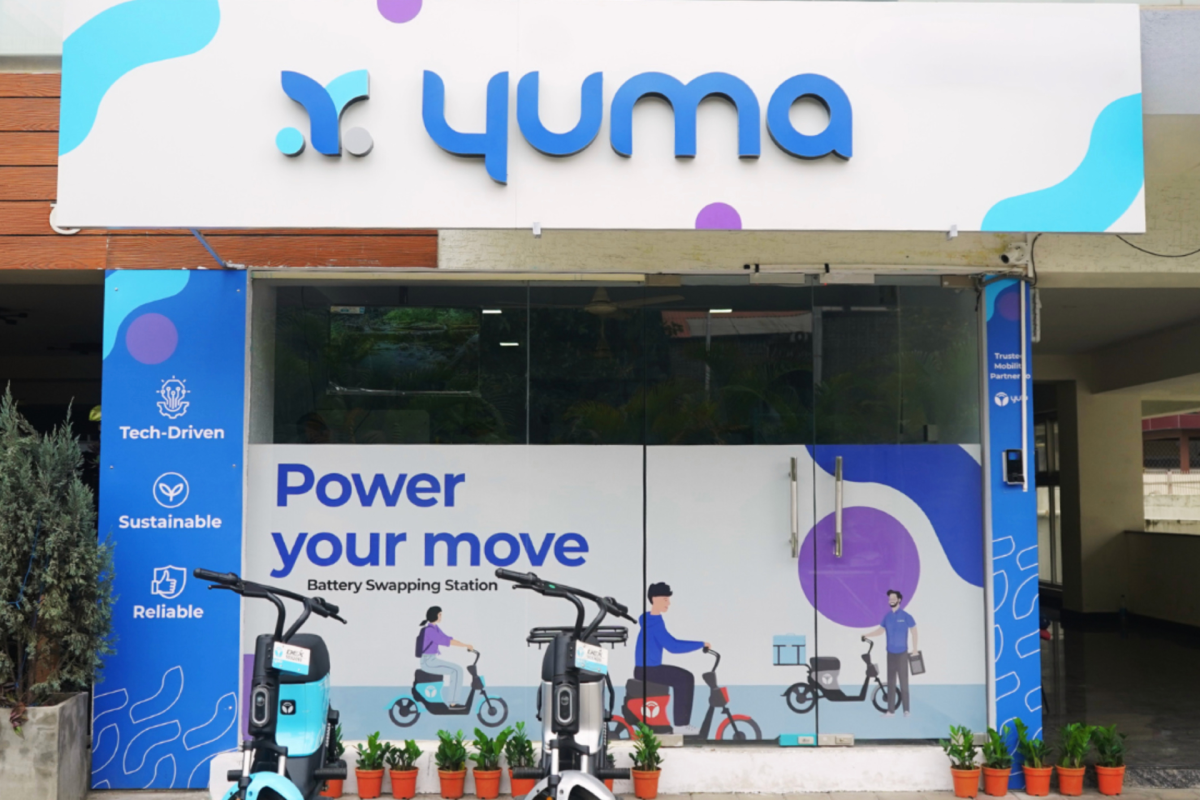
Magna International is investing a further $35 million (£26.5 million) in Indian battery-swapping company Yuma Energy, increasing the Canadian automotive supplier’s stake in a business targeting the country’s rapidly expanding electric delivery market.
Yuma operates a network for electric two- and three-wheelers, allowing riders to exchange depleted batteries for charged ones in less than two minutes. The company has completed more than 60 million swaps and has about 100,000 batteries in circulation.
The additional funding will dilute the interest held by Yulu, the Indian mobility company from which Yuma was spun out in 2023. Magna originally took a 51 per cent stake when the joint venture was established, while Yulu held the remaining 49 per cent. Yuma managing director Muthu Subramanian declined to disclose the new ownership structure.
Magna said Yulu and Yuma were its only investments in India. In 2022, it committed a combined $77 million to the two businesses, including $52 million for the battery-swapping venture and $25 million for Yulu.
Yuma targets India’s delivery riders
The latest investment is centred on India’s gig economy, where delivery riders can lose income while waiting for electric vehicles to recharge. Subramanian estimates that only 10 to 15 per cent of vehicles used by gig workers in India are currently electric, leaving room for further growth.
“With Indian gig workers’ high runtime on a daily basis, an EV makes absolute sense in terms of cost of ownership,” he said. “Uptime is important.”
Yuma argues that battery swapping is better suited to high-mileage riders than conventional charging. A fast charge can take 20 to 30 minutes and requires space and substantial power capacity, whereas a battery exchange can return a rider to the road within minutes.
The business is not yet profitable, although some of its older stations are EBITDA-positive. Yuma runs more than 400 stations and 2,500 charging units across 18 Indian cities, and recorded revenue of about 1 billion rupees (£9.1 million) in the financial year ending in March 2026.
Subramanian said Yuma was aiming to reach EBITDA break-even within the next two quarters. The company plans to use most of Magna’s new funding to expand its network and double its battery fleet over the next 12 to 18 months.
Yuma’s network is still heavily dependent on Yulu, but that reliance is beginning to fall. Customers other than Yulu accounted for between 15 and 20 per cent of swaps in the latest quarter, with the company expecting that proportion to reach about 25 per cent within two years.
The company now works with more than five fleets and has integrated its batteries with over 10 vehicle platforms, including models made by Kinetic Green, Motovolt, BGauss and Quantum Energy. Yulu raised $93 million earlier this month to expand its own electric two-wheeler fleet, increasing the need for additional swapping capacity.
Yuma currently operates in cities including Bengaluru, Hyderabad, Mumbai, the Delhi region, Jaipur, Lucknow, Indore, Coimbatore, Kochi and Kolkata. It plans to enter Chennai and Pune in the coming quarters, while adding more stations to existing markets.
The company says India will remain its priority for at least the next 12 to 18 months, although it is considering future expansion into two-wheeler markets in south-east Asia and parts of Africa. It has not yet begun discussions on entering those regions.
Unlike operators that only manage swapping networks, Yuma designs and manufactures its own battery packs and charging equipment. Its battery packs are made in Chennai and its charging units in Bengaluru, giving the company control over both the hardware and the network that operates it.
