


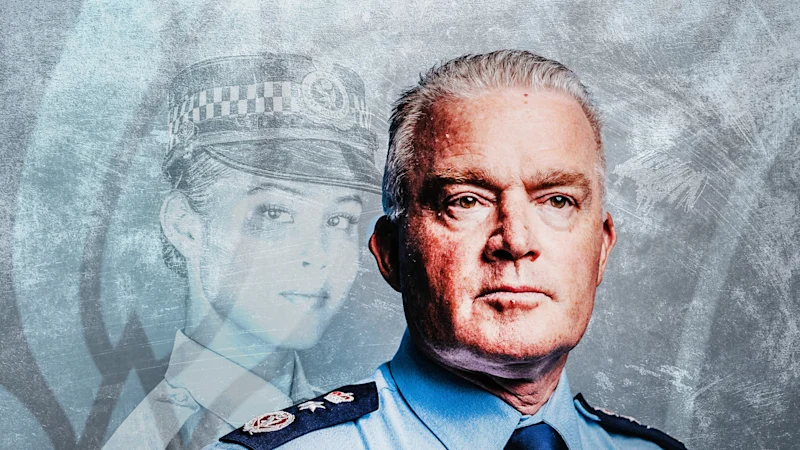
The death of Constable Mia Lay has become the most personal challenge of Mal Lanyon’s first year as commissioner of NSW Police, coming after a high-speed crash in Sydney’s inner south that killed the 20-year-old officer while she was on duty.
Lanyon returned early from leave after learning of Lay’s death in the early hours of September 25. A week later, he said the loss of an officer who had been protecting the public was difficult to express.
“To lose one of my officers in a circumstance like that, someone who was going about doing her duty to protect the community, has an impact on me,” Lanyon said.
“Losing her, someone so young with such a bright future, obviously has an impact.”
The tragedy has come during one of the most testing first years faced by a NSW police commissioner. Two and a half months after Lanyon took the role, 15 people were killed in the Bondi Beach terror attack, while officers have also been dealing with mistaken-identity killings connected to Sydney’s gangland conflicts.
Lanyon said the Bondi attack had altered the city and left a lasting mark on children who witnessed its effects.
“I think innocence was lost in Sydney and NSW through Bondi,” he said. “The overall impact that had on the community of Sydney, and NSW, and to be honest, Australia, was overwhelming.”
He added: “There’s never going back to pre-Bondi in my mind.”
Pressure on NSW Police
Police are also confronting an increasingly volatile organised crime environment, with innocent people caught up in disputes over control of Sydney’s illicit drug market. Lanyon said the alleged kidnapping and murder of 85-year-old Chris Baghsarian in February would have been unimaginable a decade ago.
“That never would have happened before. That is not something we would have seen,” he said.
Taskforce Falcon, a 150-strong operation established after the mistaken-identity killing of Sydney plumber John Versace last May, has arrested more than 850 people and laid more than 2200 charges since last June, according to Lanyon.
“No one who wants to commit these sorts of offences should feel they’re doing so with impunity,” he said. “No one should believe that we aren’t going to target them.”
The commissioner said preventing teenagers from being drawn into organised crime remained a priority, as did pursuing criminal figures believed to be directing Sydney’s underworld from overseas.
Police conduct is also under scrutiny. The Law Enforcement Conduct Commission is investigating allegations of excessive force and heavy-handedness during a protest at Sydney Town Hall against the visit of Israeli President Isaac Herzog. Public hearings are expected in the coming months.
Domestic violence, organised crime and the rising road toll remain among Lanyon’s other priorities. He said the number of deaths on NSW roads was expected to reach 300 this year despite police efforts to address speeding, fatigue and drink-driving.
“We can actually reduce the road toll,” Lanyon said. “Losing 300 people a year is something that should be simply unacceptable to the community, particularly when we can control it.”
NSW Police is short of 2500 personnel, but Lanyon said 2026 was the first year in five that more officers had joined than left. The three most recent graduating classes from the Goulburn academy were also the largest in more than a decade.
He has visited more than 50 police stations since becoming commissioner and said improving recruitment and retention would ensure officers were better supported and communities received a stronger service.
Looking beyond his own tenure, Lanyon said he wanted to oversee the force’s development and establish a succession plan. Changes among senior officers and a series of retirements have already reshaped the hierarchy he inherited from his predecessor, Karen Webb.
Reflecting on the public response to Lay’s death, Lanyon said the grief showed the regard in which police officers were held across NSW.
“I think everyone can see her as their own daughter,” he said. “It’s had a massive impact right across the board.”
As the force becomes younger on average, Lanyon said less experienced officers were increasingly being required to confront situations beyond their years.
“My job’s going to be to continually improve the organisation,” he said. “If there are better practices, we will pick them up. If we can make improvements on things we currently do, we want to do that.”
