


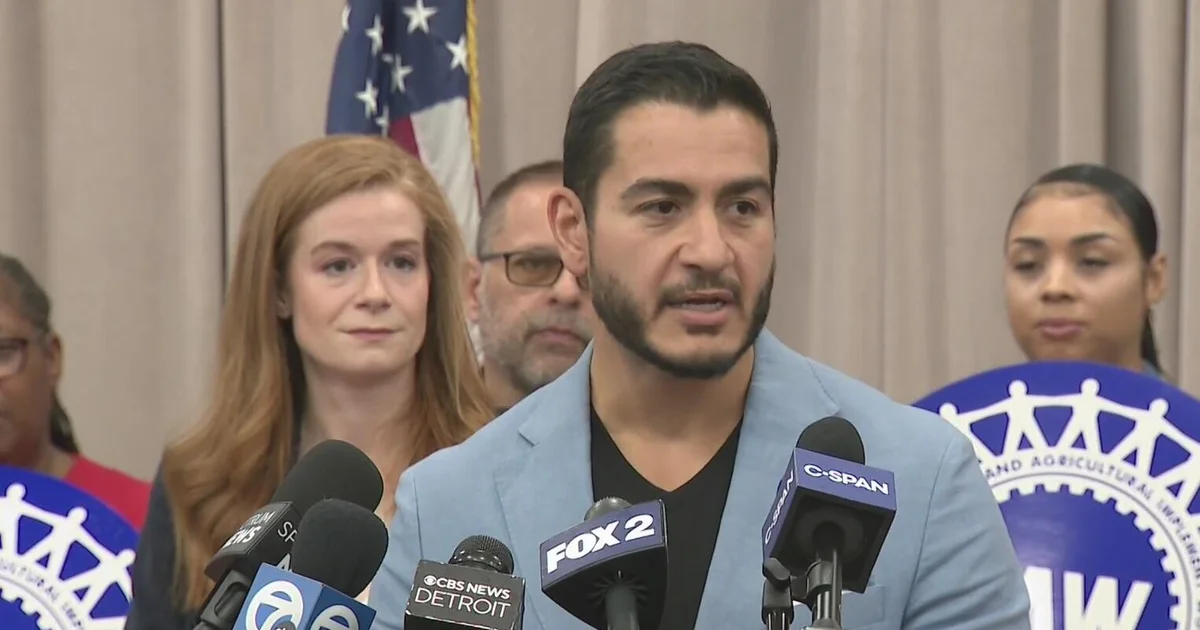
Michigan Jewish leaders have launched a petition pressing Democratic Senate nominee Abdul El-Sayed and other candidates to make clear commitments on Jewish safety, Israel and the place of Jewish voters in American political life.
The campaign, led by more than a dozen rabbis and backed by representatives of about 40,000 Jewish Michiganders, comes as Mr El-Sayed attempts to consolidate Democratic support ahead of November’s closely watched Senate election.
Although the petition does not name Mr El-Sayed, its organisers have made clear that his views and campaign conduct are central to their concerns. They say American Jews increasingly feel politically isolated within a party they have traditionally supported.
“The American Jewish community is feeling squeezed from both sides of the political spectrum,” Rabbi Josh Whinston, one of the petition’s organisers, told reporters.
The document sets out five “non-negotiables”: Jewish safety; the right of Jewish people to define their own identities; Jewish sovereignty in Israel; full participation for Jewish Michiganders in American political life; and an affirmative vision for the Middle East, including Palestinian self-determination alongside Israel.
The organisers say candidates should support a two-state future and reject language that, in their view, delegitimises Israel or treats Jewish identity and Zionism as incompatible. They describe the petition as an invitation to engage rather than an ultimatum.
“Every constituency must occasionally remind its party that support is earned, not owed,” the petition says. It adds that voters should be able to know whether candidates are willing to meet their “baseline needs”.
Mr El-Sayed, a former Michigan health official, won the Democratic nomination last month after a divisive primary against Representative Haley Stevens. His campaign was supported by Senator Bernie Sanders and Representative Alexandria Ocasio-Cortez, while Ms Stevens had backing from more moderate Democrats and Senate Minority Leader Chuck Schumer.
During the primary, Mr El-Sayed attacked Ms Stevens over more than $30 million in outside spending from a group funded by the American Israel Public Affairs Committee, or AIPAC. He has argued that criticism of Israel and AIPAC should not be confused with hostility towards Jewish people.
He has nevertheless faced criticism over his association with progressive streamer Hasan Piker, whose comments about Israel and American Jews prompted condemnation from senior Democrats. Mr El-Sayed has since said that “nobody speaks for this campaign besides me and my campaign spokespeople”.
“My commitment to Jewish safety is the same as my commitment to the safety of my own daughters,” Mr El-Sayed said in a recent statement. “Antisemitism is a scourge, and we need to address it in all its forms.”
Mr Whinston said the statement and a subsequent apology over comments made after a synagogue attack in the Detroit area had not gone far enough. He also criticised Mr El-Sayed for describing Israel as “bloodthirsty” under the leadership of Prime Minister Benjamin Netanyahu, saying the phrase echoed a historic antisemitic accusation.
Mr El-Sayed’s campaign said he had held private meetings with Jewish organisations and rabbis, attended the Michigan Democratic Jewish Caucus’s annual Summer Simcha and spoken repeatedly with Senator Elissa Slotkin, a Jewish Democrat.
Rabbi Aaron Starr, president of the Michigan Board of Rabbis, said Jewish leaders had welcomed Mr El-Sayed’s attempts to repair relations but hoped he would take further steps.
“We hope that there will be another bridge between where he is now and where he can go in the future,” Rabbi Starr said.
Mr El-Sayed will face former Republican congressman Mike Rogers in November. The contest is considered one of the most competitive Senate races of the cycle and could help determine which party controls the chamber.
Several Michigan Jewish leaders said members of their congregations remained undecided. Rabbi Starr said they would be listening closely to both candidates, while Rabbi Whinston said many people in his Ann Arbor congregation felt “politically homeless” and wanted to be brought back into the Democratic coalition.
