


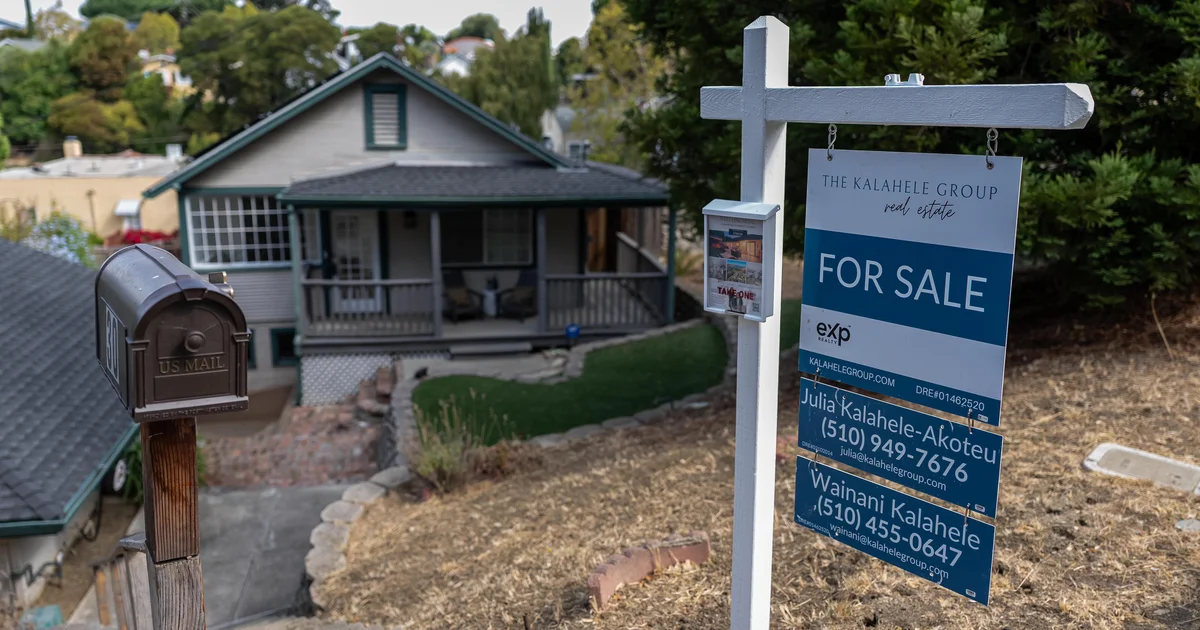
US mortgage rates have climbed to their highest level since January 2025, nearing 7% and placing further pressure on buyers already facing high property prices and limited supply. The increase is also leaving sellers with fewer potential purchasers as activity in the housing market slows.
The average 30-year fixed-rate mortgage reached 6.95% on Thursday, up from 6.76% the previous week, according to Freddie Mac. Rates have risen for 11 consecutive weeks, amid inflation concerns linked to the Iran war and volatility in financial markets.
Mortgage rates are closely tied to the yield on the 10-year US Treasury note, which reached its highest level since 2007 earlier this week. Jake Krimmel, a senior economist at Realtor.com, said about 80% of weekly movements in the cost of a conventional 30-year loan had tracked changes in the Treasury yield in recent years.
“Mechanically, the Treasury yield is doing the lion’s share of the work when it comes to changes in mortgage rates,” Mr Krimmel said.
Mortgage rates near 7% weigh on home sales
Bond yields rose ahead of the Federal Reserve’s meeting on Wednesday, when the central bank increased its benchmark interest rate by 0.25 percentage points – its first rise in three years. Officials also indicated that further increases could come later this year, depending on the path of inflation.
Some economists expect two more quarter-point rises at the Fed’s scheduled meetings in October and December. Although the central bank’s benchmark rate does not directly determine mortgage rates, it can increase borrowing costs more broadly.
Mr Krimmel estimated that just under half of this week’s 0.19 percentage-point increase in mortgage rates was probably linked to changing expectations about the Fed’s decision. The remainder, he said, reflected factors including higher oil prices and geopolitical uncertainty.
“Rising mortgage rates make it harder for folks to be able to afford a house in an already challenging time,” said Matt Schulz, chief consumer finance analyst at LendingTree. “It’s not a great thing for anybody.”
Existing home sales fell for a fourth consecutive month, according to figures from the National Association of Realtors. Sales in August dropped 2% from the previous month to 3.98 million, the lowest level since June 2025.
Bob Broeksmit, president and chief executive of the Mortgage Bankers Association, said rates hovering around 7% were continuing to undermine affordability and reduce demand from prospective buyers.
The median US listing price stood at $424,500 in August. That was 13% higher than in 2021 and 66% above the level a decade earlier.
For buyers, the combination of prices and borrowing costs is making it increasingly difficult to secure a home. A Gallup poll in April found that 25% of people without a home expected to buy one within five years, down from almost half in 2017.
Thomas Louis, 34, and his wife have spent three years looking for a property in New Jersey. They have made 15 offers, including bids above asking price, waived inspections and considered homes that did not meet all their requirements, but remain without a deal.
The couple, who co-own a graphic design studio and earn about $250,000 between them, had expected to find a property costing roughly $500,000. They have focused on Monmouth and Ocean counties, where Mr Louis said prices had eased slightly.
However, cheaper homes have attracted more competition, including buyers able to make cash offers. “It’s actually almost getting worse because more people with more money are buying the houses cheaper because they’re not worried about the rates,” he said.
Mr Louis said the family continued to search in New Jersey but had considered leaving the state because of its rising costs. “We both work as artists, and have some freedom and fun that way,” he said. “But it’s just becoming almost untenable to stay here.”
