


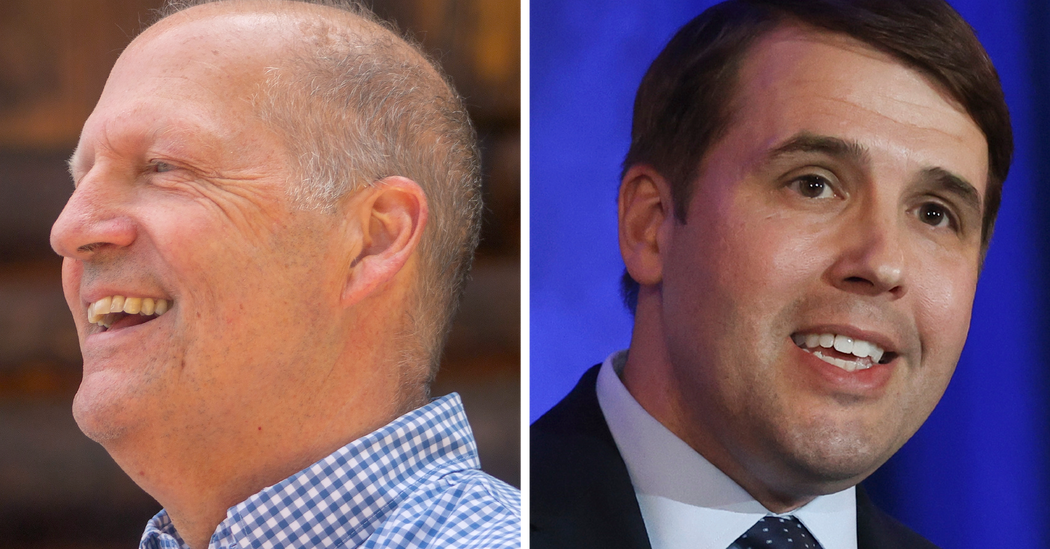
Democrats are facing a tightening battle to retain New Hampshire’s open Senate seat, with four-term congressman Chris Pappas warning that the party risks losing a contest it had expected to control.
The seat is being vacated by Jeanne Shaheen, whose retirement has created one of the Democrats’ most vulnerable positions ahead of November’s midterm elections. The likely Republican nominee, former senator John E Sununu, has turned the race into a serious test of the party’s hopes of preserving its Senate majority.
New Hampshire’s primary takes place on Tuesday, with Mr Sununu expected to defeat former Massachusetts senator Scott Brown for the Republican nomination. Mr Pappas must first overcome a challenge from Karishma Manzur, a medical scientist whose campaign has gained ground among younger and more progressive Democratic voters.
In a fundraising email sent on Friday, Mr Pappas offered a stark assessment of the race, writing: “We’re losing.” He has also appealed directly to national Democrats, warning that the party cannot afford to surrender a seat if it hopes to regain control of the Senate.
“If we’re going to be able to take back four seats and flip the Senate majority, we can’t afford to take one step backward in any seat that’s currently held by a Democrat,” Mr Pappas said in an interview.
New Hampshire Senate race tightens
The latest University of New Hampshire poll, published on August 26, found Mr Pappas still ahead of Ms Manzur in the Democratic primary, but with his advantage narrowing. Mr Sununu led Mr Brown by a wide margin among Republican voters and was statistically tied with Mr Pappas in a hypothetical general-election contest.
An earlier UNH survey in June gave Mr Pappas a 47 per cent to 44 per cent lead over Mr Sununu. The poll also showed Mr Pappas ahead of Ms Manzur by 53 per cent to 29 per cent in the Democratic primary, although his lead had fallen substantially from the spring.
The figures have unsettled Democrats who fear that national strategists are concentrating their resources on larger or more obviously Republican states, including Ohio, Iowa and Texas. A Democratic-aligned Senate group has spent or reserved tens of millions of dollars in Ohio and Iowa, while New Hampshire has received less attention.
Republicans, by contrast, are promising a major financial push. Senate Leadership Fund, the party’s principal Senate super PAC, has pledged to spend $17 million in New Hampshire during the general election. Senate Majority PAC, its Democratic counterpart, has announced an initial $10.2 million television reservation.
“Unless people wake up to the fact that New Hampshire is real, I do think there is a risk of him being swamped by all of this G.O.P. outside money,” said Aaron Jacobs, a Democratic strategist and former aide to Senator Maggie Hassan.
Lauren French, a spokeswoman for Senate Majority PAC, said the group understood that retaining the seat “should be a must-win for us”, while arguing that New Hampshire remained a Democratic-performing state.
The state has not elected a Republican senator since Kelly Ayotte won in 2010, and it has not voted Republican in a presidential election since 2000. Ms Shaheen and Ms Hassan were both comfortably re-elected in their most recent Senate races.
But Democrats’ recent record does not guarantee an easy contest. When Ms Hassan defeated Ms Ayotte in 2016, she won by roughly 1,000 votes. In 2024, Kamala Harris carried New Hampshire by less than three percentage points over Donald Trump — the narrowest margin in any state she won.
“People forget that New Hampshire’s not a blue state. It’s a purple state,” said Kathy Sullivan, a former chair of the New Hampshire Democratic Party.
Sununu family name adds to Republican challenge
Mr Sununu brings considerable political recognition to the Republican campaign. The son of former governor John H Sununu, he served three terms in the House before winning a Senate seat in 2002. He lost his re-election bid to Ms Shaheen in 2008 and has not appeared on a ballot for 18 years.
His return has also been aided by the popularity of his younger brother, Chris Sununu, who served as New Hampshire governor for eight years. Voters and even political figures have occasionally confused the two men, a mistake Democrats have sought to highlight.
John Sununu, who turns 62 this month, has the backing of President Trump. Yet he has sought to distinguish himself from the president on issues including the trade dispute with Canada, an especially sensitive subject in a state whose economy is closely tied to its northern neighbour.
Republicans describe the seat as a prime opportunity to expand their Senate majority. Chris Gustafson, a spokesman for Senate Leadership Fund, said New Hampshire was “a prime pickup opportunity as Republicans work to protect and expand the majority”.
Mr Pappas, 46, has tried to present himself as a pragmatic candidate suited to a politically mixed state rather than as a national Democratic figure. He has raised considerably more money than Mr Sununu and recently secured an endorsement from Ms Harris, in a move intended to raise his national profile and stimulate donations.
He has also sought to avoid the combative style of some of the Democratic Party’s newer stars, arguing that his focus should remain on the concerns of New Hampshire voters.
“I’m not as concerned with the national trappings of the political conversation and what you have to do to get on cable news,” he said. “I’m much more focused on how I can be dialled in to what people are living right now, and how you can translate that into some wins.”
With the primary winners facing one another only eight weeks before the general election, Democrats fear there will be little time to recover if Mr Pappas emerges weakened from his contest with Ms Manzur. For a party seeking to reclaim the Senate, New Hampshire is no longer a seat it can safely take for granted.
