


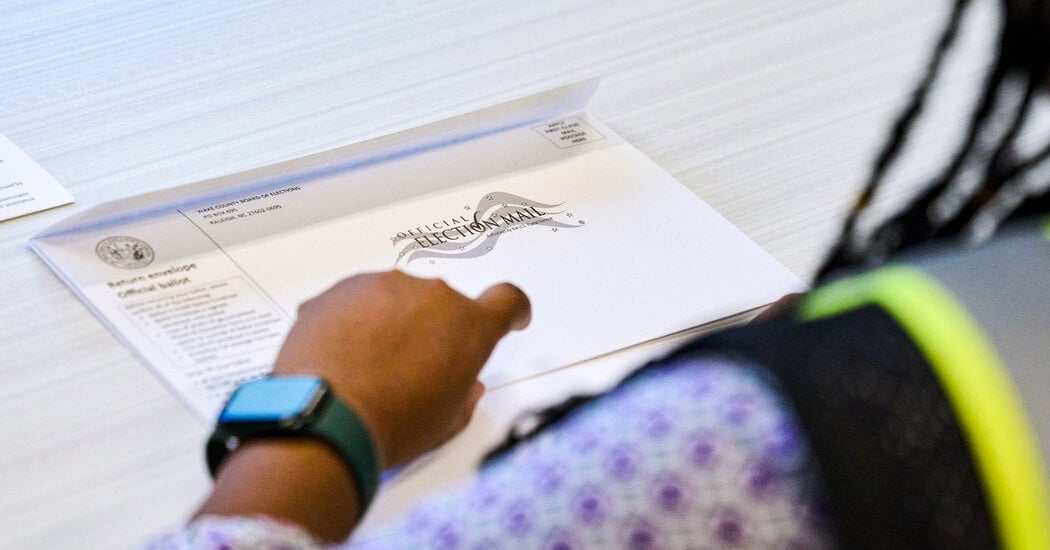
North Carolina has begun sending absentee ballots to voters, becoming the first US state to launch mail voting for the November midterm elections as Donald Trump’s administration seeks to impose new restrictions on the process.
The state’s 100 county election boards are sending an initial batch to more than 46,000 voters who have requested ballots. Further ballots will be dispatched as additional applications are received, according to election officials. ([ncsbe.gov](https://www.ncsbe.gov/news/events/absentee-voting-begins-november-2026-general-election))
The mailing marks the formal start of voting in the 2026 midterm election, which will be held on 3 November. North Carolina voters can also cast their ballots during the state’s 17-day early voting period or in person on election day. ([ncsbe.gov](https://www.ncsbe.gov/news/press-releases/2026/09/02/voting-2026-general-election-begins-week-nc))
The move comes as the administration fights to bring in a US Postal Service rule requiring states to provide voter information and use specially designed ballot envelopes containing barcodes. The system would allow postal officials to check whether ballot mailings had been approved and whether individual voters appeared on state-provided lists.
The rule also gives the Postal Service power to reject non-compliant ballot mailings, raising concerns among election officials that errors could affect entire batches. A federal court filing says the proposed system could result in batches of up to 10,000 ballots being rejected after a single error.
President Trump’s administration says the changes are intended to strengthen election security and identify non-citizens who may be improperly registered to vote. Critics argue that there is no evidence of widespread voting by non-citizens and say the policy risks disrupting established procedures just weeks before polling day.
A temporary injunction issued by a federal judge in Massachusetts has blocked the mandatory parts of the rule while the legal challenge proceeds. Judge Indira Talwani has said the requirements could cause serious disruption and that the states would have little time to redesign envelopes, alter election systems and train officials before ballots were sent. ([supremecourt.gov](https://www.supremecourt.gov/DocketPDF/26/26A297/422948/20260903154027877_USPS%20Final%20Rule%20Stay%20and%20Appx.pdf))
The Trump administration asked the US Supreme Court on Thursday to lift the order, warning that the freeze was causing “serious irreparable harm” to the federal government, states and voters. The application was filed just hours before North Carolina began sending out its ballots.
However, the administration’s filing indicated that ballots already in the postal system might not be covered by any later change to the rules. “Once those ballot envelopes enter the mail-stream, there is no retrieving them,” Solicitor General D John Sauer wrote.
The timing has created a race against the clock. Nineteen other states are expected to begin mailing ballots by 19 September, while election administrators have warned that implementing the new requirements at this stage would be extremely difficult.
Marc Brunton, North Carolina’s deputy attorney general, said in a court filing that it was “far too late in the election cycle to introduce such dramatic changes”. The states challenging the policy argue that the executive branch lacks the constitutional authority to dictate how elections are run.
Officials in Wisconsin have described compliance as “virtually impossible”, while Washington has already printed more than five million ballot packets. Hawaii has said it would struggle to order replacement envelopes from the mainland at such short notice.
North Carolina officials said they would continue following the law regardless of the court proceedings. Sam Hayes, executive director of the Republican-controlled State Board of Elections, said on Thursday: “It is business as usual as far as I’m concerned.”
The state relies more heavily on in-person voting than many others. Only about 5 per cent of North Carolina voters cast ballots by mail in 2024, even as Hurricane Helene disrupted polling locations and displaced voters in western areas. But the contest is expected to be closely watched because of a Senate race that could influence Democratic hopes of regaining control of the chamber.
The Postal Service has also acknowledged that the technology needed to screen ballot mailings under the new system is not yet fully operational. A whistleblower has alleged that development was rushed and poorly managed, adding to uncertainty over whether the administration could implement the rule even if the Supreme Court clears the way.
