


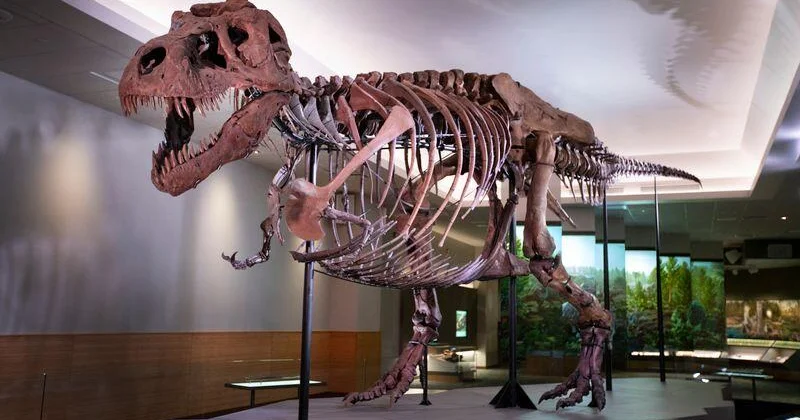
Palaeontologists have identified the first known adult Tyrannosaurus rex trackway, a 23ft trail of enormous footprints preserved in the badlands of south-western North Dakota.
The four three-toed prints, each around 3ft long, were found near Marmarth on land managed by the US Forest Service. They date back approximately 66.5 million years, to the closing stages of the Cretaceous period.
Researchers believe the tracks were most likely made by an adult T. rex because of their exceptional size and narrow toes, as well as the unusually large number of tyrannosaur fossils found in the surrounding Hell Creek Formation.
The discovery was made in 2025 by Kent Hups, a high school teacher and amateur fossil hunter who was volunteering on an excavation led by Tyler Lyson, senior curator of vertebrate palaeontology at the Denver Museum of Nature & Science.
Hups spotted the first exposed impression while searching for fossils. Further excavation revealed a sequence of tracks, allowing scientists to study not only the animal’s feet but also how it moved across the landscape.
“Bones tell us an enormous amount about these animals, but footprints capture a moment of behaviour,” Dr Lyson said. “With a trackway, we can actually follow an animal as it moved across the landscape. That is incredibly rare for T. rex.”
Adult T. rex trackway reveals walking pace
The spacing between the prints suggests the dinosaur was walking at between 3.5mph and 4.5mph, despite weighing more than seven tons. The stride between successive footprints was about 13ft.
Such evidence is exceptionally scarce. Before the North Dakota discovery, only two isolated adult T. rex footprints had been confirmed worldwide, one in New Mexico and another in Montana. Neither showed the direction or pace of the animal’s movement.
Scientists used high-resolution three-dimensional scanning to record the trackway. Peter Falkingham, a palaeobiology professor at Liverpool John Moores University and a specialist in dinosaur footprints, led the study despite not visiting the site in person.
The ancient environment may help explain why so few tracks have survived. The Hell Creek Formation was once crossed by streams and swamps, which would usually have washed away footprints before they could be preserved.
The area has also produced the juvenile T. rex known as “Teen Rex”, discovered by three boys during a family hike in 2022. The specimen was found just over 10 miles from the trackway, while a fragment of a tyrannosaur tooth has been recovered less than half a mile away.
Three of the four footprint-bearing sections are due to be lifted by helicopter this autumn and transported to the Denver Museum of Nature & Science for further study. The museum said it plans to provide visitors with updates on the recovery during the winter.
