


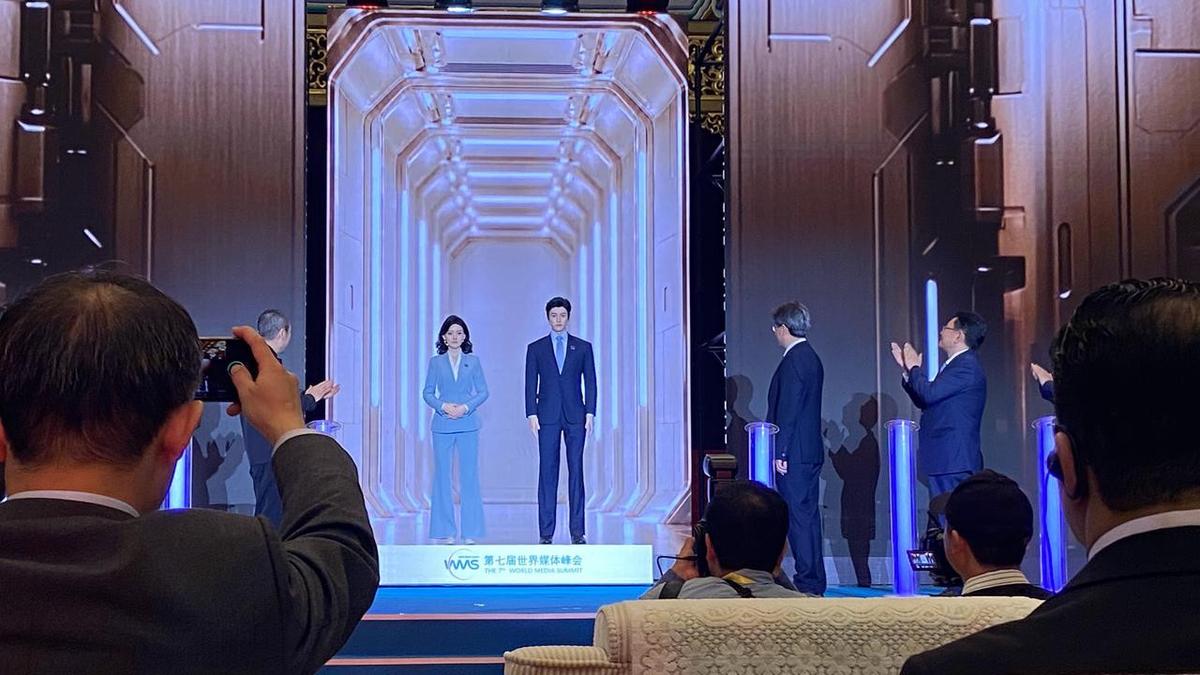
China has unveiled what it claims are the world’s first bionic humanoid robot news anchors, with the life-sized presenters demonstrated at the World Media Summit in Beijing.
Named Xinyan and Xinhu, the robots have been designed to appear dignified and approachable while delivering responses through a news system operated by Xinhua News Agency.
Lead designer Zhang Yimou said the team had focused on the details of their presentation. “We refine facial expressions, eye movements, lip shapes … to achieve a calm tone, poise and eye contact,” he told the summit.
Their movements remain distinctly mechanical, however, with heads repeatedly tilting and turning while their eyes dart and blink. A camera can be seen where a human pupil would normally be.
The robots can answer questions by drawing on Xinhua’s automated news tool. Their creators describe them as being “tailor made for news communication scenarios”.
Rather than replacing human presenters, Mr Zhang said they were intended to support them by “adding new experiences”. The robots were jointly designed by Ubtech Robotics.
Questions over robot news anchors in Australia
News organisations around the world are testing automated technology, with some radio networks, including in Australia, already using computer-generated voices for bulletins.
But Jock Cheetham, a senior news and media lecturer and journalist at Charles Sturt University, said Australian television newsrooms were unlikely to adopt humanoid presenters soon.
He said online commentators and influencers might be more inclined to use the technology, while broadcasters such as the ABC and commercial networks would seek to protect the credibility of their established presenters and reporters.
“Established brands won’t want to undermine the trust they have … by using what could become perceived as fake, cheap and maybe even weird,” Mr Cheetham said.
“Real presenters will become a hallmark of quality.”
He added: “Authenticity is about to become an even more commodifiable asset, and newsreading robots threaten to undermine authenticity, clearly.”
