


Saudi Arabia’s east-west oil pipeline has been shut after a drone attack, raising fears that available supplies could run out within days and putting further pressure on a global energy market already strained by the war with Iran.
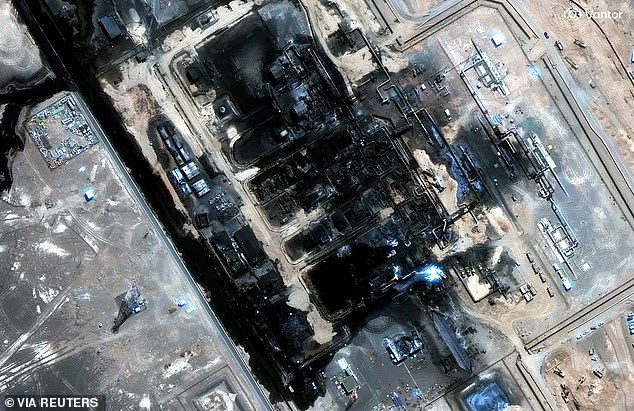
Satellite images showed extensive damage at a pumping station along the 745-mile pipeline, which normally carries about four million barrels of crude a day to Yanbu on the Red Sea.
The route is crucial to Saudi Arabia, the world’s largest crude oil exporter, because it allows the country to bypass the Strait of Hormuz. Its closure threatens the loss of about 4 per cent of global oil supplies.
Industry sources estimated that stocks at Yanbu could support exports for only five to seven days if the pipeline remains out of action. Storage capacity at the port is thought to be about 35 million barrels, although supplies are not full.
Saudi oil pipeline damage could take weeks to repair
Estimates of the repair time varied. One source said restoring the damaged infrastructure could take five to six weeks, while another said pumping might resume partially during repairs.
Iraq acknowledged that the attack originated in one of its provinces bordering Iran and said it had launched an investigation. A military commander was dismissed following the admission.
Oil prices rose by more than 3 per cent on Monday after the latest attacks on Saudi energy infrastructure. Crude had already climbed by 8 per cent the previous week, rising above 100 dollars a barrel for the first time since July.
ING commodity strategists said the increase followed “a step-up in attacks on Saudi Arabian energy infrastructure, including targeting the crucial east-west pipeline”.
The market is also dealing with the closure of the Strait of Hormuz, through which about a fifth of the world’s oil and gas normally passes. Industry sources said flows through the waterway had slowed to between six million and nine million barrels a day.
The International Energy Agency said Saudi oil supply had fallen to a more than three-decade low in August as flows through Hormuz and the Red Sea declined. Saudi Arabia told OPEC that production had dropped to 6.2 million barrels a day in August, from 10.9 million in February.
The IEA expects world oil supply to fall by 5.7 million barrels a day this year, equivalent to about 6 per cent. The Middle East supplied about 22 million barrels a day before the war.
Further attacks have added to concerns over regional shipping routes. Yemen’s Iran-aligned Houthi rebels have attacked targets in Saudi Arabia and reached the strategic island of Perim in the Bab al-Mandeb strait, which has carried between 4 and 5 per cent of global oil supplies in recent months.
Saudi state media released footage of damage to homes and a mosque in the southern Jazan province, which it attributed to a Houthi attack. The Houthis said they had also struck a Saudi military base in a neighbouring province.
A vessel in the Strait of Hormuz was hit by a projectile on Sunday, causing a fire and forcing its crew to evacuate, according to the British maritime security agency UKMTO. Iran said one person was killed and four crew members wounded on an Iranian commercial vessel struck off its coast.
A planned meeting in Oman between Gulf countries and Iran to discuss the Strait of Hormuz was postponed, the country’s Foreign Minister Badr Albusaidi said. No peace talks have taken place since an interim agreement in June collapsed.
