


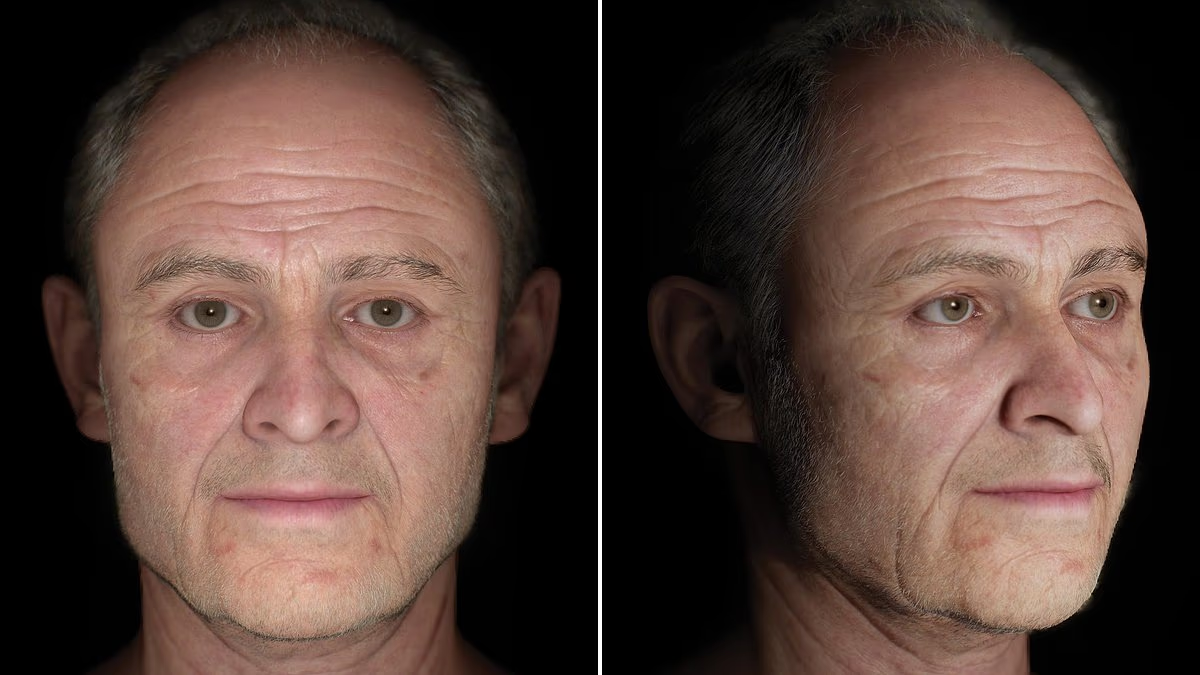
Scientists have reconstructed the face of a man who lived through the Norman Conquest, offering new clues about his origins and the complex population of 11th-century England.
Known as “Conquest Man”, the stocky, muscular man was aged between 50 and 60 when he died around the late 11th century. He stood approximately 5ft 1in tall and had suffered several injuries during his life, although the fractures had healed.
His remains were discovered about 50 years ago at St Peter’s Church in Barton-upon-Humber, North Lincolnshire. The church had been associated with Gilbert de Ghent, one of William the Conqueror’s knights, after the Norman takeover.
A digital reconstruction by Face Lab at Liverpool John Moores University suggests the man had thin lips, a receding hairline and a direct expression.
The work brought together researchers from English Heritage, Historic England, the Francis Crick Institute, the British Geological Survey, the University of Southampton and other specialist organisations. Their findings were based on analysis of the skeleton, ancient DNA and chemical signatures preserved in his teeth.
The results point to a man with substantial ancestry from continental Europe. His skull shape has also been interpreted as consistent with Scandinavian origins, while oxygen isotope readings suggest he may have spent at least part of his adolescence in a colder region.
Strontium isotope levels in his teeth, however, are compatible with the Barton area, raising the possibility that he was born locally or arrived there later in life.
Kevin Booth, English Heritage’s head curator of collections, said the man’s story challenged the idea that England after 1066 was divided neatly between Saxons and Normans.
“He’s likely neither, and we shouldn’t be shocked by that,” Mr Booth said.
The burial itself indicates that he held an important position within the local community, or was treated with unusual respect. He was placed in an oak coffin made from a tree thought to have been felled in about 1079. His head was supported by a grass pillow and secured with two pieces of local chalk.
Three staffs made from apple wood had been placed alongside him, a practice associated with Scandinavian beliefs and traditions.
Researchers said the evidence could fit with the man having arrived in Barton from Scandinavia during early adulthood. Before the Norman Conquest, the settlement stood in the Danelaw, the area of northern and eastern England shaped by centuries of Scandinavian settlement and rule. The Humber also provided an important route for movement and trade across the North Sea.
Mr Booth said the region’s connections meant that travel between England and Scandinavia would have been commonplace during the man’s lifetime.
The man is thought to have been born during the reign of Cnut, the Danish king who ruled England from 1016 to 1035. He would have been old enough to witness the invasion led by William, Duke of Normandy, and the defeat of King Harold at Hastings in 1066.
Whether he took part in the battle remains unknown. The current research has not established whether he was a combatant, a migrant or a local resident whose family had links across northern Europe.
The study has not yet been peer-reviewed, but the researchers say it provides a more detailed picture of movement and identity during a period of major political change.
Dr Sarah Stark, human skeletal biologist at Historic England, said the evidence did not identify one clear homeland for the man.
Instead, she said, his skeleton, burial, DNA and isotope results showed that he was connected to the wider continental world. His story could reflect either migration to Barton or a local population already shaped by links with communities around the North Sea.
The findings come as historians and archaeologists prepare to mark the enduring legacy of 1066, when Norman rule replaced the Anglo-Saxon political order and a new aristocracy took control of much of England.
Conquest Man’s skeleton will go on display at St Peter’s Church in Barton-upon-Humber on September 20, allowing visitors to see the remains and the research behind the facial reconstruction.
