


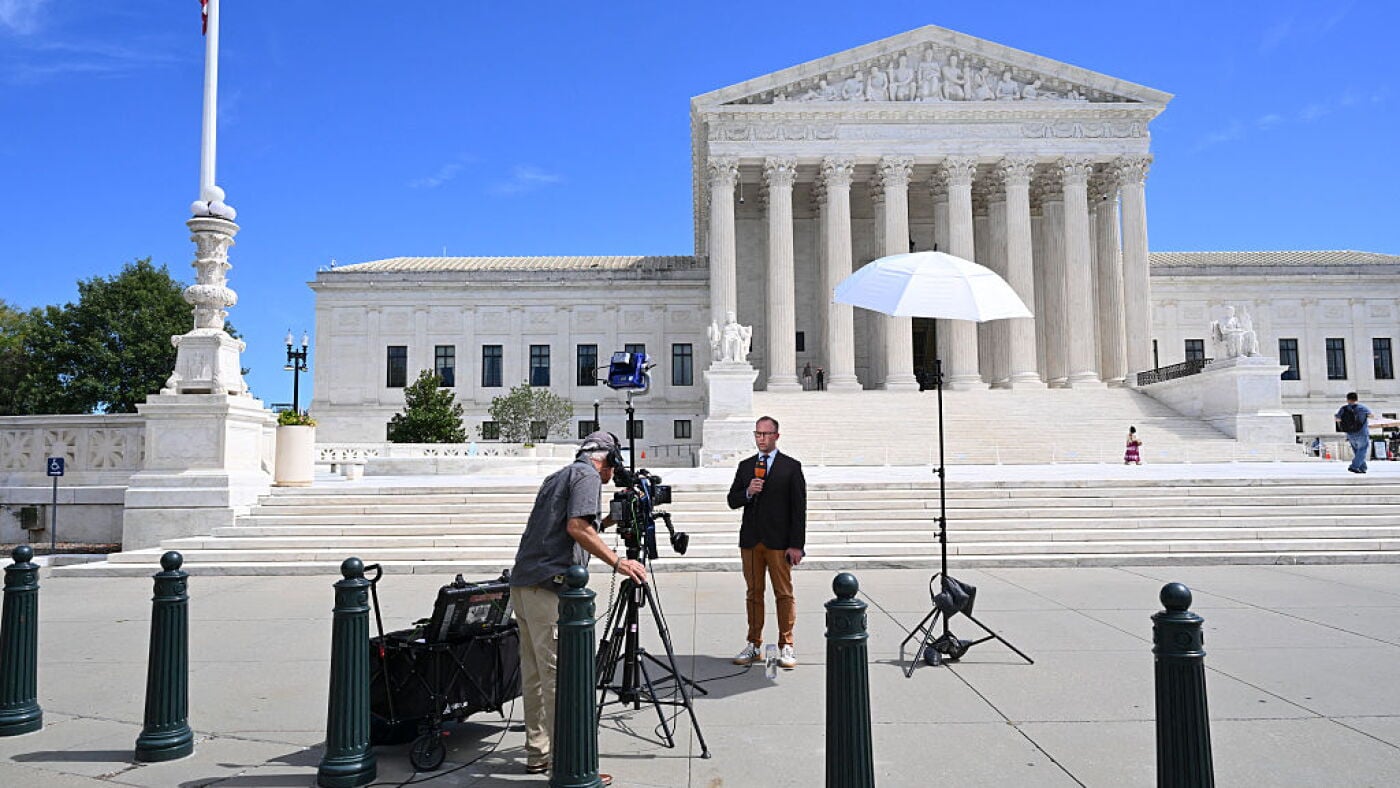
The US Supreme Court’s new term begins on Monday with major disputes over religion, semi-automatic weapons, climate change and immigration, while a growing number of fast-tracked applications linked to Donald Trump’s administration are placing fresh pressure on the justices.
The court has traditionally opened its term on the first Monday in October. But the quieter period after the end of its main hearings has largely disappeared, with emergency appeals increasing sharply during the Trump administration even as the number of fully argued cases has fallen.
Georgetown University law professor Stephen Vladeck said the court now issues roughly twice as many full rulings on emergency applications as decisions on its main merits docket.
Emergency applications are decided quickly, usually without oral argument and often with little explanation. By contrast, cases on the merits typically involve extensive written submissions, lengthy hearings and months of deliberation.
The court has recently offered limited explanations for some emergency decisions. However, lower-court judges from both sides of the political spectrum have complained that these do not provide sufficient guidance. The administration has also frequently sought to bypass lower appeals courts it considers hostile.
Climate change case opens the term
The first case, due to be argued on Monday, concerns whether state and local authorities can sue energy companies accused of misleading the public about the harmful effects of fossil fuels.
Harvard Law School professor Deepak Gupta said the claim was that the companies had spent years telling the public the opposite of what their own scientists knew about the consequences of fossil fuels, leaving local authorities to bear the costs.
Most observers nevertheless regard the case as a difficult one for environmental campaigners.
Religion and public funding
One of the term’s most consequential disputes involves whether a Catholic parish in Colorado can receive state funding for a universal pre-school programme while refusing admission to LGBTQ pupils and children with gay or transgender parents.
St Mary Catholic Parish in Littleton argues that excluding such pupils is required by its religious beliefs and that denying it funding would infringe its right to freely practise its religion. Colorado maintains that providing public money to the parish would breach the state’s anti-discrimination law.
The case follows a tied decision last term over a separate dispute concerning religious charter schools in Oklahoma. Justice Amy Coney Barrett had recused herself, leaving the court split evenly and allowing the state supreme court’s ruling against public funding for overtly religious charter schools to stand.
The conservative majority has repeatedly supported religious exemptions from laws that apply generally. The court has not previously ruled that religious schools are entitled to full taxpayer funding, but the Colorado case could force it to address that question with Justice Barrett participating.
Michigan State University law professor Frank Ravitch said the court’s approach to religion was now “literally the opposite of what the law was not that long ago”.
Second Amendment challenge to weapons bans
In December, the justices will consider whether state and local bans on semi-automatic weapons such as the AR-15 violate the Second Amendment right to bear arms.
Former US solicitor general Don Verrilli Jr said the weapon could fire upwards of 100 bullets a minute without modifications and as many as 500 with enhancements. At the same time, he noted that millions of Americans owned AR-15s and that removing them from civilian possession would be highly disruptive.
Erin Murphy, a lawyer who has represented gun owners, said the central issue was who should decide which weapons people are allowed to possess. The case is expected to test the limits of government authority over firearms ownership.
Immigration disputes reach the court
The justices are also due to hear a challenge to the Trump administration’s policy of deporting migrants to so-called third countries when their countries of origin will not accept them.
Since the start of Mr Trump’s second term, the administration has sent thousands of people to countries where they have no established connections and may not speak the language. Some have been jailed, and allegations have been made that some were subjected to torture.
The Supreme Court has twice blocked lower-court decisions that would have prevented the policy and will hear arguments on it in December.
A separate immigration case concerns the administration’s policy of detaining undocumented migrants without a bond hearing, regardless of how long they have lived in the United States.
Election disputes could emerge later
Several other cases may yet be added to the docket. Among them is a challenge to a nearly 50-year-old precedent that prevents public schools from displaying the Ten Commandments in classrooms.
Texas, Arkansas, Louisiana and Alabama have passed laws conflicting with the 1980 ruling, while lower courts have reached different conclusions. That disagreement could lead the Supreme Court to revisit the issue.
The justices may also be asked to decide whether states can regulate Kalshi, a prediction-market company where users bet on events including sporting contests and the outcome of Supreme Court cases.
Other disputes involving the Trump administration have moved more slowly. They include efforts to withhold medical research grants from Harvard University, restrict security clearances for law firms and seek financial damages from firms viewed by the president as hostile.
Stanford University law professor Pam Karlan said the administration did not want the court to take cases it expected to lose, while the president wanted disputes brought before the justices.
Professor Vladeck said the most significant cases of the term might not yet have reached the docket.
Election law is another area likely to draw the court’s attention. The administration has sought to influence elections in several ways, while Democrats have assembled lawyers to respond to possible problems including last-minute polling-place changes and federal agents being stationed near polling stations.
If serious disputes arise, they are likely to reach the Supreme Court through its emergency docket.
