


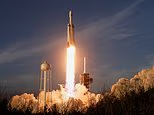
NASA launches Roman Space Telescope to map the hidden universe
NASA’s Nancy Grace Roman Space Telescope has launched on a mission to survey vast reaches of space and investigate some of the biggest unanswered questions in astronomy.
The telescope lifted off from Kennedy Space Centre in Florida at 7.26am local time on Sunday, 30 August 2026, aboard a SpaceX Falcon Heavy rocket. It is now beginning a journey of about three months to an observation point roughly one million miles from Earth.
Designed to provide a panoramic view of the cosmos, Roman will combine a wide field of view with high-resolution infrared imaging. Its field of view will be at least 100 times wider than Hubble’s, allowing it to survey enormous areas of the sky while gathering data on billions of galaxies and tens of billions of stars.
The mission is expected to help scientists study dark energy, the unexplained force thought to be accelerating the expansion of the universe, as well as dark matter, which can be detected only through its gravitational effects. Roman will also search for planets beyond the Solar System and observe transient events, including exploding stars and other rapidly changing cosmic phenomena.
NASA said ground controllers began receiving telemetry from the observatory seven minutes after launch. The telescope separated from the Falcon Heavy’s upper stage 31 minutes into the flight, while the rocket’s reusable side boosters returned safely to the launch site for refurbishment. Roman’s solar panels and lower instrument sunshade were successfully deployed about 83 minutes after liftoff.
Named after Nancy Grace Roman, NASA’s first chief astronomer and a key figure in the development of the Hubble Space Telescope, the observatory is intended to complement rather than replace Hubble and the James Webb Space Telescope. Roman will scan broad regions of space at speed, identifying objects and events that Webb can then examine in greater detail.
NASA expects Roman to produce huge surveys of the infrared universe, helping astronomers trace the distribution of galaxies and dark matter, measure the history of cosmic expansion and build a more complete census of planetary systems in the Milky Way.
