


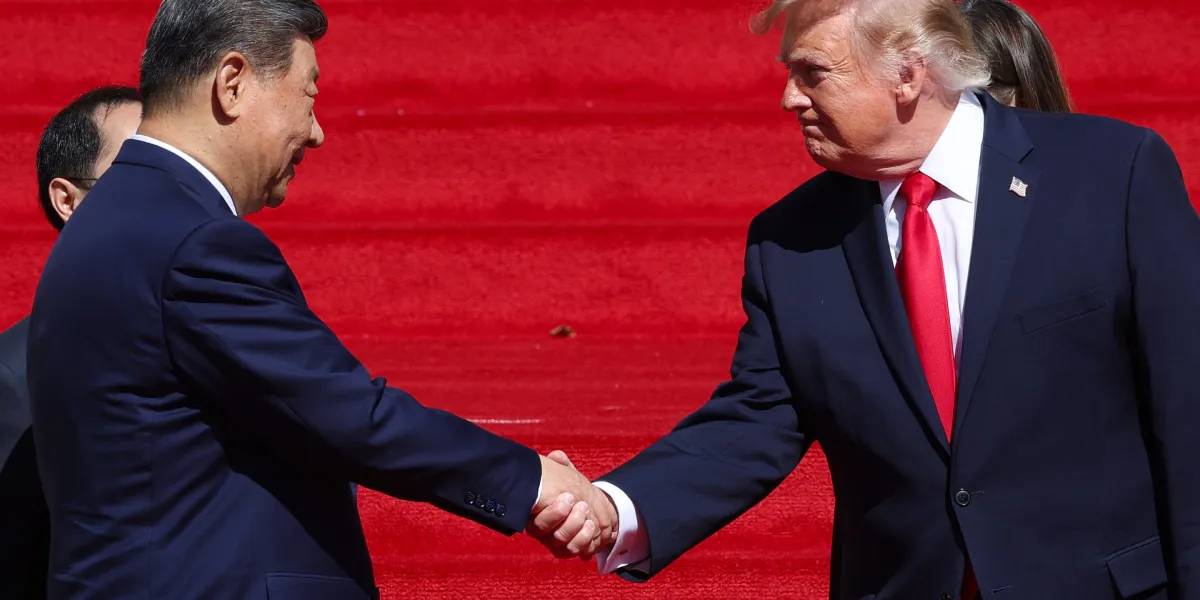
The apparent warmth between Donald Trump and Xi Jinping at last week’s US-China summit has not removed the deep commercial and strategic tensions between the two countries, as American businesses increasingly look to Chinese technology for products and expertise.
Chinese-made devices and electric vehicles remain largely unavailable to US consumers, with carriers not selling or supporting many Chinese handset brands. BYD’s Seagull, one of the world’s best-selling electric vehicles, starts at about $8,000, while Chinese firms have also advanced in humanoid robots, consumer technology and integrated digital services.
Restrictions on Chinese products and companies have been driven by concerns over security, intellectual property theft and unfair competition linked to state subsidies. But Chinese businesses have also moved ahead of American rivals in several important areas, prompting some US executives and entrepreneurs to seek access to their technology.
Trust remains a major obstacle in US-China relations
Distrust between Washington and Beijing intensified in September. The US Justice Department brought a criminal case against Huawei Technologies to trial in Brooklyn, alleging that the company was built on a two-decade “culture of crime” involving the theft of technology from businesses including T-Mobile, Cisco and Motorola.
The National Security Agency, FBI and Cybersecurity and Infrastructure Security Agency also accused six Chinese artificial intelligence companies of industrial-scale theft of trade secrets from firms including Anthropic, OpenAI, Google and xAI.
Chinese business leaders have indicated that geopolitical uncertainty is making them less willing to invest in the US. China’s overseas investment rose by 11 per cent to $214 billion last year, but its direct investment in the US fell by 71 per cent to $1.9 billion.
Artificial intelligence at the centre of the rivalry
Artificial intelligence is emerging as the most consequential area of competition between the two countries, alongside manufacturing, energy and e-commerce. Nvidia chief executive Jensen Huang, AMD chief executive Lisa Su, Apple chief executive Tim Cook and Elon Musk were among the business leaders seated at Trump’s state dinner for Xi.
OpenAI chief executive Sam Altman and Meta founder Mark Zuckerberg also attended, while Anthropic chief executive Dario Amodei was notably absent. Chinese companies, including Alibaba, are developing powerful AI chips, making their involvement increasingly relevant to debates over AI safety and regulation.
Washington and Beijing agreed to establish an AI safety channel, intended to provide a direct line of communication between the two countries. The arrangement has been compared with the hotline created between Washington and Moscow during the Cold War to help prevent catastrophic miscalculation.
Public attitudes towards China are also becoming more positive in some areas as confidence in the United States declines internationally. Chinese companies are winning customers by competing on the value and quality of their products, while entrepreneurs are using services such as DeepSeek and Alibaba.com to support their businesses and supply chains.
Kuo Zhang, chief executive of Alibaba.com, said the company’s aim was “to make it easy to do business anywhere”, adding that building trust and providing “flexible and agile support for their supply chains” were important because “tariffs are only one factor to consider”.
