


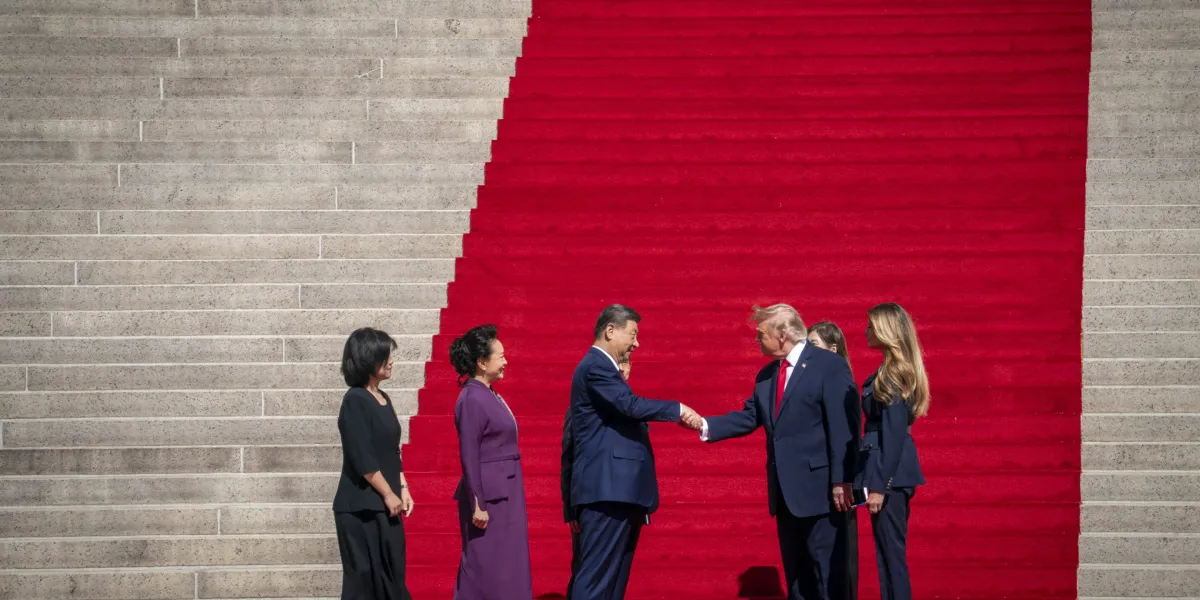
The Xi-Trump summit has produced limited concrete agreements but may have established a more managed relationship between Washington and Beijing, with both sides avoiding major concessions while their economic and technological ties continue to weaken.
Chinese President Xi Jinping has returned to Beijing after a three-day state visit to the United States, during which Donald Trump hosted him at a state dinner and showed him the US Constitution and the first treaty between the United States and Qing-dynasty China at the National Archives.
The two leaders said they would work towards a “constructive relationship of strategic stability on the basis of respect, fairness, and reciprocity”. However, agreements on trade and artificial intelligence were limited, while major disputes over export controls, Taiwan, Ukraine and Iran remained unresolved.
“Expectations were low for this meeting and those expectations were met,” said Lindsay Newman, a visiting research fellow at King’s College London.
Eswar Prasad, a professor of trade policy at Cornell University, said the summit had “fizzled out on substance, confirming the vast gulf between the two countries’ objectives and the lack of enthusiasm on either side to craft a grand bargain”.
Xi-Trump summit extends tariff truce
The main practical outcome was a two-month extension of a tariff truce first agreed in South Korea last year. The US and China also agreed to seek lower tariffs on $30 billion worth of “non-sensitive goods” from each country and to create new communication channels between their militaries to help manage crises.
Washington said China had agreed to import 10 million tons of coal a year for the next two years, although the Chinese account of the meeting did not mention the arrangement.
On Monday, the two countries published lists of goods that could benefit from tariff reductions. The US plans to cut tariffs on 77 categories, including fireworks, household equipment and toys, while China intends to reduce tariffs on 1,619 categories covering agricultural goods, timber, seafood, dairy products and medical equipment.
The countries also agreed to establish an artificial intelligence dialogue, including a channel for discussing incidents involving the technology. Chinese officials said Beijing “respects the U.S. side’s wording” after Mr Trump claimed Mr Xi had accepted his preferred term, “super intelligence”.
There was no progress on several issues that had raised hopes of a more substantial deal, including wider access to US semiconductors, Chinese rare earths, Chinese investment in the US and Washington’s position on Taiwan.
“Almost everything else remains unresolved between the sides,” Ms Newman said.
The leaders did, however, announce plans for further meetings. Mr Trump is due to travel to Shenzhen in November for the Asia-Pacific Economic Cooperation summit, followed by a visit from Mr Xi to Miami in December for the G20 meeting.
Dan Wang, China director for the Eurasia Group, said the meetings could bring “better stability, although without strategic concessions from either side”. She said the leaders had established a positive tone, while detailed negotiations would probably be left to senior officials around the APEC summit.
Ms Wang expects the tariff truce to be extended again next year, noting China’s preference for external stability before the Communist Party’s 21st Congress next autumn. She was less confident about lasting cooperation on artificial intelligence, saying Beijing viewed US restrictions on advanced processors as an attempt to limit China’s development.
A relationship managed rather than repaired
The cautious outcome came after Washington introduced further measures aimed at China. These included a ban on new foreign-made humanoid robots and power inverters, the addition of several Chinese universities to a research blacklist and sanctions on Chinese shipping companies and refiners linked to a wider pressure campaign on Iran.
Yet Mr Trump has also restrained some more confrontational proposals. He has delayed approval of a $14 billion arms package for Taiwan, officially because of concerns about US munitions supplies during the war in Iran, while describing the package as a possible negotiating tool in talks with Beijing.
The president has also expressed support for the possibility of Chinese carmakers manufacturing in the United States, despite opposition in Washington and a congressional proposal to ban Chinese cars from the American market.
David Perdue, the US ambassador to China, said on Sunday that Mr Trump had offered to sell American arms to China during the visit. The White House later said there was “no plan or offer to sell arms to China”.
Ali Wyne, a senior research adviser on US-China issues at the International Crisis Group, said the relationship was “on tactical autopilot” and likely to remain there while Mr Trump and Mr Xi maintained a cordial working rapport.
He added that the president was likely to continue restraining advisers who favoured a more confrontational approach. But Chandran Nair, co-author of Understanding China and chief executive of the Global Institute for Tomorrow, warned that Beijing would remain cautious because “everything could change next month”.
Financial markets gave mixed signals after the summit. Hong Kong’s Hang Seng index rose 0.7 per cent, while mainland China’s CSI 300 fell 2.2 per cent.
Analysts said the limited outcome reflected the widening separation between the two countries. China is developing trade relationships in Europe, south-east Asia and Latin America, while the US is seeking rare earth minerals and semiconductor production through partners including the Philippines, Japan and South Korea.
The two countries are also pursuing increasingly separate paths in artificial intelligence, with China building an industry based on domestically produced chips and open-source models as US companies seek to restrict Chinese access to advanced systems.
“The baseline for the bilateral relationship is a slow and progressive deterioration of the trade, financial, and technological linkages between the two countries,” Mr Prasad said.
Ali Wyne said both governments appeared to have recognised that aggressively dismantling their relationship carried risks, and could instead seek to use their mutual vulnerabilities to limit further escalation.
“The U.S. has failed to force China into its agenda,” Ms Wang said. “That’s given rise to China’s more determined stance.”
