


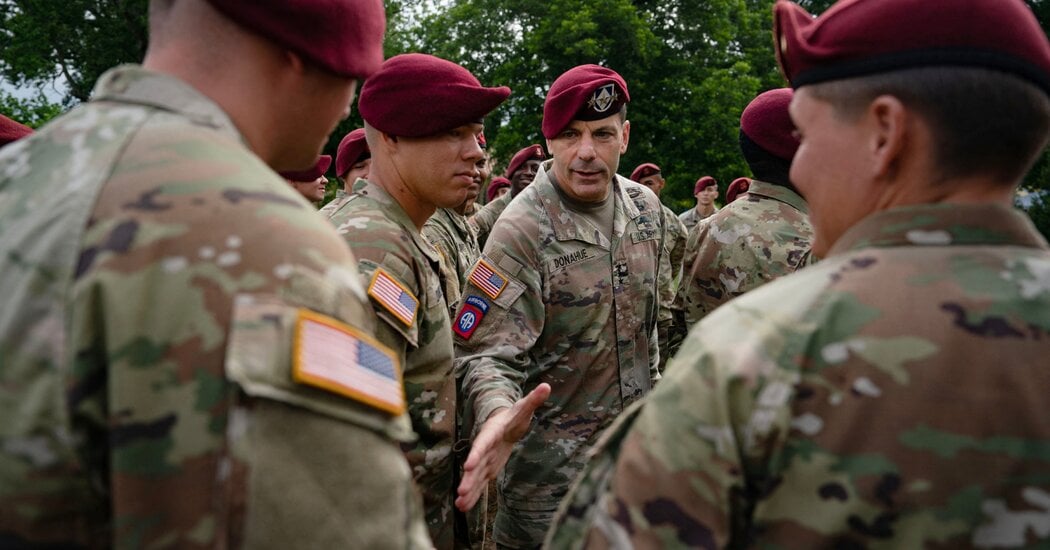
Defence Secretary Pete Hegseth blocked General Christopher T Donahue’s path to the top US military post in Europe after deciding that President Donald Trump wanted senior officers held responsible for the deaths of 13 American service members during the chaotic withdrawal from Afghanistan, according to people familiar with the discussions.
The decision set off a 16-month campaign inside the Pentagon, Congress and the Army to protect one of its most highly regarded commanders from a purge of senior officers. Donahue was not responsible for security at Abbey Gate, where the suicide bomber struck in August 2021, but he was a senior commander at Kabul airport and became associated with the evacuation after being photographed as the last US soldier to leave Afghanistan.
More than 40 current and former officials described the struggle, speaking anonymously because of concerns about retaliation. Their accounts portray a clash between Hegseth, who arrived at the Pentagon promising to remove generals he believed had failed in America’s post-9/11 wars, and supporters who regarded Donahue as an unusually experienced combat commander with a clear vision for the future of warfare.
The Pentagon declined to discuss the general’s case, saying senior military leaders serve at the pleasure of the president and the defence secretary.
The campaign to save General Donahue
Joe Kasper, Hegseth’s chief of staff, made an early attempt to change his boss’s mind. A senior Pentagon official prepared a card setting out several points in Donahue’s defence, which Kasper took with him when he and Hegseth drove to the White House for a press engagement in March 2025.
The card explained that the widely circulated photograph of Donahue boarding the final evacuation aircraft was not a selfie and had not been distributed by the general. It also stated that Marines, rather than Donahue’s paratroopers, controlled the gate where the bombing took place.
Hegseth glanced at the card before handing it back. “I don’t care,” he told Kasper, according to people familiar with the exchange.
By then, Donahue had spent three decades in uniform and more than 20 deployments in combat zones. He had commanded Delta Force, the Army’s elite counter-terrorism unit, and served in Iraq, Afghanistan and Syria before rising through the ranks of the 82nd Airborne Division and 18th Airborne Corps.
His reputation rested not only on battlefield experience but also on his ability to build relationships with local forces. In Afghanistan, he worked closely with Brigadier General Sami Sadat, an Afghan commander, combining air strikes, special operations advisers and Afghan commandos in an effort to recover territory from the Taliban.
Those gains collapsed after the first Trump administration reached an agreement with the Taliban in February 2020 that set the withdrawal in motion. When the Afghan government fell the following year, Sadat turned to Donahue for help.
Donahue arrived in Kabul on 17 August 2021, where he was forced to negotiate with Taliban commanders who had previously been targets of American operations. The shared threat was Islamic State Khorasan, which US intelligence warned was preparing to attack the evacuation.
He identified Abbey Gate as especially vulnerable because thousands of civilians were pressed against the Marines controlling the entrance. Donahue recommended closing it immediately, but British forces were using the route to evacuate their own citizens and allies, and the Americans kept it open.
At 5.48pm on 26 August, an Islamic State suicide bomber killed 11 Marines, a Navy medic and an Army soldier, as well as scores of Afghans. Donahue was at a headquarters on the other side of the runway when the explosion occurred.
Four days later, he boarded the final US aircraft out of Kabul. The resulting night-vision photograph turned a previously little-known special operations commander into a global symbol of the war’s bitter end.
That image later became central to Hegseth’s opposition, even though Donahue’s supporters argued that he had helped impose order on an operation unfolding amid extraordinary chaos. The Washington Post has reported that Donahue’s troops did not control Abbey Gate when the bombing occurred and that he was sent to Kabul only after the evacuation had already descended into crisis. ([washingtonpost.com](https://www.washingtonpost.com/national-security/2026/06/24/effort-extend-army-generals-career-falls-flat-with-hegseth/))
Donahue passed over for Europe
Donahue’s career had already come under political pressure. In November 2024, Senator Markwayne Mullin placed a hold on his nomination to lead US Army forces in Europe, citing questions about the Afghanistan withdrawal. The hold was later lifted after senior Army figures and lawmakers intervened.
After Hegseth became defence secretary, Donahue was initially considered the leading candidate to succeed General Christopher Cavoli as commander of US European Command. Hegseth later backed Air Force Lieutenant General Alexus Grynkewich instead. The Pentagon announced Grynkewich’s nomination on 5 June 2025, confirming that he would also take over the NATO post of Supreme Allied Commander Europe. ([defense.gov](https://www.defense.gov/News/Releases/Release/article/4206995/secretary-of-defense-general-officer-announcements-for-june-5-2025/))
The decision was particularly significant because European Command oversees US military operations across the continent and its commander has traditionally held NATO’s most senior military position. It also came as the Trump administration pressed European allies to assume more responsibility for the defence of the region and reviewed the future size of the American military presence there. ([defensenews.com](https://www.defensenews.com/pentagon/2025/05/01/hegseth-backs-air-force-three-star-grynkewich-for-top-europe-job/))
Kasper later told Donahue that the European command was no longer available. The general was disappointed but continued to develop a plan for the Army headquarters in Germany that he had established to co-ordinate weapons, intelligence and military assistance for Ukraine.
Donahue believed the war offered a rare opportunity to test a new model of combat. Ukrainian forces, short of conventional ammunition, had made extensive use of inexpensive drones and improvised systems. He wanted the US Army and its NATO partners to combine those lessons with precision missiles, Patriot air-defence systems, satellite intelligence, robotics and artificial intelligence.
The concept, initially given the blunt working title “the Global Killing Machine”, became the Eastern Flank Deterrence Initiative. Donahue’s supporters believed it could provide a model for defending Europe against Russia while also preparing American forces for future conflicts in the Pacific.
Army Secretary Daniel Driscoll backed the idea after Donahue presented it during an informal meeting in Germany. Senior Army officers then considered Donahue as a possible successor to General Randy George as Army chief of staff when George was due to retire in 2027.
Hegseth, however, favoured General Christopher LaNeve, his former senior military adviser, for the post. An attempt by Driscoll to arrange a meeting between Donahue and Vice-President JD Vance was blocked after Hegseth learnt of it, officials said.
A career under mounting pressure
Hegseth also sought to reduce Donahue’s European command from a four-star to a three-star post. The change fitted the administration’s wider effort to cut the number of senior military officers and shift strategic attention away from Europe towards Asia, but it would also have made it difficult for Donahue to remain in the role.
The proposed downgrade came as Donahue’s preparations for drone warfare gained fresh relevance. After an American base in Kuwait was struck by Iranian drones and six soldiers were killed, the Pentagon urgently sought additional interceptor systems and combat expertise.
Donahue had already distributed much of Europe’s stock to NATO partners. He then asked General Oleksandr Syrskyi, Ukraine’s commander-in-chief, for help. Ukrainian personnel with battlefield experience operating drone interceptors were sent to assist American forces in the Middle East, according to Syrskyi.
In early March, George told Donahue to submit his retirement papers. The Army chief said he would seek a six-month extension for him, but was unable to secure a meeting with Hegseth. On 1 April, Hegseth dismissed George during a phone call that lasted about 15 seconds, officials said.
Donahue’s remaining supporters in the Senate then tried to intervene. Senator Tim Sheehy, a Republican from Montana and former Navy SEAL, had previously persuaded Hegseth to reconsider several officers with whom he had served. But officials said the campaign to save Donahue only strengthened the defence secretary’s view that the general was too influential and too well connected.
Senator Joni Ernst, a Republican from Iowa and former Army National Guard officer, continued pressing for an alternative. After George’s dismissal, she urged the White House to consider Donahue as Army chief of staff rather than Hegseth’s preferred candidate.
She was told that Hegseth would never nominate him.
Donahue ultimately submitted his retirement paperwork after months of uncertainty, as the Pentagon moved towards reducing his European command to three stars. The Army later confirmed that he would relinquish command of US Army Europe and Africa and NATO’s Allied Land Command on 2 July 2026, with his deputy, Major General Christopher Norrie, taking over on an interim basis. The move came amid a wider departure of senior military leaders under Hegseth and a review of the American military role in Europe. ([apnews.com](https://apnews.com/article/9ade7033e3a9e0c5e41acb5dcdb25133))
For Donahue’s allies, the episode was not simply the early retirement of a decorated officer. They saw it as evidence that Hegseth’s campaign to reshape the Pentagon had overridden the judgement of senior commanders and sidelined a general whose experience in Afghanistan, Ukraine and special operations had made him one of the Army’s leading advocates for adapting to a new era of warfare.
