


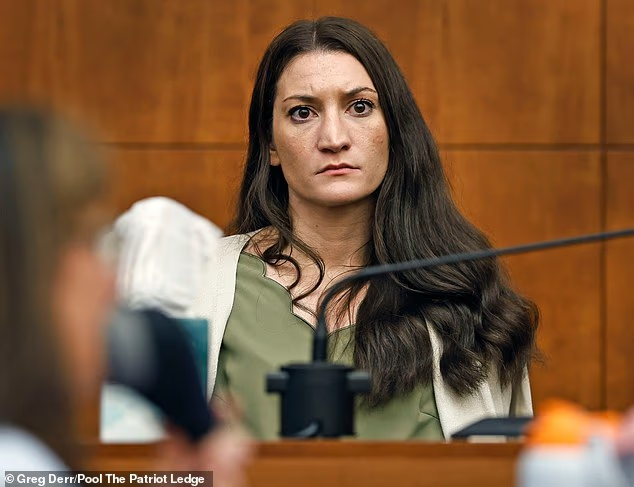
Three former jurors in the Lindsay Clancy murder trial have described heated arguments with the lone holdout whose refusal to acquit led to a mistrial in Massachusetts.
The women, including the jury foreperson, said the male juror acknowledged having reasonable doubt but still refused to find Clancy not guilty by reason of mental disease or defect.
Roni Carlson, the foreperson, told NBC10 Boston that she had begun completing the verdict forms after the juror admitted he had doubts about the case.
“I started filling out the forms, I was so excited,” she said. “There were three forms I had to fill out, and then he said, ‘But I’m still not going to say she’s not guilty.’”
Another juror, identified only as juror two, said the man appeared unwilling to engage with the rest of the panel or examine the evidence with them.
“He would not interact with us and try to understand,” she said. The women also said they read out the legal definition of reasonable doubt to him during their discussions.
The arguments became so loud that alternate jurors seated nearby could hear the exchanges through a wall, according to the three women. They said the deliberations included name-calling but that the panel remained determined to reach a unanimous decision.
The jury of nine women and three men spent more than 37 hours considering evidence heard during the five-and-a-half-week trial before Judge William Sullivan declared a mistrial at Plymouth Superior Court on Friday, September 4.
Clancy, a former nurse, is charged with murdering her children, Cora, five, Dawson, three, and eight-month-old Callan at the family home in Duxbury in January 2023. She has admitted strangling them with exercise bands but denies being criminally responsible for their deaths.
Her defence argued that she was suffering from postpartum depression and psychosis after being prescribed a combination of medication. Clancy also attempted to take her own life by jumping from an upstairs window, an act which left her paralysed and permanently dependent on a wheelchair.
Lindsay Clancy jurors describe holdout
The jurors told NBC10 Boston that the holdout would not accept their interpretation of the judge’s instructions, even after repeatedly discussing the meaning of reasonable doubt.
They said he had barely approached the evidence displays during deliberations and rejected attempts by the other jurors to work through the case with him.
The three women have not publicly identified him. NBC10 Boston said it had attempted to contact the juror for his response.
Clancy’s lawyer, Kevin Reddington, said on Good Morning America that, to his knowledge, 11 jurors supported a verdict of not guilty by reason of mental disease or defect, leaving one juror opposed.
Reddington also asked President Donald Trump to consider pardoning Clancy, describing her as intelligent, hardworking and a “wonderful” person.
However, Clancy is facing state charges in Massachusetts rather than federal offences, meaning the president does not have the legal power to pardon her. Reddington later said his request was intended to seek Mr Trump’s influence rather than a pardon that could legally be granted.
He said he was open to discussions with Plymouth County District Attorney Timothy Cruz about reaching an agreement that could avoid a second trial.
Reddington also defended his comments after the trial, when he said he had “crushed” the prosecution. He told the broadcaster that he did not regret the remark, although he accepted he could have been more measured in describing his performance.
“Instead of saying I crushed him, I could have said I did a good job,” he said.
Cruz has not ruled out seeking a retrial. He said after the mistrial that prosecutors would consider the case but that their responsibility was to focus on the facts and seek justice for the three children.
A status hearing has been scheduled for September 29 to determine the next steps. Clancy remains charged and is being held in a psychiatric hospital while the case is resolved.
