


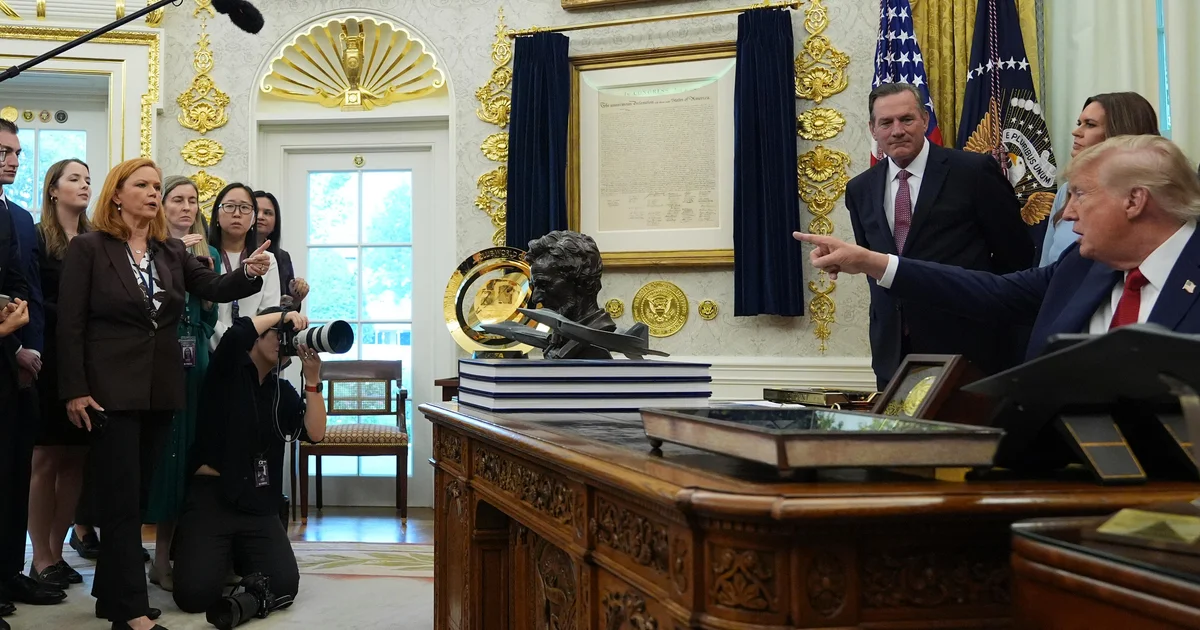
Donald Trump has announced a ban on CNN, MS NOW and Politico from the White House, accusing the organisations of repeatedly publishing what he called “FAKE NEWS” about his administration.
The US president made the announcement on Truth Social, warning that other media outlets could face similar action. He did not explain precisely how the ban would be enforced, but said he did not want the organisations in his office, meaning the Oval Office.
Journalists from the three outlets remained on White House grounds as of 4.45pm on Friday.
Asked during an Oval Office healthcare event how he justified the move while having sworn to uphold the Constitution, Mr Trump replied: “Because they’re fake news. I get so tired of reading and seeing fake news.”
He said the timing was not prompted by a single report, telling reporters there was “no reason” for the decision to have been made then. “It’s really just cumulative stories of the last two years,” he said. “You get sick of it.”
When asked whether he was trying to intimidate the press, Mr Trump denied it. “No, no, no, no,” he said. “I dislike dishonest press, like you. I think you’re terrible.”
Trump White House media ban faces legal challenge
The move is expected to face legal challenges. CNN said it stood behind its White House team and its “fair and accurate reporting”, arguing that the US Constitution protected its right to report without government interference.
“Should the ban which President Trump threatened go ahead, it would be an illegal assault on that fundamental and constitutionally-protected right,” the network said.
Jameel Jaffer, executive director of Columbia University’s Knight First Amendment Institute, described the proposed ban as unconstitutional. He said the First Amendment prevented the president from punishing journalists because he disliked their coverage, and argued that excluding organisations from the White House press pool on the basis of their views would also breach the Constitution.
The administration has previously faced a dispute over media access. Last year, it took steps to bar the Associated Press from White House coverage after the organisation refused to use the term “Gulf of America” for the Gulf of Mexico.
A federal judge ruled in April 2025 that the White House must restore the AP’s access to presidential spaces, although a federal appeals court allowed the administration temporarily to bar it from smaller restricted areas. That case remains ongoing.
During Mr Trump’s first term, the White House also attempted to remove the press credentials of CNN correspondent Jim Acosta after a tense exchange at a news conference. A federal judge ordered his pass to be restored after CNN brought a legal challenge, and the White House later reinstated it and dropped the matter.
