


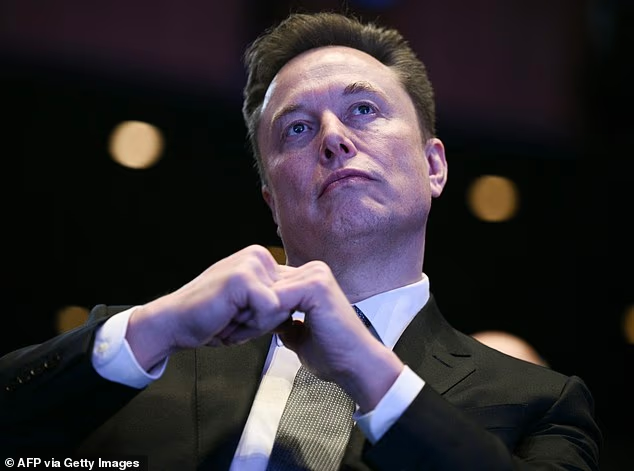
A new documentary portraying Elon Musk as a figure whose immense wealth and influence have become a global danger premiered at the Venice Film Festival on Tuesday, with former partner Ashley St Clair claiming the billionaire offered her $40 million (£30 million) to stay out of the film.
Musk, directed by Oscar-winning filmmaker Alex Gibney, runs for 225 minutes with a further ten-minute interval and was shown out of competition at the 83rd Venice International Film Festival. Its contributors include Musk’s first wife Justine Musk, technology journalists and former colleagues, as well as St Clair. ([labiennale.org](https://www.labiennale.org/en/cinema/2026/venice-open-out-competition/musk?utm_source=openai))
St Clair, who has a son with Musk, told a press conference that she had been offered “the opportunity not to speak for $40 million”. She said she rejected the offer so she could discuss her experiences and take part in the documentary. ([washingtonpost.com](https://www.washingtonpost.com/business/2026/09/08/elon-musk-documentary-venice-film-festival-ai/03f38ca2-ab86-11f1-b498-8697f35a6743_story.html?utm_source=openai))
In the film, St Clair alleges that Musk told her he wanted to father a large number of children before an anticipated “civil war”. She describes his direct messages with women as “a Gatling gun of sperm”, according to material presented at the premiere.
She also claims that Musk appeared unusually certain Donald Trump would win the 2024 US presidential election, telling her on election night that he had known the result “hours ago”, before the final outcome had been declared.
St Clair said at the Venice premiere that Musk’s conduct on X, the social media platform he owns, should not be ignored. She accused him of fuelling divisions which could have consequences in the real world, while saying she now regretted some of her own previous political activism. ([theguardian.com](https://www.theguardian.com/film/2026/sep/08/elon-musk-ashley-st-clair-documentary-venice?utm_source=openai))
The documentary’s portrait of Elon Musk
Gibney’s film examines Musk’s rise from South Africa to the centre of the technology, automotive and space industries before turning to his expanding political influence and turbulent personal life.
It includes interviews with Justine Musk, who was married to him for eight years, and explores claims about the treatment of his former partners and children. Justine describes a relationship marked by emotional distance and says she came to recognise what she regarded as gaslighting.
She also disputes Musk’s public account of the death of their first child, Nevada Alexander, who died from sudden infant death syndrome at ten weeks old. Musk has previously said he held the baby as he died, while Justine says she was holding him in hospital.
The film examines Musk’s relationships with British actress Talulah Riley, musician Grimes and Shivon Zilis, an executive at his brain-computer interface company Neuralink. It also discusses disputes over access to the children he had with Grimes.
St Clair claims that Musk’s attitude changed after their son was born and that his representative, Jared Birchall, later proposed a child-support agreement containing restrictions on what she could say about him.
According to the documentary, the proposed arrangement included a $15 million lump sum and monthly payments of $100,000. St Clair says the monthly amount was later reduced after she declined to sign, although the details of the agreement have not been independently established.
The film also revisits Musk’s public claims about Tesla’s technology, including an announcement that owners would be able to exchange depleted batteries for fully charged ones within minutes. Critics interviewed by Gibney argue that the scheme was presented as a practical capability but never became widely available in the form promised.
Other sections focus on Tesla’s driver-assistance systems, Musk’s plans for a permanent human settlement on Mars and his ambitions for Starlink, the satellite internet network operated by SpaceX.
Gibney also explores Musk’s brief role in Donald Trump’s administration through the Department of Government Efficiency, known as DOGE, and allegations that access to government data could be used for political purposes. Those claims are presented as allegations in the film and have not been established as fact.
The director uses a computer-generated avatar and an artificial intelligence-generated voice to recreate Musk saying words drawn from his own previous public statements. Gibney said the device was intended to be ironic, reflecting Musk’s interest in simulations and artificial intelligence. ([apnews.com](https://apnews.com/article/8d684e5e1455c04590e6bcb786735d03?utm_source=openai))
Musk was invited to comment on the documentary but did not take part. After its screening, his response on X was reported as “LMFAO”.
Gibney said the film was intended to examine how one unelected individual had accumulated such influence over politics, business and geopolitics. Its central warning, he said, was that great wealth and power did not necessarily make Musk less unstable or less dangerous.
The documentary received a four-minute standing ovation in Venice, according to Variety, and is due to open in US cinemas in October. ([au.variety.com](https://au.variety.com/2026/film/news/elon-musk-documentary-venice-biggest-revelations-40078/?utm_source=openai))
