


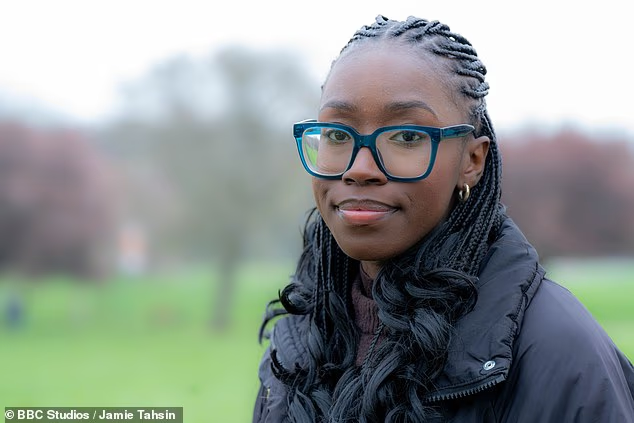
Women who were groomed, trafficked and sexually exploited by drug gangs as teenagers have accused police and social services of failing to protect them, as a BBC documentary examines why the abuse has continued for more than two decades.
Five survivors describe being raped, assaulted and forced to have sex with gang members and their associates while also being used to sell or transport drugs across Britain. Four have chosen to reveal their identities in Britain’s Forgotten Girls, which airs on BBC Two tonight.
The women say some officers appeared more concerned with gathering intelligence about criminal networks and pursuing drug offences than investigating the sexual abuse they had suffered.
Drug gangs’ sexual exploitation of girls
Christine, who moved from London to Coventry as a child, said she was targeted online at the age of 13 by a man who was 23. She recalled being isolated at school after the move and meeting him in person after he contacted her through a group chat.
On her 14th birthday, she said, the man asked her to have sex with his friends. What began as a single demand became a pattern of abuse involving numerous men.
“After that, I’ve lost count of how many times,” Christine said. “Some were his friends, some were his age, some looked older. I don’t know who they were.”
She said the abuse continued for more than eight years and became physically violent, including an assault which left her with fractured ribs. She also alleged that police and social workers repeatedly failed to intervene despite being aware of her relationship with an older man.
“I sat for hours and hours in interviews… but the moment I told them about the drugs and the houses, everything shifted,” she said.
Christine said officers appeared focused on arresting her boyfriend for drug offences and learning more about his gang. “Little old me coming and saying, ‘this is the abuse I’m going through’, wasn’t enough,” she added.
Violet, who became involved with a south London drug gang at 13, said she was raped and sexually abused by members of the group. Although men were arrested over drug offences, she claimed officers told her they had “bigger fish to fry” when she asked about the rape investigation.
She later received compensation from the Criminal Injuries Compensation Board, but said a letter informed her that the case had been closed without reaching court.
“It was pretty shocking, pretty offensive, pretty insensitive,” Violet said.
Holly was taken into care at 12 and became involved in selling drugs in Manchester city centre. She said that over the following four years, she was repeatedly sexually assaulted by gang members and made to sleep with different men.
“After a while it just became normal to me,” she said, explaining that she convinced herself the abuse meant she was wanted and belonged to a family that cared about her.
Holly was also used to carry drugs to the Isle of Man, Newcastle, Wales and London. She said the work exposed her to dangerous situations and further sexual assaults by drug users.
Annie, from Eltham in south-east London, said she was raped by three older boys after being introduced to them at the age of 14. The boys, who were part of a gang controlling a local estate, took photographs of her and threatened to share them unless she had sex with other associates.
The images were later posted online. Annie’s school alerted the police, but she said none of those who abused her was brought to justice.
A police letter seen by the BBC said there was “not a realistic prospect of a conviction” and that the investigation had therefore been closed.
Annie said the decision deepened her feelings of shame. “The fact that they did nothing, really made me feel like it wasn’t abuse,” she said. “It made me feel like it was my fault.”
Warnings about exploitation
Connie Muttock, director of policy and public affairs at the Centre for Young Lives, said the sexual abuse of girls within drug gangs was a widespread issue across the UK and should not be confused with the separate phenomenon of grooming gangs.
She said drug gangs primarily existed to make money through criminal activity, with girls often recruited to help generate income before being sexually exploited by gang members.
An inquiry led in 2012 by Sue Berelowitz, then the Deputy Children’s Commissioner for England, found that more than 16,500 children had shown signs of being at risk from grooming groups or criminal gangs. The review covered cities, towns and rural local authorities.
Ms Berelowitz said the scale of the problem had been difficult for some people in senior positions to accept. Professor Carlene Firmin, who carried out research for the inquiry, said there had been resistance within government to acknowledging the number of children at risk and the resources needed to respond.
The issue is expected to be considered by the Government’s independent inquiry into grooming gangs, established after Baroness Louise Casey’s audit found systemic failures and institutional paralysis had allowed group-based sexual exploitation to continue.
Acting Chief Constable Rebecca Riggs, the National Police Chiefs’ Council lead for child protection, abuse and investigations, apologised to survivors who felt ignored or disbelieved.
“Hearing the experiences of the women featured in this programme is devastating,” she said. “Where people felt they were not listened to, were not believed, or did not receive the response they needed, that can compound the trauma they have already experienced.”
Ms Riggs said some of the cases may already fall within Operation Beaconport, the national investigation launched after the Casey Review, while others could be considered by the independent Child Sexual Abuse Review Panel.
“We did not always get it right, and where we failed victims, we continue to acknowledge it and learn from it,” she said.
Britain’s Forgotten Girls airs on BBC Two at 9pm on Wednesday, September 9, and will be available on BBC iPlayer.
