


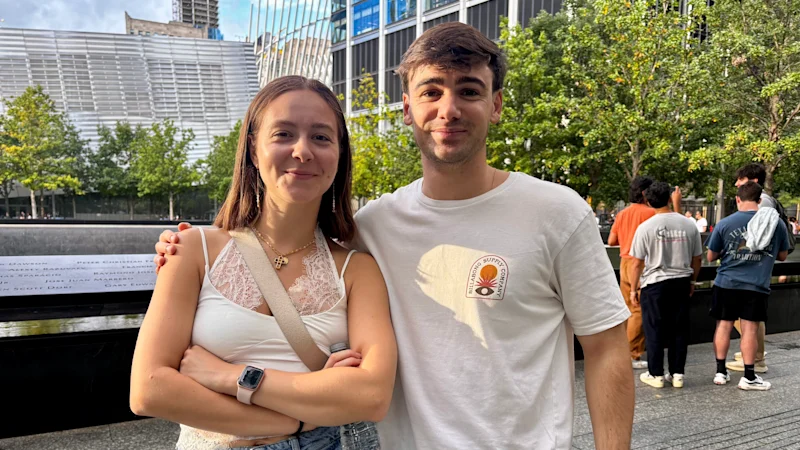
Young visitors to the September 11 memorial in New York have described the attacks as a subject surrounded by uncertainty and conspiracy theories, highlighting the growing challenge of preserving an event that is now a quarter of a century old.
At the memorial in Lower Manhattan, where two reflecting pools mark the footprints of the World Trade Centre towers, some people born after the attacks said they were unsure what had happened on September 11, 2001.
Enrique Subiran, 25, from Spain, visited the site with Maria Nieto, 23. He said the attacks remained significant but added that he was not confident enough to explain what had taken place.
“There are still so many conspiracies about it; you can believe them or not. I don’t know,” he said.
Asked whether he believed the official account of the attacks, Subiran replied: “I don’t like to speak when I’m not informed about a topic. I can’t really say what happened; I just believe what everyone says. But I don’t know what happened, to be honest.”
He acknowledged having seen footage of the planes hitting the towers but said he was aware of claims that no aircraft had crashed into the buildings.
Conspiracy theories find a new audience
Two American teenagers encountered at the memorial expressed more extreme views. Frank Catalanello, 18, said the Illuminati had been responsible for the attacks, while his 19-year-old companion, who gave his name as John, referred to the United States as the “United States of Israel”.
The pair also made references to the Freedom Tower, which replaced the World Trade Centre, and suggested that America was being “sold out”. They became reluctant to elaborate when asked to explain their claims on the record.
It was not clear whether the teenagers genuinely held the views they expressed or were attempting to shock. But their comments reflected the way long-standing 9/11 conspiracy theories have become intertwined online with antisemitic claims and hostility towards Israel.
Researchers and educators have warned that the passage of time is creating a growing distance between the attacks and those now learning about them. The 9/11 Memorial & Museum says about 100 million Americans were born after the attacks or were too young to remember them.
The museum has announced a digital learning programme featuring the testimony of a survivor, an NYPD first responder and relatives of people who died. A 35-minute film is due to become available on demand on September 11, 2026, while a new exhibition examining the legacy of public service after the attacks is scheduled to open the following day.
The Associated Press has found that at least 40 US states now have laws, education standards or other policies encouraging or requiring schools to teach about September 11. The detail and approach vary widely, with some lessons focusing on terrorism and others examining the wars, civil liberties and discrimination that followed.
A recent Pew Research Centre survey found that 93 per cent of Americans aged 18 and over who were old enough to remember the attacks said they could recall exactly where they were or what they were doing when they first heard the news. For those born afterwards, the event exists only through lessons, recordings, family stories and online material.
Not every young visitor to the memorial expressed doubt. Harrison Tarbox, 23, from New Jersey, said he found the site “very powerful” and had not met anyone who dismissed the attacks or treated them as unimportant.
“I haven’t met anyone that has forgotten [the event] or takes it for granted,” he said.
Michael Gaylor, 15, from Long Island, said September 11 was discussed at school every year. An Italian visitor, Arianna Giacobbr, 23, described it as one of the most significant tragedies of modern times and said terrorism remained a threat.
That contrast is at the heart of the memorial’s challenge. The young people who remember the attacks most clearly carry personal memories of television pictures, frightened adults and a country suddenly transformed. Those born later inherit the consequences without having experienced the shock that produced them.
Nancy Gibbs, a professor of media, politics and public policy at Harvard Kennedy School who wrote about the attacks for Time magazine shortly afterwards, said conspiracy theories had always existed but were now able to reach far larger audiences.
“The ability to distribute it and amplify it at scale, that’s what’s new,” she said. “The ability for purveyors of conspiracy theory to reach enormous audiences is very different than the age of gatekeepers who could keep crank ideas or extreme views truly on the margins.”
For the memorial’s educators, the priority is not simply to preserve a date in the history books but to explain how September 11 changed the lives of millions of people and reshaped the world in which younger generations have grown up.
