


Melbourne’s latest arts week has offered a varied encounter with fairytale theatre, adventurous jazz, electronic pop and technology-led dance, with Vera Blue’s Modern Rituals tour emerging as the most fully realised performance of the group.
Across venues including Arts Centre Melbourne, The JazzLab, Northcote Theatre and the Now or Never Festival, artists have tested the boundaries between live performance and digital spectacle, although the most ambitious productions have not always matched their ideas with equal clarity.
Vera Blue finds power in transformation
Vera Blue’s first Australian headline tour since 2022 arrived at Northcote Theatre on August 26 in support of her third album, Modern Rituals. The performance treated the record’s themes of repetition, desire and self-reinvention as a series of changing visual and musical states.
On stage, Celia Pavey moved between shadowy theatrical tableaux and increasingly vivid bursts of colour. A gauze curtain became a portal, while costume changes and shifting projections gave the relatively small production a sense of scale beyond its two accompanying musicians.
Yet the centre of the show was Pavey’s voice. Once known as a folk singer on The Voice, she has developed into an electro-pop performer without losing the precision and control that first distinguished her.
The new material allowed her to move from clipped, confrontational delivery on Private to the exposed intensity of Rituals. Later, a succession of heavy electronic beats carried the concert towards the dancefloor, with Go Lucky and Regular Touch providing its most euphoric moments.
The encore brought the evening back to its simplest elements. Accompanied by guitar, Pavey led the audience through Dolly Parton’s Jolene before closing with her cover of Radiohead’s Creep. The contrast underlined the quality of a voice capable of carrying both intimate confession and arena-sized release.
GRIMM turns dark folklore into comic mayhem
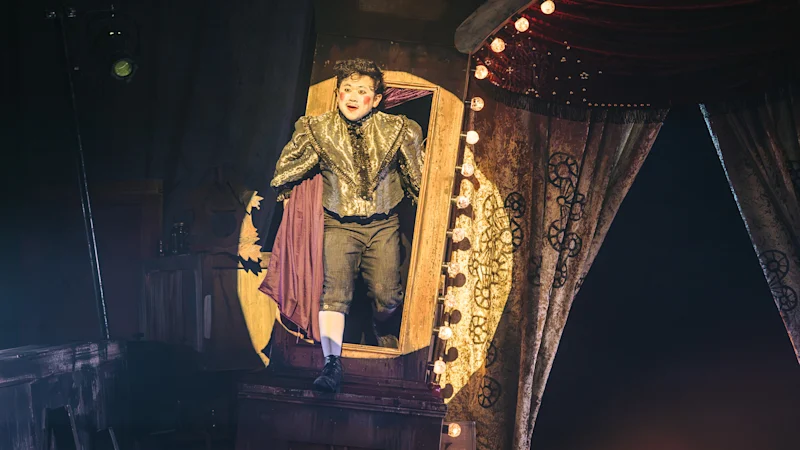
At Arts Centre Melbourne, Brisbane company Shake & Stir is marking its 20th anniversary with GRIMM, a fast-moving collision of Brothers Grimm stories, pantomime and cabaret.
The production’s central narrative draws on the brutal German version of Cinderella, alongside episodes from Little Red Riding Hood, The Robber Bridegroom and Beauty and the Beast. Its treatment of the material is deliberately broad, combining comic horror, slapstick and musical-theatre parody.
The four performers — Aljin Abella, Helen Cassidy, Henry Rollo and Nelle Lee — attack the material with considerable energy. Their timing and physical precision keep the show moving even when the plot becomes deliberately tangled.
GRIMM is less interested in the sophistication of a work such as Sondheim’s Into the Woods than in the rowdy pleasures of theatrical excess. Its appeal lies in its unpretentious mixture of panto, cabaret and commercial comedy, rather than in any sustained attempt to deepen the fairytales it borrows.
Stephen Byth quartet delivers the week’s finest jazz
The strongest musical performance came at The JazzLab on August 30, where Melbourne-born saxophonist Stephen Byth reunited with guitarist Theo Carbo, bassist Yunior Terry and drummer Ebs Daramola.
Byth, who has been based in the United States, assembled the group around a recording project connected to his National Jazz Awards win. The quartet had only recently worked together, but the performance had the ease and responsiveness of a long-established band.
Terry and Daramola supplied a restless, flexible rhythmic foundation, while Carbo shifted effortlessly between melodic unison with Byth and warmer, more textural guitar work. Their treatment of Milton Nascimento’s Paula e Bebeto brought buoyant Afro-Latin rhythms to the set, while Keith Jarrett’s De Drums was driven by a particularly effective bassline and backbeat.
Byth’s own composition, Pain to Progress, showed that his writing is as compelling as his interpretations. Angular melodies, shifting harmonies and expansive improvisations gave the piece the shape of a compact suite, suggesting that the quartet could become more than a one-off collaboration.
Now or Never explores bodies controlled by technology
The Now or Never Festival has also presented two productions concerned with the increasingly blurred line between physical performance and digital mediation.
GG, created by street-dance partnership CONJAH and new-media collective PSEUDO, places the restricted movements of video-game characters into a live setting. Its performers behave like non-player characters, repeating gestures, moving with programmed stiffness and struggling against the apparent limits of their virtual world.
The production’s use of motion capture and digital avatars extends the ideas behind its street-dance cypher. Arts House describes the work as an exploration of control, choice and agency, and the relationship between watching and participating is central to its final sequence.
There are striking passages, including a puppet-like opening and a finely judged solo by Jahra Wasasala. But the production’s layers of sound, video and audience participation sometimes overwhelm its most interesting observations. Its individual images are stronger than the larger argument they are meant to form.
At the Victorian College of the Arts, Megan Beckwith’s Networked Flesh gives spectators an even more active role. Audiences move freely around a large ensemble of student dancers, using their phones to reveal augmented-reality forms hovering around the performers.
The University of Melbourne, which presented the work as part of the festival, says it examines how data shapes representation and how technology influences perceptions of what is human. On stage, pink digital organisms gather around bodies that cannot see the imagery being projected through the audience’s devices.
The effect is both inventive and faintly unsettling. The smartphones become part of the choreography, transforming spectators into a silent network of observers while the dancers continue to perform largely without access to the digital layer surrounding them.
The contrast between the advanced physicality of the dancers and the sometimes rudimentary augmentation is revealing. In Networked Flesh, the technology does not replace the body; instead, it makes the act of watching more complicated, and raises questions about intimacy, surveillance and who controls an image in performance.
