


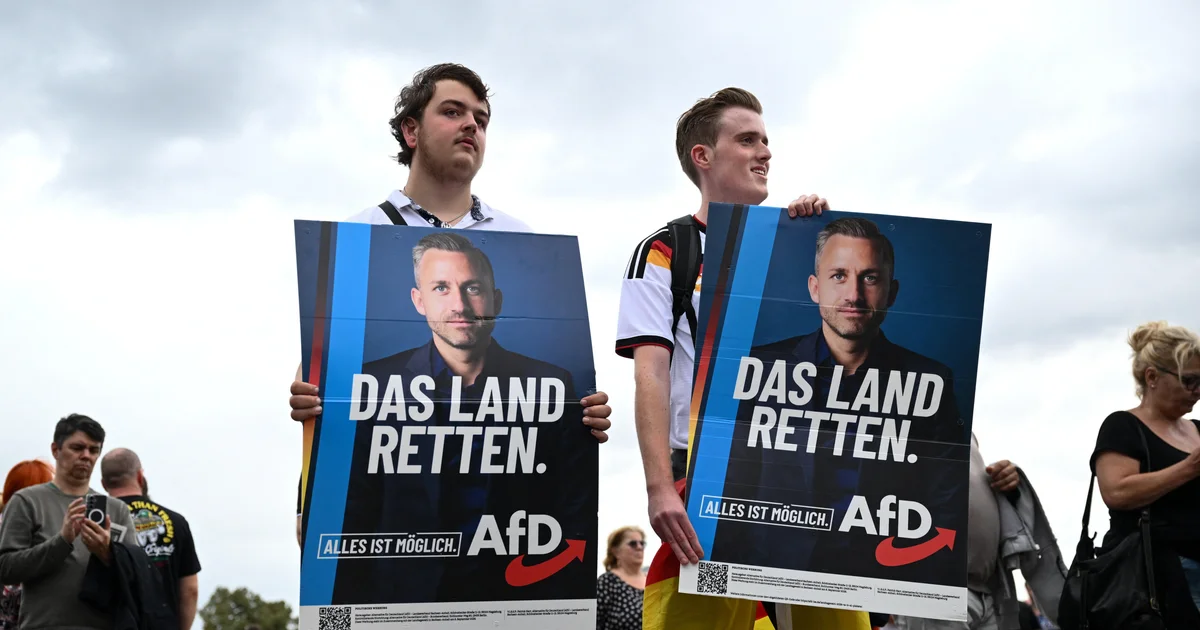
Germany’s far-right Alternative for Germany (AfD) has taken a commanding lead in the Saxony-Anhalt state election, according to early exit polls, but appeared to have fallen just short of the absolute majority needed to govern alone.
The result gives the party its strongest prospect yet of taking control of a German state government, although the country’s mainstream parties have ruled out entering a coalition with it.
Projections broadcast by ARD and ZDF put the AfD on about 44 per cent, more than twice its share at the previous election in 2021. The Christian Democratic Union (CDU), which has led Saxony-Anhalt and is Chancellor Friedrich Merz’s party, was projected to take about 18.5 per cent.
The Left was on roughly 9 per cent, while the Social Democrats and Greens were each expected to win between 8 and 9 per cent. The result for the Sahra Wagenknecht Alliance (BSW) remained uncertain, with the party needing at least 5 per cent to enter the state parliament.
Ulrich Siegmund, the AfD’s 35-year-old lead candidate, told ARD that his party had “written history” and that voters had sent a signal that “things cannot carry on like this”.
But without more than half the seats in the Landtag, the AfD would need the support of another party to form a government. Siegmund has said he would only lead an administration made up entirely of AfD ministers, ruling out a coalition.
AfD majority remains out of reach
The party’s failure to secure an outright majority would leave its route to power uncertain. Germany’s other major parties have maintained a political “firewall” against co-operation with the AfD, which has become the strongest opposition force in the national parliament.
A similar situation arose in neighbouring Thuringia after its 2024 election, when the AfD won more seats than any other party but was kept out of government after rival parties formed a coalition.
Saxony-Anhalt’s outgoing minister-president, Sven Schulze of the CDU, was seeking to defend his party’s long hold on the eastern German state. A ZDF poll published before the vote found that Schulze was preferred as premier by 48 per cent of respondents, compared with 34 per cent for Siegmund.
The election was held on Sunday, 6 September, in the state capital Magdeburg and across Saxony-Anhalt, a former East German region west of Berlin. A preliminary official result was expected during the night or early on Monday.
The AfD was founded in 2013 as a protest movement against the European Union but has since moved sharply to the right. The state branch has been classified by Saxony-Anhalt’s domestic intelligence agency as a “confirmed far-right extremist” organisation since 2023.
The agency has accused the chapter of being influenced by an ethnically defined nationalist ideology and pointed to anti-Muslim, racist and antisemitic statements by party officials. Siegmund rejects the classification, saying the intelligence service is being used as a political weapon against the AfD.
Immigration was central to the campaign. The state party has called for a “deportation and remigration offensive”, including tighter limits on migration and expanded detention facilities for people facing deportation.
The term “remigration” has been associated with proposals to expel not only asylum seekers but also legal residents and German citizens with immigrant backgrounds deemed insufficiently assimilated. The policy has been condemned by opponents as an attack on the country’s constitutional order.
Migration has also become a particularly sensitive issue in Magdeburg since a Saudi-born doctor drove into crowds at the city’s Christmas market in December 2024, killing five people. The attacker was not identified as an Islamist extremist and had expressed hostility towards Islam and sympathy for the far right, but the incident nevertheless intensified debate about immigration and public safety.
AfD supporters in the city said they wanted the party to confront what they described as uncontrolled migration and declining living standards. Opponents warned that an AfD-led government could threaten social services, increase hostility towards migrants and alter how Germany teaches the history of Nazi rule and the Holocaust.
Even if the exit-poll figures are confirmed, the AfD’s victory may therefore mark the beginning of a difficult battle over who can govern Saxony-Anhalt — rather than an immediate transfer of power.
