


A new interactive calculator has ranked the jobs most exposed to replacement by artificial intelligence, with telephone operators, office support staff and computer programmers among those facing the highest levels of risk.
The tool, developed by careers platform Kickresume, assesses 756 occupations using data from Anthropic’s Economic Index and the US Department of Labor’s O*NET database. It gives each role a risk score, with anything above 30 per cent classed as high risk.
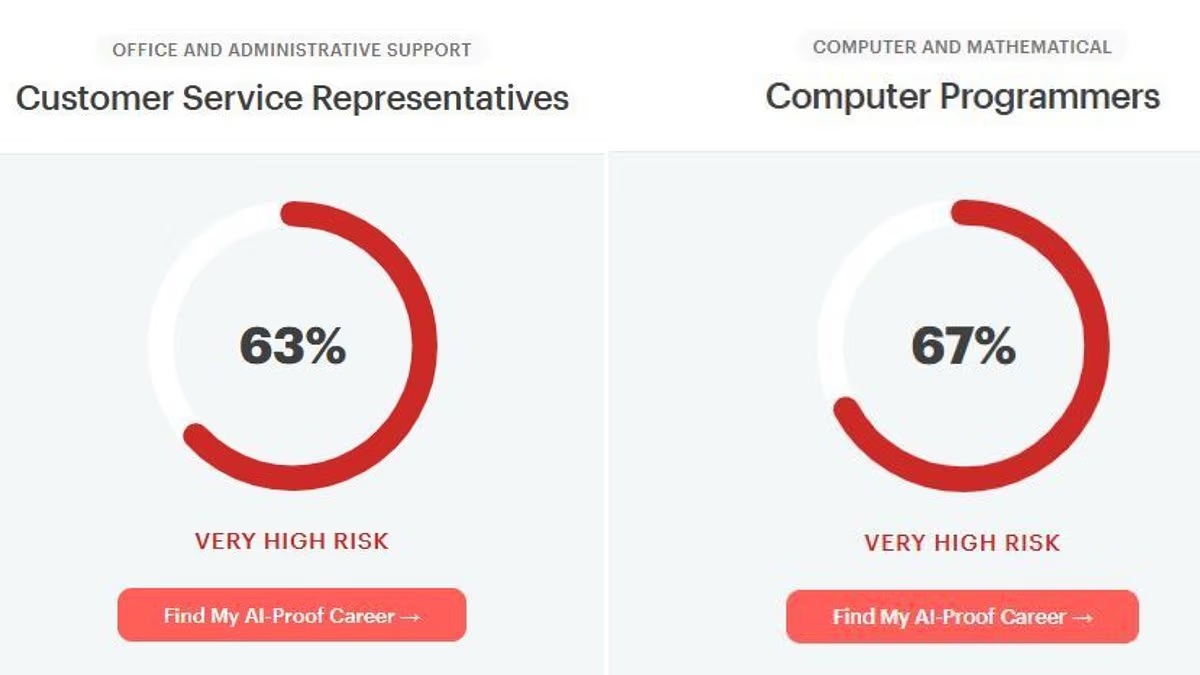
Telephone operators and office administration or support roles jointly top the list, with a score of 83 per cent. Computer programmers follow at 67 per cent, challenging the assumption that learning to code is a reliable safeguard against automation.
Legal secretaries and administrative assistants are rated at 64 per cent, while customer service representatives, data-entry keyers and medical records specialists each receive a score of 63 per cent. Medical transcriptionists are assessed at 60 per cent.
Other highly exposed roles include market research analysts and marketing specialists, at 57 per cent, wholesale and manufacturing sales representatives at 54 per cent, and database architects at 52 per cent.
The calculator’s rankings are based partly on “observed exposure”, a measure developed by Anthropic to track how artificial intelligence is being used in real workplace tasks. The system gives greater weight to activities that are already being automated, rather than tasks where technology is simply helping employees work more quickly.
Kickresume says it then adjusts the results according to the extent to which each occupation depends on creativity, interpersonal skills and practical dexterity. Those adjustments can alter an initial score by up to 25 per cent.
Peter Duris, the company’s chief executive and co-founder, said routine activities such as arranging meetings, taking notes, handling emails and processing documents were increasingly being carried out by automated systems.
He said the main indicator of risk was whether technology could already perform part of a job, or was likely to do so in the near future.
The rankings also suggest that pay is not a reliable guide to protection from automation. Software quality assurance analysts and testers, for example, appear in 19th place among the 20 jobs judged most exposed, despite being a comparatively well-paid technical profession.
By contrast, a number of occupations involving physical work or sustained human contact receive a zero per cent score. They include stonemasons, roofers, surveyors, preschool special education teachers, tire repairers and wellhead pumpers.
The score is not a prediction that a particular occupation will disappear. Rather, it indicates how much of the work involved could potentially be automated using current or developing systems. Many jobs contain a mixture of tasks, meaning employees may see parts of their role change without the occupation itself being eliminated.
Recent research has found little evidence of economy-wide job losses directly linked to the technology so far. Anthropic reported no systematic rise in unemployment among workers in highly exposed professions since late 2022, although it found signs that hiring of younger people had slowed in some of those occupations.
A separate analysis by Stanford University and payroll firm ADP found that employment among 22 to 25-year-olds in highly exposed occupations was 19 per cent below the level expected if it had continued to track less exposed roles by June 2026. The researchers stressed that the figures show a correlation rather than proving that artificial intelligence was the sole cause.
The effect appears to be concentrated among early-career workers, with experienced employees showing no comparable decline in the same analysis. The researchers said the change appeared to be driven mainly by reduced hiring rather than a sharp increase in redundancies.
The wider UK jobs market has also weakened. Office for National Statistics figures show there were an estimated 707,000 vacancies between May and July 2026, down 19,000 on a year earlier. There were 2.5 unemployed people for every vacancy between April and June.
However, the technology is also creating demand for new skills. A UK Government analysis estimated that almost 450,000 job adverts between 2021 and 2023 were linked to artificial intelligence, while ministers have backed new training and apprenticeship schemes intended to help workers adapt.
In March, Skills England launched an artificial intelligence and automation practitioner apprenticeship. The Government said roles directly involving artificial intelligence-related activity could increase from 158,000 in 2024 to 3.9 million by 2030, although those estimates include a wide range of jobs using the technology.
Mr Duris said workers in exposed occupations did not necessarily need to abandon their careers. Instead, he advised them to learn how to use the systems, oversee their output and check whether the results were accurate.
The businesses adopting the technology are already beginning to make significant changes. In February, payments company Block announced plans to cut more than 4,000 jobs, reducing its workforce by about 40 per cent. Chief executive Jack Dorsey said the company intended to operate with smaller teams and use artificial intelligence to automate more work.
The development has fuelled concerns that the first impact of the technology may be felt not through mass redundancies, but through fewer entry-level opportunities and a gradual reduction in the number of people required to carry out routine tasks.
