


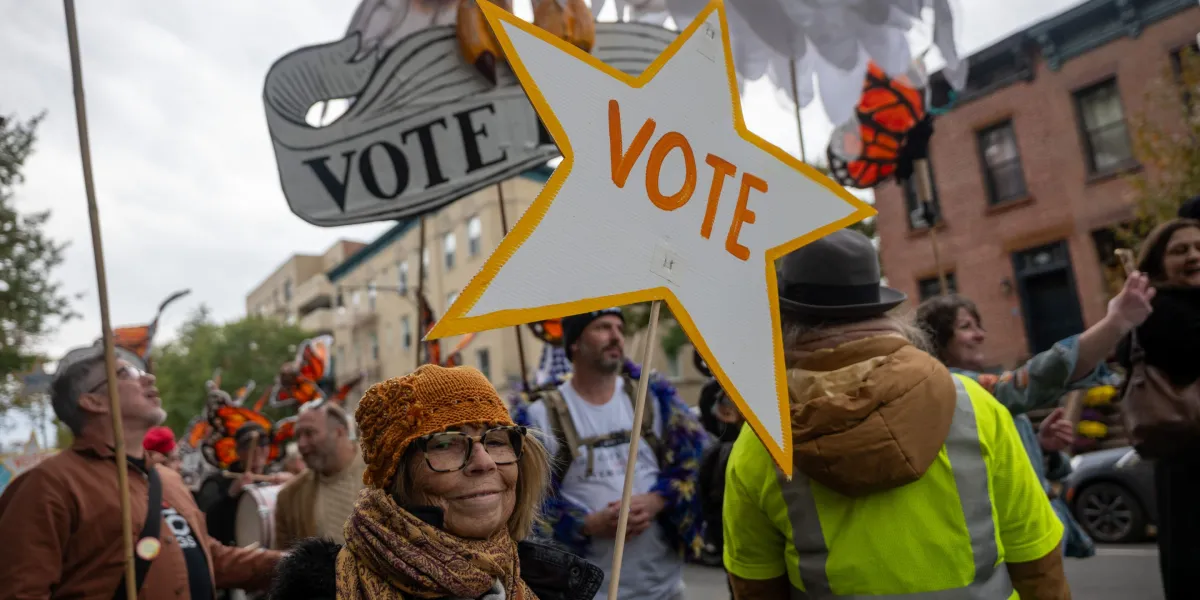
A gathering of Democratic campaigners, advisers and journalists in Brooklyn has highlighted the party’s unresolved identity crisis ahead of the midterm elections, with speakers divided over socialism, artificial intelligence and whether data centres represent economic opportunity or a growing threat.
About 300 people attended Newsreel’s “Midterm Mania” event at 100 Sutton Street in Greenpoint, where phones were placed in pouches at the door. The discussion was held five days before the midterms, as Democrats appeared well placed to make significant gains but remained uncertain about the platform that should define them.
Newsreel founder and chief executive Jack Brewster said more than 150 attendees had submitted questions for the event. He framed the central issue for the final panel: “Democrats are on track to win big according to polls, but they still cannot agree on who they are.”
A New York Times/Siena poll released on 21 October put Democrats 10 points ahead on the congressional ballot and recorded Donald Trump’s approval rating at 36 per cent. Yet the party has not settled its position on the rapid expansion of artificial intelligence infrastructure, despite polling indicating that half of Americans oppose a data centre within three miles of their home.
Democrats divided over socialism and AI
Chi Ossé, the youngest member of New York City Council and a democratic socialist, said defeating the right was more important than settling the party’s ideological label.
“The number one thing that I care about within our party is taking back this country back from the right,” he said. “Whatever you need to do in order to do that at this point in time, you know, I do support that.”
Ossé also backed Abdul El-Sayed, the Michigan Democrat who won his Senate primary with the support of Bernie Sanders and Alexandria Ocasio-Cortez but has said he is not a socialist. Ossé said he believed the party would ultimately move towards democratic socialism.
On AI, Ossé acknowledged that he did not understand the technology particularly well and used it little himself. He nevertheless supported calling major technology and AI executives before Congress, saying they might “be put behind bars for a little bit”, and endorsed Sanders’s proposal for a one-off 50 per cent stock tax on the largest AI companies.
Data centres become a political fault line
The sharpest disagreement centred on data centres, with campaigners warning about their environmental impact and local disruption while others pointed to the jobs and investment associated with new facilities.
Hilary Flint, who organises against data centres in Pennsylvania for the Center for Oil and Gas Organizing, said opposition crossed traditional political boundaries. The Pennsylvania Data Center Resistance group on Facebook, she said, had more than 44,000 members from across the political spectrum.
Maia Woluchem, who has tracked the expansion for Data & Society, described data centres as part of a “long legacy of industrial obfuscation”. She said they were being developed in communities already affected by fracking wells and coal mines.
Nationally, data centres account for about 1.5 per cent of global electricity demand and 0.5 per cent of global carbon dioxide emissions. In the United States, they used 4.4 per cent of electricity in 2023, a figure projected to rise to between 6.7 and 12 per cent by 2028. In Virginia, the share is already 26 per cent.
Pennsylvania’s Democratic governor, Josh Shapiro, has found himself caught between investment and opposition. He announced Amazon’s planned $20 billion data centre investment in the state before, according to Woluchem, attempting to reverse the decision after strong public resistance.
Hilary Flint said activists were pressing Mr Shapiro to introduce tougher rules. She said he had begun claiming Pennsylvania had the strictest data centre laws in the country, although she added that this was not yet accurate.
Morris Katz, a partner at Fight Agency and Zohran Mamdani’s lead media strategist, said Republicans could take ownership of the issue if Democrats failed to do so. “Republicans can feel free to have the pro-data-center lane if they’d like,” he said, arguing that districts won by Trump by 25 points could be affected by the debate.
That position risks alienating organised labour, according to Batya Ungar-Sargon, a NewsNation host who describes herself as a “MAGA leftist” and voted for Trump in 2024. She said national trade unions were crossing party lines to endorse Republicans because data centres offered work for electricians and pipefitters.
Ungar-Sargon argued that working-class voters had moved to the right while Democrats represented nine of the ten wealthiest counties. She also warned that policies such as Medicare for All could lose support if voters were told their taxes would rise.
Questions left for after the vote
Katz described himself as “a populist who believes we should have a big tent party”, while Astead Herndon, host of America, Actually, said the 2024 result represented an “establishment collapse” rather than a lasting political realignment.
Even a strong Democratic performance would not resolve the party’s internal dispute, Katz said. “Even in the best-case scenario where we win big,” he said, “I think we still need to be ready to have harder conversations about where we go from here.”
Those conversations were already evident in a rapid-fire session on the Senate leadership, the next steps for Mamdani and control of Congress. Several panellists declined to make firm predictions.
Aryan Ranjan, co-founder, chief financial officer and head of AI at campaign-software company Baraza, offered the most specific forecast, predicting Democrats would win 231 House seats and 52 Senate seats. Ungar-Sargon was the only panellist to call the Senate for Republicans, while acknowledging: “I could be wrong.”
After the discussion ended, the chairs were cleared and the phones returned to their owners.
