


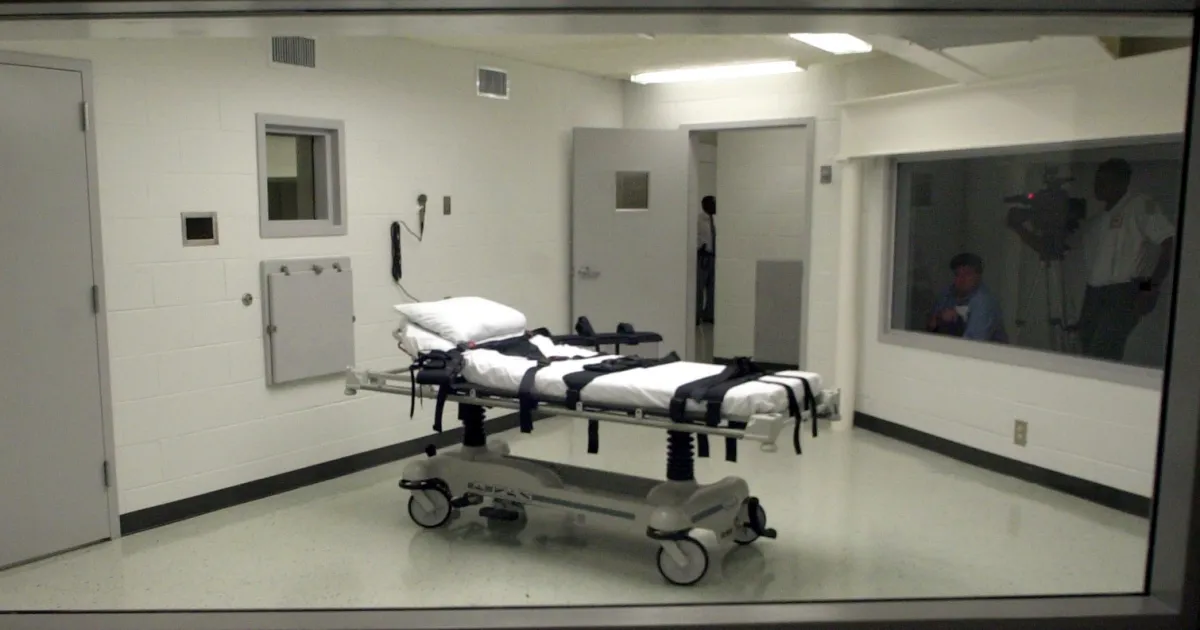
The botched execution of Christa Pike has prompted a renewed debate over lethal injection in the United States, where experts say failed attempts are a frequent feature of capital punishment.
Pike, who was sentenced to death for taking part in the murder of a classmate when she was 18, remained alive after two doses of pentobarbital were administered in Tennessee on September 30. Witnesses said she continued breathing, snoring and lifting parts of her body from the gurney.
Her lawyers said she regained consciousness in hospital on October 6 and faces a long recovery. They had previously argued that Pike’s small veins and a blood condition could make lethal injection more difficult.
Tennessee Governor Bill Lee has paused executions in the state and ordered a “comprehensive, third-party review” of the incident. It was the second time this year that Tennessee authorities abandoned an execution after a lethal injection failed.
The Tennessee Department of Correction declined to say why the attempt had gone wrong or whether the state intended to try to execute Pike again.
Why lethal injections fail
Lethal injection is the most widely used execution method in the US, but researchers say it has proved less reliable than its clinical appearance suggests. States including Tennessee, Idaho, Alabama, Arizona, Texas and Oklahoma have recorded at least one botched lethal injection since 2022.
A survey of US executions between 1890 and 2010 found that lethal injections were botched at more than twice the rate of all other methods. Experts attribute the failures partly to the difficulty of carrying out a complex medical procedure in prison settings without qualified medical staff.
Major medical organisations prohibit their members from assisting with executions because it conflicts with the duty to do no harm. Prison authorities may therefore rely on staff or officials whose medical credentials are limited or unclear.
“Lethal injection has all of the delicacies of a medical procedure: all of the error-prone qualities, all of the need for precision. But it has been warped to fit the needs of execution settings,” said Corinna Barrett Lain, a University of Richmond law professor.
She said she had witnessed executions lasting for hours, with prisoners being punctured by needles more than a dozen times. “It’s this really bad combination of a delicate procedure that is not performed in a delicate way,” she said.
Pharmaceutical companies restrict the use of their medicines in executions, leading some states to obtain drugs from compounding pharmacies. The medicines produced by those facilities are not subject to the same level of scrutiny as mass-produced drugs, while existing state stockpiles can become expired or faulty.
Prisoners can also present additional challenges. Many spend years or decades on death row and are older by the time an execution is scheduled, making underlying health problems more likely.
Botched executions commonly involve difficulties locating a vein or establishing an intravenous line. Pike’s lawyers described her arms as swollen and burned after the injections, which Robin Maher, executive director of the Death Penalty Information Center, said could indicate that the drugs had not properly entered her bloodstream.
“Everyone has speculated that the drugs were administered to her but did not enter her bloodstream in sufficient amounts to kill her,” Maher said. “It’s likely that her veins were blown, or that the needle went through the vein.”
Lethal injection remains the dominant method
The incident followed other recent failures. In May, Tennessee abandoned the execution of Tony Carruthers after staff spent more than 90 minutes trying to establish a backup intravenous line.
Idaho suspended the execution of Thomas Creech in February 2024 after an execution team failed to insert an intravenous line following eight attempts on his arms, legs and feet.
Despite such cases, lethal injection is the primary execution method in 28 of the 29 US states that still permit the death penalty. In 2025, 39 people were executed by lethal injection, compared with five by lethal gas and three by firing squad.
Michael Radelet, a University of Colorado sociology professor who has tracked botched executions, said lethal injection had replaced older methods that came to be regarded as outdated and brutal. But he said the promise of a more peaceful procedure had been undermined by its record and by autopsies showing that prisoners could still experience pain.
“Lethal injection, from the very start, was about a humane-looking execution, not a humane execution,” said Lain. “There’s a big difference.”
