


Dumfries and Galloway Council has turned to drones, lasers and bio-acoustic devices in an effort to stop gulls nesting on public buildings and attacking people in urban areas.
The non-lethal measures were deployed across Nithsdale before the 2026 breeding season, as the authority faced tighter requirements to prove it had tried other options before seeking permission to remove eggs or nests.
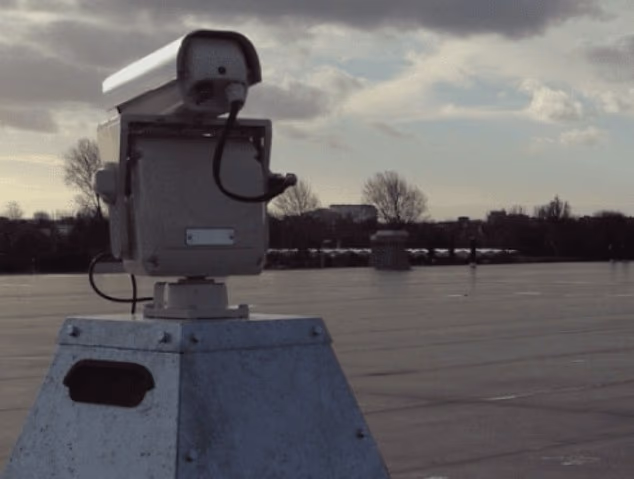
Environmental health teams used a green laser twice a day at 11 council-owned properties, including sites in Dumfries, Georgetown, Annan and Stranraer. The beam is intended to appear to the birds as a physical danger, encouraging them to abandon potential nesting sites.
A drone has also been used to locate nests at an early stage, while other deterrents include roof spikes, noise emitters, hawk kites and bio-acoustic scarers.
The council has secured £10,000 from NatureScot for the programme, including £3,000 spent on an Agrilaser 500 handheld unit and two smaller lasers.
A council spokesman said the equipment was being used in locations where gull problems were “most acute”. Early indications suggested it could discourage the birds from roosting and nesting when introduced at the start of the breeding season, although a full assessment of this year’s operation is still being completed.
Gulls have been a persistent problem in Dumfries and other communities across the region, with complaints ranging from torn rubbish bags and scavenged food to aggressive swooping birds defending their young.
The council has operated an egg and nest removal scheme since 2009. However, papers due to be considered by the Nithsdale Area Committee next week say NatureScot has, in recent years, required preventative measures to be exhausted before licences for removals are issued.
During the 2025 nesting season, two licences were granted in Nithsdale. Eleven nests were removed from Dumfries Activity and Resource Centre, while a further nest was taken from Brownhill Primary School.
Independent councillor David Slater said he hoped the new approach would prove more humane than removing eggs after gulls had already established nests.
“For years they have nested within Dumfries….they found the town had a lot of discarded food that would lie on the streets; it was easy pickings for them,” he said.
Mr Slater also raised concerns about the difficulty of determining how far eggs have developed when they are collected.
“It takes around 30 days for them to hatch and around the 20 day mark the birds are fully formed and like chickens can whistle to each other,” he said. “So unless you are an ornithologist, the layman can be throwing away live chicks which to say the least is barbaric.”
The latest programme follows a Scottish Government-backed summit on urban gulls held in Inverness last year, after which £100,000 was made available to councils to support deterrence work ahead of the 2026 breeding season.
Elsewhere in Scotland, councils have also experimented with similar tactics. Moray Council has used lasers and sonic devices in Elgin, Forres, Lossiemouth and Buckie, while a gull ranger was appointed in Eyemouth this summer to help reduce conflict between residents and birds.
Dumfries and Galloway Council said financial pressures meant the deterrents could not yet be introduced at every council site. Members of the Nithsdale Area Committee are due to discuss the results of the operation at their meeting on 9 September.
