


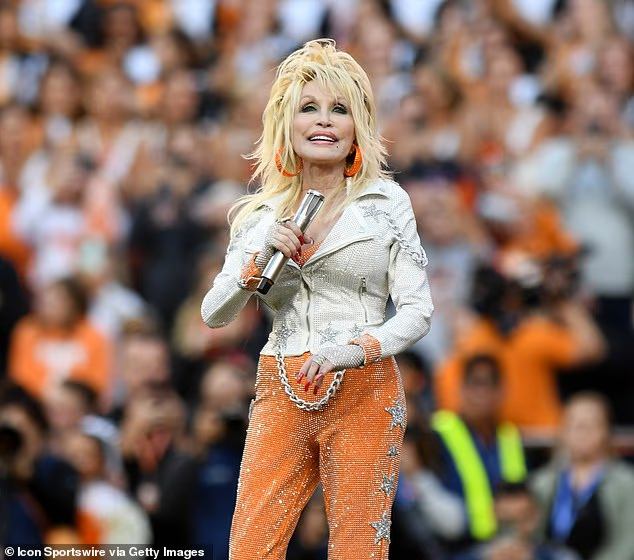
Dolly Parton’s death has left Nashville facing an uncomfortable question: who, if anyone, can succeed the woman whose appeal extended far beyond country music?
Parton died in Nashville on August 25, aged 80, after a short illness. Her family held a private service last week, with plans for a larger public celebration of her life now being developed for 2027. ([axios.com](https://www.axios.com/local/nashville/2026/08/25/dolly-parton-has-died-at-80-obit?utm_source=openai))
Yet the debate over her successor is not simply about finding another singer with a distinctive voice or a string of hit records. Parton occupied a rare position in American culture, moving effortlessly between the Grand Ole Opry, Hollywood, business and philanthropy.
She wrote her own songs, starred alongside Jane Fonda and Lily Tomlin in 9 to 5, established Dollywood and created the Imagination Library, which has distributed millions of books to children. Her flamboyant wigs and rhinestone costumes became part of the image, but they never overwhelmed the warmth and self-deprecating humour that made her so widely admired.
That breadth is what makes the search for a new Dolly Parton so difficult. Shania Twain helped push country music towards the mainstream, Carrie Underwood possesses one of the genre’s great voices, Miranda Lambert commands respect in Nashville and Ella Langley has emerged as one of its most promising new names.
None, however, has yet matched Parton’s combination of artistic authority, commercial instinct and cross-generational affection.
Taylor Swift and Beyoncé offer two very different comparisons
Taylor Swift is the most obvious candidate on paper. She began as a teenage songwriter in Nashville before moving through country-pop into mainstream pop and, ultimately, a level of global fame that places her beyond any single genre.
Like Parton, Swift has shown a formidable understanding of business, branding and songwriting. But their public identities have developed in sharply different ways.
Parton spent much of her career avoiding party politics. She declined the Presidential Medal of Freedom three times: twice during Donald Trump’s presidency and once under Joe Biden, saying that accepting it after turning down earlier offers could appear partisan. The Associated Press has described her refusal to align herself with either political camp as part of the broad appeal that allowed her to be embraced across America’s divisions. ([apnews.com](https://apnews.com/article/8b8494ba94515327853881e60224c577?utm_source=openai))
Swift, by contrast, endorsed Kamala Harris during the 2024 presidential election and has openly criticised Trump. That has not diminished her influence, but it has made her a more politically defined figure than Parton ever wished to be.
Beyoncé represents another possible comparison. Her album Cowboy Carter challenged the boundaries of country music, won Album of the Year and Best Country Album at the 2025 Grammy Awards, and was followed by a tour that grossed $407.6 million from 32 shows, according to Billboard Boxscore figures reported by Pollstar. ([news.pollstar.com](https://news.pollstar.com/2025/07/28/beyonces-historic-cowboy-carter-tour-concludes-as-top-grossing-country-tour-with-more-than-400m/?utm_source=openai))
Those achievements underline Beyoncé’s extraordinary reach, but they do not necessarily point to a lasting role in Nashville. Her country project was a major cultural event, rather than evidence that she intends to become a permanent country performer.
Other names have their own claims. Reba McEntire remains one of the most beloved figures in the genre, with the warmth, humour and longevity to appeal to several generations. Kacey Musgraves has critical acclaim and Grammy credibility, while Lainey Wilson is widely regarded as one of country music’s more authentic contemporary stars.
Miley Cyrus may come closest to Parton in one important respect: fearlessness. Parton was Cyrus’s godmother, and their relationship remained close for decades. Cyrus, like Parton, has moved between country, rock, pop and blues while turning her own contradictions into part of her appeal.
But commercial success, musical versatility and celebrity are not enough on their own. Parton’s connection reached people who did not necessarily listen to country music, from children and grandparents to film audiences and fans across the political spectrum.
That kind of affection is particularly difficult to create in the fragmented media environment of 2026. Audiences no longer necessarily watch the same programmes, listen to the same radio stations or recognise the same stars. Streaming services and social-media algorithms increasingly present each person with a different cultural landscape.
A singer can now command tens of millions of followers while remaining unfamiliar to large sections of the public. The shared national audience that helped turn Parton into a truly universal celebrity has become harder to build.
Swift may be the stronger commercial force, Beyoncé may be the more spectacular performer and Cyrus may possess the closest emotional connection to Parton’s legacy. Wilson could yet become one of country music’s defining stars, while McEntire’s status as its grande dame appears secure.
But the central truth is less convenient for Nashville: there may be no next Dolly Parton.
Her successor would need to combine songwriting, entertainment, business, philanthropy, humour and an almost impossible ability to remain beloved without becoming bland. The crown she leaves behind is not waiting for a new wearer so much as marking the end of an era.
