


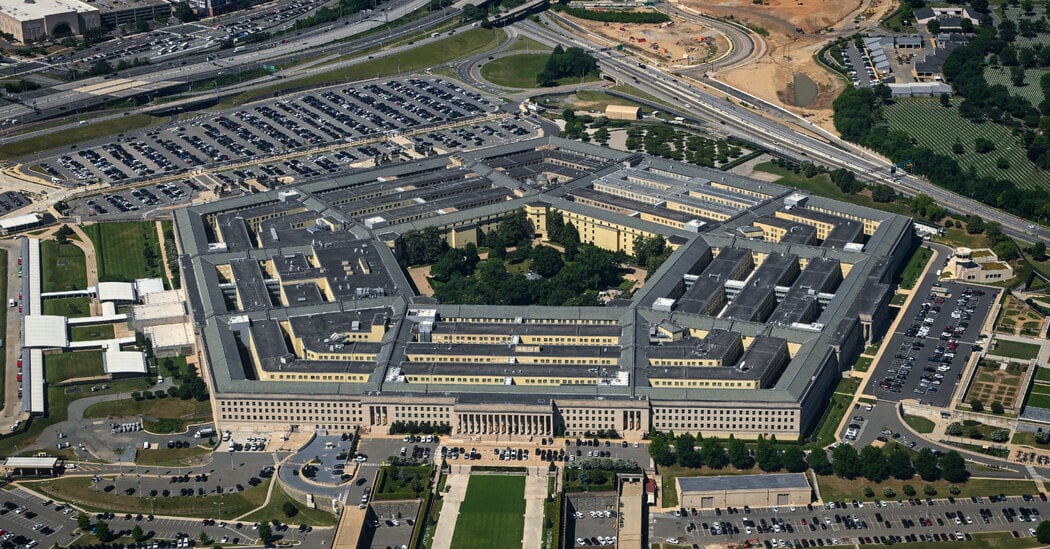
The Pentagon and the National Institutes of Health have signed an agreement to work together on biodefence and pandemic preparedness, prompting warnings from senior Democrats that the arrangement could give the defence department access to billions of dollars intended for medical research.
The agreement covers chemical and biological defence research but does not set out a total value or identify the projects involved. People familiar with the arrangement said it could eventually involve as much as $2 billion from the National Institute of Allergy and Infectious Diseases (NIAID), roughly a third of its budget.
Democrats on Capitol Hill said the deal risked allowing Pentagon officials to redirect money approved by Congress for public health priorities towards their own programmes.
Representative Rosa DeLauro of Connecticut, the senior Democrat on the House Appropriations Committee, called for the agreement to be ended immediately.
“These funds were provided for lifesaving medical research, not as extra money for the Department of Defense,” she said.
Senator Patty Murray, the senior Democrat on the Senate Appropriations Committee, accused the Pentagon of trying to take billions of dollars from the NIH in order to increase its own budget.
The criticism comes as the Trump administration faces continuing scrutiny over its use of interagency agreements and other executive measures to move or cancel federal spending without securing fresh approval from Congress.
NIH defends Pentagon research partnership
Administration officials denied that NIH money was being transferred to the Pentagon.
Jay Bhattacharya, the NIH director, said the partnership would support research intended to benefit both the public and the military. He said all work led by NIAID would remain aligned with the agency’s public health mission.
White House spokesman Kush Desai said the NIH was not transferring money to the defence department and described the arrangement as a project-by-project research partnership. He accused Ms DeLauro of misrepresenting the agreement for political purposes.
The Pentagon did not respond to a request for comment.
A spokeswoman for the Department of Health and Human Services said possible projects could include therapeutics, diagnostic tools and personal protective equipment designed to protect against infectious diseases and other health threats. She cited the response to the Ebola outbreak as an example of the type of work that could be supported.
The agreement was signed by Dr Bhattacharya and Dr Robert Kadlec, who works on biodefence matters at the Pentagon. Dr Kadlec previously served as assistant secretary for preparedness and response at the Department of Health and Human Services and was involved in Operation Warp Speed, the US government’s Covid-19 vaccine and treatment programme.
The deal comes during a period of major change at NIAID, which has lost several longstanding leaders and is being reshaped under the Trump administration.
For years, biodefence and pandemic preparedness were among the institute’s three principal areas of work. However, a recent strategic plan shifted the emphasis towards two broad pillars: infectious diseases and immunology, with biodefence absent as a standalone priority. ([pmc.ncbi.nlm.nih.gov](https://pmc.ncbi.nlm.nih.gov/articles/PMC12820581/?utm_source=openai))
NIAID played a central role in the scientific response to Covid-19, while its former director, Anthony Fauci, became one of the most prominent public figures associated with the pandemic. The institute also helped support the rapid development of vaccines that were credited with saving millions of lives, but its work later became a focus of political controversy.
In a statement issued in July, Dr Bhattacharya said the NIH would work with other government agencies to implement new safeguards governing high-risk life sciences research, including stronger review and reporting requirements. ([nih.gov](https://www.nih.gov/about-nih/nih-director/statements/announcement-release-us-government-policy-stopping-high-risk-life-sciences-research?lctg=1997172&psid=98C40DA0-F334-482E-89DC-7D390CDF263A&utm_source=openai))
Historically, about one-third of NIAID’s budget of roughly $6.6 billion has been directed towards biodefence and emerging pathogen research. Democrats fear the new arrangement could enable the Pentagon to influence how that money is spent, while the administration insists that any collaboration will be tied to specific research projects rather than a wholesale transfer of funds.
The agreement also arrives as the Pentagon seeks a substantial increase in spending. The administration has requested a defence budget of $1.5 trillion, including a further $350 billion proposed through the reconciliation process.
Both measures face obstacles in Congress. Democrats opposed to the war in Iran have resisted providing additional funding through the normal appropriations process, while Senate Republicans remain divided over the budget plan needed to advance the reconciliation package.
