


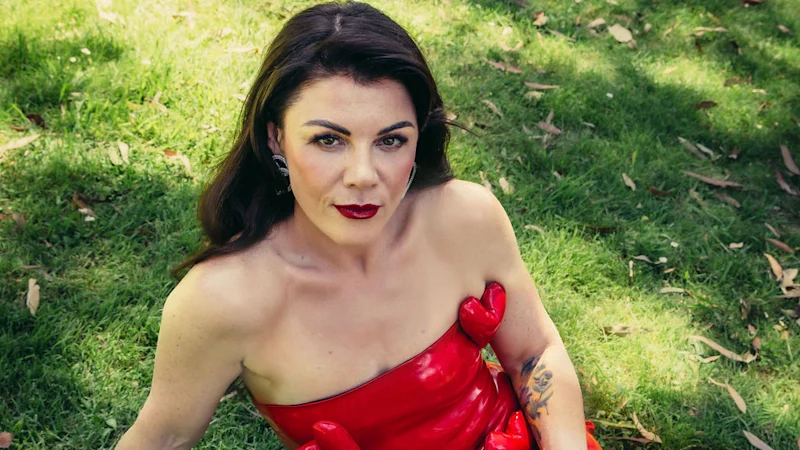
Em Rusciano has said her ADHD and autism diagnoses transformed the way she understood herself, after years of believing she was “a broken, lesser human”. The Australian comedian, singer and broadcaster is now taking those experiences to the stage in her new live show, Addicted to Love.
The show, which begins its latest run in Newcastle on Friday, explores Rusciano’s divorce, dating again in her 40s and the pressure placed on women to build their identities around being chosen by others.
“My whole life, I was conditioned to believe I wasn’t a successful woman until I was chosen,” she said. “Not just chosen by romantic partners but chosen by my friends, my parents, the workplace and the public.”
Rusciano was with her former partner for 25 years. Although the relationship’s end brought pain and upheaval, she said it should not be viewed as a failure, pointing to their three children and continuing friendship.
“It wasn’t a failure, it was just an ending,” she said. “We have three beautiful kids, we’re still great friends and we’re going to be in each other’s lives forever.”
Her new show examines the expectations placed on women to carry the emotional and practical burden of family life, often at the expense of their own needs.
Rusciano said many women reached midlife exhausted from being expected to act as “the chef, the cook, the cleaner, the psychologist, the chauffeur, the organiser” while having little time left for themselves.
“Women are told you’ve got to sacrifice everything and set yourself on fire to keep everyone else warm,” she said. “And I really interrogated that idea while writing this show.”
Her personal reassessment followed an ADHD diagnosis at 42 and an autism diagnosis at 45. The discoveries helped explain difficulties with social interaction, sensory overload and executive function that she had previously interpreted as personal failings.
“I used to believe that parts of me were broken; that I was a lesser human,” Rusciano said.
She described everyday life as frequently overwhelming, recalling how a trip to the supermarket could leave her feeling as though she had been “fighting for your life among a pack of bears”. At the same time, she said her diagnoses had helped her recognise her intense curiosity and capacity for excitement.
Rusciano has previously spoken publicly about the difficulties of obtaining an autism diagnosis as a woman. Her interest in the possibility was prompted in part by the assessment process for her son, when she began recognising her own sensory and behavioural traits.
She said the autism diagnosis was especially difficult because she had not initially been believed by medical professionals. After she began discussing it publicly, critics questioned whether she was genuinely autistic.
“My biggest fear about coming out as an autistic woman was not being believed,” she said.
That fear remains closely linked to her concern about being misunderstood. Rusciano said she had spent much of her life attempting to explain herself in increasingly precise detail, only recently accepting that clarity was her responsibility but other people’s interpretations were not.
She also described what she called the “ADHD tax”, including once missing a flight and leaving her family stranded in Italy after confusing a morning departure with an evening one. Her memory, she said, could retain detailed information about pop culture while failing to reveal where she had left her keys.
The diagnosis has nevertheless given her a new framework for understanding both her difficulties and her strengths. Rusciano said she no longer felt the same need for external validation and had become “pretty rock solid in who I am”.
Addicted to Love plays in Newcastle on 4 September, Thirroul on 5 September, Melbourne on 18 September and Sydney on 19 September.
