


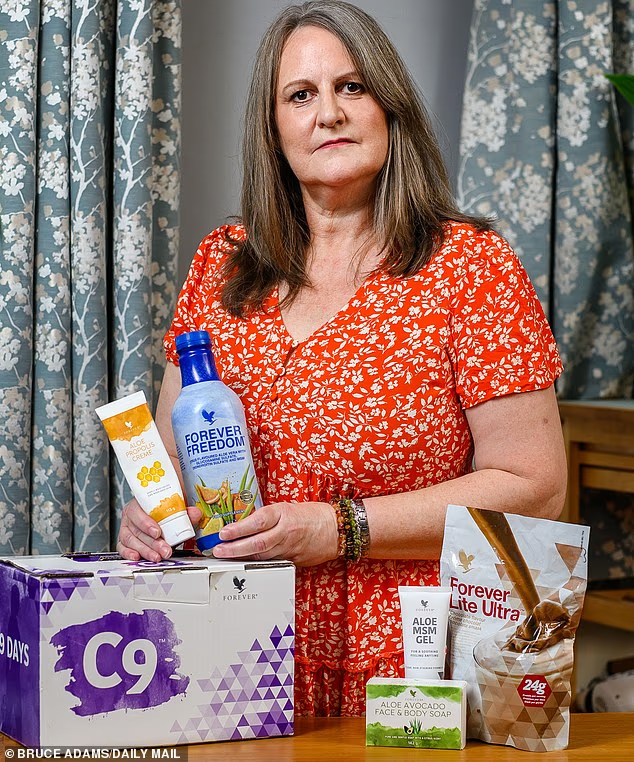
A Cheshire woman who joined the Forever Living MLM after being promised a lucrative home-based career says she spent £5,310.50 on products and selling equipment, but earned just £154.48 before leaving the business.
Alison Bryant, 57, from Warrington, had been unable to work for five years because of arthritis after her career as a carer came to an end. She says a representative told her she could eventually make £2,000 a month and one day afford the seaside cottage she had always wanted.
Forever Living, an American company selling aloe vera-based beauty, health and wellness products, operates through a multi-level marketing structure. Its representatives, known as Forever Business Owners, can earn money from product sales and by recruiting other people to join.
Alison says she had never heard of multi-level marketing when she signed up. “I hated being on benefits,” she said. “I thought this was something I could do from home.”
The company launched in the UK in 1992 and has an estimated ten million representatives worldwide. It has consistently rejected claims that it is a pyramid scheme, pointing to the physical products it sells.
However, critics argue that the distinction between selling goods and recruiting representatives can become blurred. Forever Living’s latest income disclosure statement, published in 2022, said 89.8 per cent of representatives received no “meaningful” income. Of the 10.2 per cent who did, 58.6 per cent earned less than £375 a year.
Forever Living representatives and income claims
Training material seen from this summer said new starters could earn between £75 and £300 a month, while earnings of up to £5,000 a month were described as possible within 16 weeks. A senior UK seller said in a video recorded in March that a £100,000 salary was possible for the “very ambitious”.
Forever Living said the £75 figure referred to potential retail profit from product sales, while its income disclosure statement measured bonus and incentive payments made by the company. It said the two figures were therefore not directly comparable.
In April, the US Federal Trade Commission prohibited Forever Living from making unsubstantiated earnings claims after accusing the company of misleading people about the money they could make. In May, the business stopped operating as an MLM in the US, although American representatives can still sell its products and cannot profit from recruitment.
Alison became interested in the business after meeting a representative, whom she has called Sarah, at a market last spring. She says the aloe vera products appealed to her because she disliked synthetic ingredients and believed a £27.09 drinking gel had helped problems linked to arthritis and fibromyalgia.
To join, she paid £172 for a “Start Your Journey Pack” containing two sets of ten products: one to try and another to sell to friends and family. She was also encouraged to compile a list of potential customers and join a WhatsApp group with other representatives recruited by Sarah.
Sarah had been with Forever Living for 13 years and had risen to manager, the fourth level of its sales structure. Alison says she was told that building a team was necessary for “lasting growth”, although the business was presented as one centred on selling products.
At a company “Success Day”, Alison says senior representatives told the audience they had left their jobs and achieved life-changing incomes. She was taken on stage and given a sash, despite having only bought a box of products at that point.
“Looking back, it was almost cult-like, but at the time I was inspired,” she said. “They all said they’d quit their day jobs and had life-changing incomes. One said she was earning £30,000 a month.”
Representatives were encouraged to create private social media groups and promote the products alongside images of successful lifestyles. Alison says she created a group for 20 friends but was uncomfortable with the approach because she considered herself a private person.
She instead concentrated on face-to-face selling. After two successful evenings at a hair salon, she sold more than £1,000 worth of products in one month. But she received only £70, equivalent to 5 per cent of her sales, and says some of the products had been bought by her for people to try.
Forever Living uses an internal currency of case credits, or CCs. Representatives must sell four CCs, worth about £630 of products, each month to remain active and receive sales bonuses.
Alison says customers were reluctant to make repeat purchases, with products including soap costing £6.83 and cleanser priced at £28.79. She also held ten market stalls, each costing about £35 to hire, and spent money on stock, a gazebo, furniture, branded materials and samples.
“The market was saturated,” she said. “Some days nobody bought anything. Some I just about made back the stall money. Every single penny I earned, I put straight back into products.”
She says she was encouraged to collect contact details through prize draws and follow up with entrants several times to persuade them to join the business. Alison declined to do so, saying entering a draw did not give permission for repeated contact.
She did not recruit anyone and says she used money from a pension she had begun drawing at 55 to pay for the business. When she raised concerns about her spending, she says she was told she was not giving the opportunity enough time.
“You’re not encouraged to look at the finances,” she said. “Anything you spend is seen as an investment. You’re told you need to buy the products to try them – or how can you sell them?”
Alison became increasingly concerned after watching training videos that she says focused on recruitment rather than the products. In one session, a senior representative reportedly said she had stopped memorising ingredients because “nobody cares”.
“That was a trigger for me,” Alison said. “I thought ‘I care’.”
She later searched for information about the company and discovered it was an MLM. She also found its income disclosure statement and details of the US regulator’s complaint, which alleged that Forever Living had used false and unsubstantiated earnings claims, including social media posts featuring luxury cars and large cheques.
Alison says she sent her concerns to Sarah, who removed her from the WhatsApp group within minutes. She alleges that Sarah accused her of making false claims. A dispute then unfolded on social media, where Alison says a photograph of her was posted with the word “vile”.
She also received an email from Forever Living’s compliance team asking her to avoid abusive comments towards other representatives and advising her to raise concerns directly with the company.
After checking her bank statements, Alison says she realised her total spending on products, travel, fuel and equipment was more than £5,000, rather than the £1,000 she had initially feared. She says all but £200 of her pension has now gone.
“It’s just so misleading and can potentially ruin you,” she said. “You can’t make real money selling products. You can only make money by recruiting a team. I believe it absolutely is a pyramid scheme.”
Forever Living said it had operated in the UK for almost four decades and took compliance, product quality and ethical business practices seriously.
The company said it was a member of the Direct Selling Association and committed to maintaining high standards and complying with legal and regulatory requirements. It added that it had policies covering product and income claims, data protection and the conduct of representatives.
It also said its products were manufactured in line with applicable safety and regulatory requirements and that it remained committed to maintaining high standards across its products and business opportunity.
