


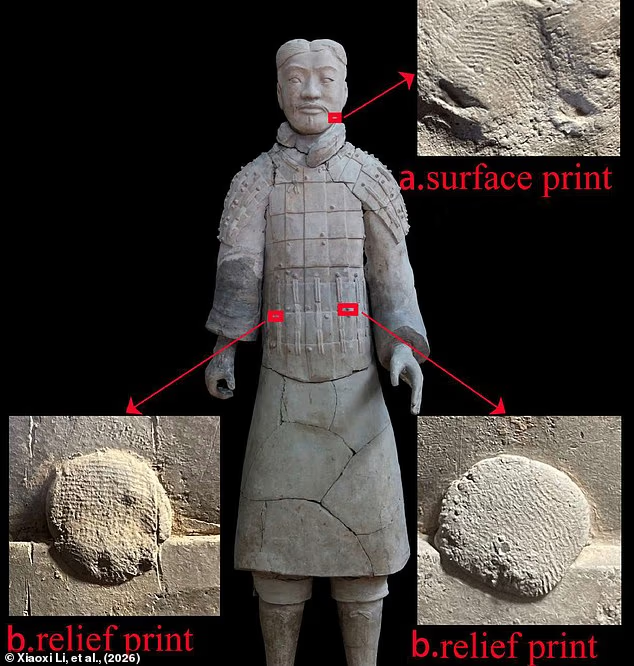
Fingerprints pressed into the Terracotta Army suggest that women and children played a significant part in building the vast funeral monument more than 2,200 years ago.
Researchers examined marks left in the wet clay by artisans working on the life-size figures, challenging the assumption that major construction projects in ancient China were carried out almost entirely by adult men.
The study, published in the Journal of Cultural Heritage, found that 45 per cent of the surviving fingerprints were attributed to adult men. Adult women accounted for nearly 33 per cent, while children under 15 left 22 per cent of the marks.
Fingerprints reveal workforce behind the Terracotta Army
The scientists analysed 79 fingerprints from 36 warriors, including marks found on the figures’ arms, heads and body armour.
They measured the distance between fingerprint ridges. Those gaps increase as children grow and also vary between men and women, allowing the researchers to estimate the age and sex of the people who made the prints.
Distinguishing adult women from children has proved difficult using this method because the spacing between their ridges can be similar. The researchers therefore used a statistical technique known as a Bayesian mixture model, which assesses the prints as a group and compares them with modern databases covering different ages and sexes.
The study’s authors said the findings indicated that the artisan community was “not exclusively composed of adult males”. They said the biological evidence supported historical records describing state-run workshops during the Qin Dynasty where men and women worked together, alongside adult artisans and juveniles who may have acted as helpers or beginners.
The Terracotta Army was commissioned by Qin Shi Huang, the first emperor of China, as part of a vast funeral complex. It was intended to guard him and fight his battles in the afterlife.
Construction began after the emperor took the throne at the age of 13 and is believed to have continued for about four decades. The three pits contain more than 8,000 soldiers, 130 chariots, 520 horses and 150 cavalrymen.
Archaeologists believe factory-like workshops may have mass-produced components such as heads and arms before they were sent elsewhere for assembly. Earlier research has distinguished between figures made by so-called royal potters, who marked their work with a special symbol, and those produced by local potters.
Each warrior was originally brightly painted with pigments made by grinding precious stones, although the figures are now reddish brown. The army was discovered by villagers in 1974 and excavation has continued since then.
The researchers cautioned that the fingerprint study is based on a small sample taken from a single area of the enormous complex. The prints could represent one workshop or a short period of construction rather than the workforce as a whole.
The mausoleum covers a vast area enclosed by a 6.3-kilometre wall and includes towers, stables and simulated rivers made from liquid mercury. The study’s authors said further sampling from other pits and workshops would be needed to assess how the workforce changed across different places and periods.
