


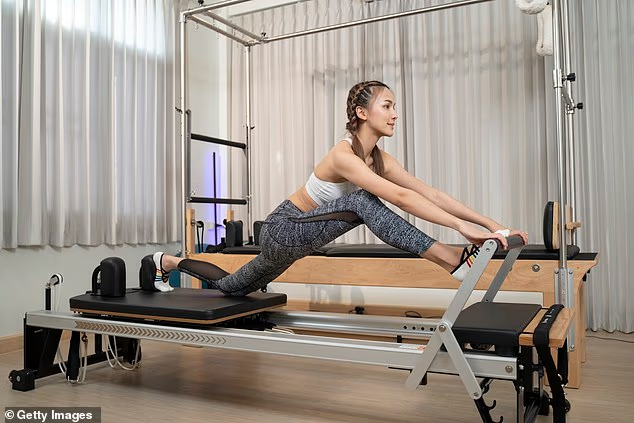
Reformer Pilates warning signs are being highlighted by an instructor who says constant soreness, pain and exhaustion can indicate that a workout routine is doing more harm than good.
As custom-built Reformer studios have spread across town centres and high streets, the exercise has become increasingly popular for building strength, mobility and stability. But Nikkii Behrens, founder of Rare Street Pilates, said the discipline’s principles can be undermined when classes become focused on intensity and exhaustion.
Behrens, who has practised Reformer Pilates for more than a decade, said progress should be measured through control, precision and sustainable recovery rather than the amount of sweat produced or how sore someone feels afterwards.
She warned that, when performed incorrectly, Reformer Pilates could lead to serious injury. These are the five signs she says should prompt people to reassess their routine.
Persistent soreness or exhaustion
Some muscular fatigue is normal, particularly when someone is trying a new exercise or increasing their training. However, Behrens said ongoing soreness and exhaustion could indicate that the body is not recovering properly between sessions.
“If you’re never fully recovering between sessions, your body may be signaling that the overall training load is too high,” she said.
She also advised people to consider whether they were attending the right class and working at an appropriate level if they had begun dreading their next session.
Every class feels harder than the last
Behrens said fitness culture could create the impression that progress always involved heavier weights, more difficult movements or an increased workload. In Pilates, she said, improvement could instead mean greater control, more accurate movement and a better range of motion.
“Sometimes making a movement slower and more controlled is far more challenging – and beneficial – than adding another spring,” she said.
She added that mastering the foundations was more important than attempting advanced exercises before the basics had been properly learned.
Pain rather than muscular discomfort
Repeated pain in the lower back, neck, shoulders, hips or knees should not be treated as a normal part of Reformer training, according to Behrens.
She said it could point to poor technique, unsuitable resistance or an exercise that was not appropriate for the individual at that time. A good instructor, she added, should be able to adapt an exercise rather than encourage someone to continue through pain.
Ignoring the body’s changing needs
Behrens said a person’s capacity to exercise could vary from one day to the next. Sleep, stress, recovery, the menstrual cycle, pregnancy, postpartum recovery and perimenopause or menopause could all affect how someone felt and what level of exercise was suitable.
She said this did not mean people should avoid challenging themselves, but that adjusting the intensity could sometimes be the more effective form of training.
Exercise becomes a form of punishment
Behrens described this as the biggest warning sign. Choosing a class because of guilt over food, feeling panicked after missing a session or judging a workout only by calories burned, sweat or soreness could all suggest an unhealthy relationship with exercise.
“Movement should be something that contributes to your health, strength and longevity rather than another way to punish your body,” she said.
She also rejected the idea that a successful Reformer class had to leave someone drenched in sweat or barely able to walk the following day. Sweat is primarily the body’s cooling mechanism, she said, while soreness is not a reliable measure of progress.
Behrens said people could become preoccupied with making exercises appear advanced before they had developed the necessary control and alignment. A well-executed basic movement, she argued, could be more valuable than a difficult variation performed with poor technique and momentum.
Although Reformer Pilates can help with strength, control, mobility and stability, Behrens said it should ideally form part of a broader routine that could include walking or cardiovascular exercise, as well as resistance and weight-bearing exercise depending on an individual’s goals.
“The best training isn’t necessarily the training that takes the most out of you – it’s the training your body can adapt to, recover from and keep doing consistently,” she said.
