


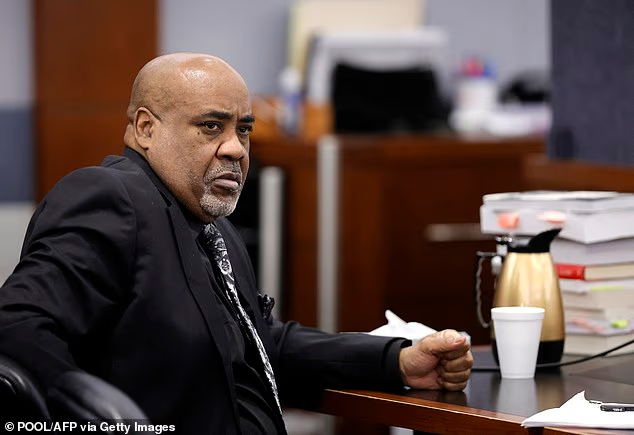
Duane “Keffe D” Davis has been found guilty of orchestrating the murder of Tupac Shakur, bringing the first conviction in one of hip-hop’s most enduring mysteries nearly 30 years after the rapper was gunned down in Las Vegas.
Davis, 63, was convicted of murder with the use of a deadly weapon in connection with the drive-by shooting. He was not accused of pulling the trigger, but prosecutors said he organised the attack, supplied the gun and directed those in the car to target Shakur and Death Row Records co-founder Marion “Suge” Knight.
The jury reached its verdict on Monday after hearing nine days of evidence from 24 prosecution witnesses and three witnesses for the defence. Davis could face life in prison, with sentencing to be decided by a judge at a later date.
Prosecutors said Tupac Shakur shooting was retaliation
Chief Deputy District Attorney Binu Palal told jurors that Davis set out to avenge an assault on his nephew, Orlando “Baby Lane” Anderson, at the MGM Grand earlier on the night of September 7, 1996.
Shakur and members of his entourage had been involved in the casino fight following a Mike Tyson boxing match. Prosecutors argued that Davis responded by obtaining a firearm and joining a white Cadillac that later pulled alongside the black BMW carrying Shakur and Knight.
“Who fired is not the question,” Mr Palal said during closing arguments. Under Nevada law, a person who helps another commit murder can be convicted of the crime.
The prosecution maintained that the attack was planned rather than spontaneous. The group had searched for Shakur before spotting the BMW, prosecutors said, and then made a U-turn to follow it.
“It’s a plan, not an impulse,” Mr Palal told the court.
Shakur was struck by multiple bullets while stopped at a red light near the Las Vegas Strip. He died six days later, aged 25. Knight was also wounded but survived.
Davis was the only surviving member of the four-man group prosecutors said had been inside the Cadillac. Anderson, whom investigators had long suspected of being the gunman, and the other two men in the vehicle have since died.
The case remained unsolved for decades until Davis began speaking publicly about the shooting. In interviews and in his 2019 memoir, Compton Street Legend, he said he had been in the Cadillac and handed a gun to men in the back seat.
His accounts varied over time. In some versions, Davis said Anderson took the weapon and fired. In others, he declined to identify the gunman or said he did not know who pulled the trigger.
Prosecutors argued that the changing details did not undermine the central account. Mr Palal said Davis repeatedly placed himself in the white Cadillac and acknowledged a role in the attack.
The state also relied on evidence about the rivalry between the South Side Compton Crips and Mob Piru, groups associated with the competing Death Row Records and Bad Boy Records camps.
A gang expert described Davis as a “shot caller” whose instructions younger members were expected to follow. Prosecutors also showed jurors footage from the MGM Grand depicting the confrontation involving Anderson and Shakur’s entourage.
Defence challenged lack of physical evidence
Davis’s lawyer, Michael Sanft, argued that the case depended too heavily on his client’s own claims and that there was no independent evidence placing him in Las Vegas or inside the Cadillac that night.
Mr Sanft pointed to the absence of phone records, reliable hotel documentation, surveillance footage from the shooting scene and other physical evidence linking Davis to the killing. A Las Vegas hotel bill found at Davis’s home during a police search was discussed at trial, but investigators could not establish when it was issued or where the original evidence was now held.
The defence portrayed Davis’s public statements as exaggerated boasts intended to sell his life story rather than truthful admissions. Mr Sanft also questioned the reliability of evidence collected during an investigation that was almost three decades old.
Prosecutors, however, urged jurors to consider Davis’s statements alongside the surrounding circumstances, including the earlier MGM Grand fight and the gang conflict that had intensified around the two record labels.
The verdict closes a case that has fascinated hip-hop fans and true-crime audiences since Shakur’s death. Members of the rapper’s family, including his stepbrother Mopreme Shakur, attended much of the trial.
Shakur, who was also an actor, was at the height of his career when he was killed. He went on to become one of the most influential figures in rap, with his music and legacy continuing to shape popular culture long after his death.
