


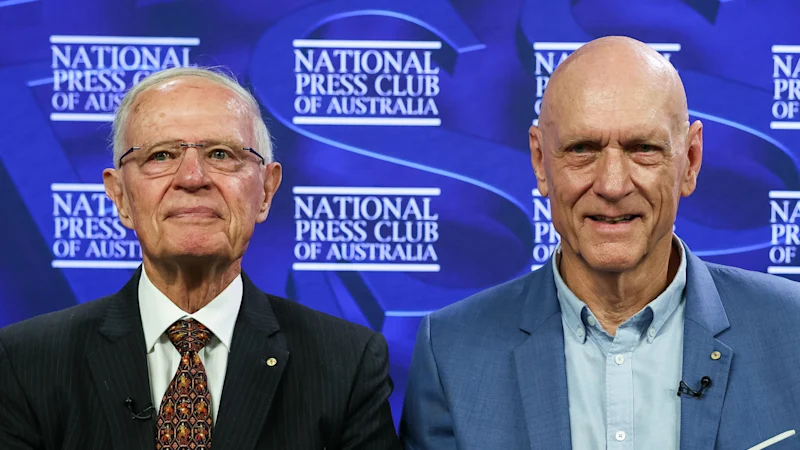
Australia should abandon the $368 billion AUKUS nuclear submarine pact and rethink its relationship with China, a public inquiry led by former Labor minister Peter Garrett and retired defence chief Admiral Chris Barrie has concluded.
The inquiry warned that the agreement could undermine Australian sovereignty and risk drawing the country into a military confrontation between the United States and China. It called for the submarine programme to be cancelled immediately, alongside a fundamental review of Australia’s defence strategy.
Speaking in Canberra, Admiral Barrie said Australia should not allow Washington to dictate its strategic priorities and needed to invest more heavily in diplomacy with Beijing.
“Whatever way you want to look at the future in this region, by 2050, China will be the world’s largest power, the world’s greatest power,” he said.
Admiral Barrie, who led the Australian Defence Force from 1998 to 2002, said he was concerned about the growing contest between the US and China. He argued that Australia needed a more sophisticated understanding of Beijing’s ambitions rather than viewing China’s rise solely through the lens of American strategic competition.
“I think we need to recalibrate the way we deal with China,” he said, suggesting Australia’s embassy in Beijing should become the country’s second-largest diplomatic mission, if not its largest.
Inquiry attacks cost and feasibility of AUKUS submarine pact
The report, titled Surrendering Australia: The AUKUS Deception, said successive Coalition and Labor governments had committed generations of taxpayers to an exceptionally expensive defence programme without properly assessing its cost, feasibility or implications for national independence.
It described the submarine acquisition as the “worst, riskiest and most costly” defence decision made by an Australian government, and claimed the programme could leave the Royal Australian Navy without an effective submarine fleet.
The inquiry recommended halting work on submarine construction facilities at Adelaide’s Osborne naval precinct and ending the deployment of Australian submariners on American vessels. It also called for a royal commission into AUKUS and an investigation of its costs by the Australian National Audit Office.
Among its 17 recommendations was a proposal to develop a cheaper replacement for the ageing Collins-class submarines. The report also urged a review of the separate AUKUS agreement covering advanced defence technologies.
The inquiry questioned whether the delivery timetable could be met and warned that operating three different classes of submarine could place excessive pressure on Australian defence personnel and resources.
Under the current plan, Australia is due to receive its first US-built Virginia-class submarine in 2032, followed by another every four years until the country’s own fleet becomes operational. The first Australian-built SSN-AUKUS submarine is scheduled to enter service in 2042.
The report also warned that the US and Britain could withdraw from the agreement without supplying the promised submarines while retaining billions of dollars for their own shipbuilding industries.
Government defends AUKUS as vital to national security
Mr Garrett, a former minister and frontman of Midnight Oil, criticised the lack of debate over AUKUS within the Labor Party and government. He said the evidence presented to the inquiry had confirmed his original concerns about the agreement.
“My major objection to AUKUS in the first instance was that there was no debate,” Mr Garrett said. “Where was the vigorous debate in the caucus? Where was the vigorous debate in the cabinet? We don’t have any sense that there’s been a debate.”
He said the programme’s cost, the lack of clarity over radioactive waste storage and the terms of the agreement showed it was fundamentally flawed, describing it as “a complete absolute crock”.
The public inquiry was convened by the Australian Peace and Security Forum. It received more than 1,000 written submissions and heard evidence over 10 days in eight cities, with organisers raising $220,000 to finance the exercise.
A government spokesperson rejected the inquiry’s conclusions, saying AUKUS had already undergone extensive parliamentary scrutiny and remained essential to addressing Australia’s most serious strategic challenges since the Second World War.
The government defended the pact’s cost, saying it would strengthen the Australian Defence Force’s ability to project power, support regional security and create about 20,000 direct jobs across industry, defence and the public sector over the next three decades.
