


Donald Trump’s proposal to give every adult American $5,000 (£3,700) if Republicans retain control of Congress has been condemned as an unfunded electoral bribe, as the party faces mounting pressure ahead of November’s mid-term elections.
The payment, which Trump has presented as a “Trump dividend”, would apply if voters keep both the House of Representatives and the Senate in Republican hands. The proposal comes as senior Republicans fear Democrats could take control of both chambers.
The House was already considered vulnerable because the Republican majority is narrow and the party occupying the White House traditionally suffers losses in mid-term elections. The Senate, once viewed as safer, is now also regarded by Republican strategists as being at risk.
A Democratic victory in both chambers would leave Mr Trump facing much tighter congressional scrutiny during the final two years of his presidency. Committees would be expected to investigate the President, his family and associates, including allegations concerning personal enrichment while in office.
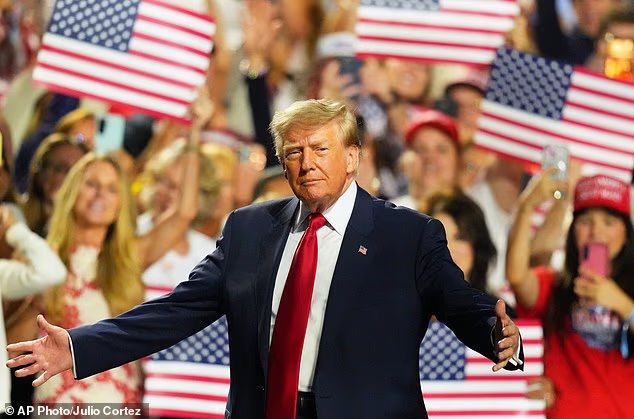
The prospect has prompted an unusual two-day Republican rally in Dallas, Texas, where candidates from marginal constituencies were promoted and Mr Trump placed himself at the centre of the party’s campaign despite not standing for election.
The funding challenge behind Trump’s $5,000 proposal
There are about 245 million adult citizens in the United States, meaning the proposed payment would cost roughly $1.2 trillion. The central question is how such a sum would be financed.
Vice-President JD Vance said on Fox News that tariffs imposed by the Trump administration were generating substantial revenue and helping to reduce the national debt. He also told voters that they would share in the resulting wealth if Republicans remained in control of Congress.
Critics argue that the figures do not support that explanation. Tariff income had been expected to reach about $400 billion over this year and next, but court rulings declaring some tariffs unlawful have led to refunds and could reduce the total to about $200 billion a year.
That revenue has already been allocated towards offsetting part of the cost of Mr Trump’s tax cuts, according to the analysis. The United States continues to run a federal budget deficit of about $2 trillion a year, while the national debt has risen from $36 trillion when Mr Trump began his second term to $40 trillion less than 20 months later.
Financing the proposed payment would therefore require borrowing a further $1.2 trillion on top of the planned deficit and existing debt. The proposal has also been criticised as a misuse of the term “dividend”, because the federal government does not generate profits to distribute to citizens.
It follows two earlier promises of payments to American voters. During the early part of Mr Trump’s second term, voters were told they could receive $5,000 from savings that Elon Musk was expected to make by cutting federal spending, but the projected savings did not materialise on that scale.
In November, Mr Trump also said tariff income would fund a $2,000 payment to every voter. That promise was not fulfilled, and the latest proposal would more than double the amount despite tariff revenues falling short of earlier expectations.
Republicans are also facing difficulties over the wider political climate. Mr Trump’s approval rating is below 40 per cent, while support for his handling of issues linked to the cost of living is below 30 per cent.
Fuel prices, inflation and the war with Iran are contributing to concerns about the administration’s record. At the Dallas rally, Mr Trump acknowledged that the conflict would continue beyond the mid-term elections, meaning further economic pressure could come before voters go to the polls.
The party needs support from independent voters as well as a strong turnout among the MAGA base. But Mr Trump’s decision to make the mid-terms a referendum on his second term risks further weakening Republican support among those voters, according to the assessment.
Republican officials are said to be concerned that the President has focused on plans for a White House ballroom and a triumphal arch in Washington while voters remain preoccupied with grocery and fuel prices.
With the Republican Party’s prospects worsening and Democrats threatening both chambers of Congress, the $5,000 proposal has been portrayed as a sign of political desperation. Even if Republicans retain control, doubts remain over whether the government could raise the money required to deliver it.
