


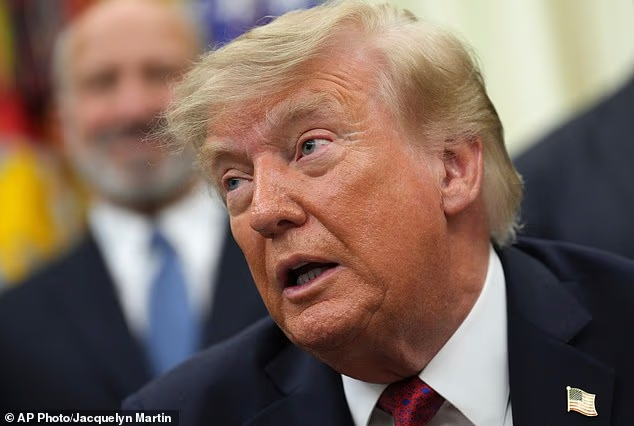
Donald Trump’s uncompromising defence of America’s data-centre boom is widening a political faultline within the Republican Party, as candidates face mounting anger over electricity bills, water use and the spread of vast industrial sites across rural communities.
The President dismissed opponents as people who wanted to remain “backwards and poor” in a social-media post after a Fox News discussion highlighted complaints from residents in Virginia, including Greg Pirio of Loudoun County, who raised concerns about noise and pollution.
“The only reason that communities throughout the USA should not want data centres is if they want to end up being backwards and poor,” Mr Trump wrote. “If they want to be successful and rich, with far lower taxes and jobs all over the place, let Data Reign.”
He added: “If we kill the Golden Goose, you will only have yourselves to blame,” while warning that China would welcome an American backlash against the facilities.
The intervention has complicated efforts by Republican strategists to develop a more measured message on data centres before November’s midterm elections. Behind the scenes, party consultants have been advising candidates to insist that technology companies pay for their own power and water, while ensuring that any financial benefits are returned to local communities.
Mr Trump’s message contained none of that reassurance. Instead, he portrayed resistance to data centres as a rejection of economic progress, reflecting his administration’s belief that artificial intelligence is central to America’s competition with China.
Republicans fear data-centre backlash
One Republican strategist said the President’s political advisers had persuaded him to support artificial intelligence and data-centre construction without qualification.
“His team has convinced him to go all in for AI, all in for data centres,” the strategist said. “He’s in a bubble.”
The remarks have already drawn criticism from within the President’s own party. Representative Tim Burchett, a Tennessee Republican who has backed Mr Trump on many issues, responded when asked about the comments: “I guess I’m backwards and poor.”
Mr Burchett said data centres should be considered for military installations and argued that the industry had failed to explain its benefits to the public.
Other Republicans are attempting to distance themselves from the President’s position. In Texas, Attorney General Ken Paxton has proposed repealing tax incentives for technology companies, despite previously supporting a sales-tax exemption for data-centre projects.
In Ohio, Democratic Senate candidate Sherrod Brown has made Republican Senator Jon Husted’s record on the industry a central line of attack, branding him “the face of data centres”. Mr Husted helped recruit projects to the state while lieutenant governor and supported tax and regulatory incentives.
Mr Husted has since softened his position, saying the industry had “earned that backlash” by failing to explain its benefits and by not doing enough to cover the cost of new power infrastructure. He has argued that local residents should ultimately decide whether projects go ahead.
In Michigan, Democratic Senate candidate Abdul El-Sayed has also attacked Republican rival Mike Rogers over his links to technology companies, accusing him of putting the interests of Donald Trump and Big Tech ahead of local voters.
The Republican concern is underlined by an internal National Republican Senatorial Committee memo warning that data centres could become a “sleeper issue for the entire election cycle”. The document said Democrats had made the projects a centrepiece of their campaign against Mr Husted and urged technology companies to explain “who benefits, who pays, and why a community should want one”.
More than 4,000 data centres are operating across the United States, with thousands more proposed or under construction, according to the memo. The facilities are designed to provide the computing power needed for artificial intelligence but can consume enormous quantities of electricity and water.
The Department of Energy said data centres used about 4.4 per cent of US electricity in 2023. That figure could rise to between 6.7 and 12 per cent by 2028, as demand for AI services and other digital products grows.
For residents, the issue is increasingly linked to the cost of living. Projects can require major investment in power generation and transmission, while opponents fear that the expense will be passed on through higher household bills. Some communities have also objected to the loss of farmland and the arrival of warehouse-sized buildings that provide relatively few permanent jobs.
A Gallup survey published in May found that 71 per cent of Americans opposed building an artificial-intelligence data centre in their local area, including 48 per cent who were strongly opposed. Opposition was higher than for a nuclear power plant, with 53 per cent saying they would object to one being built nearby.
Gallup found that opponents most commonly cited excessive use of energy and water, pollution, damage to quality of life and the possibility of higher utility bills. Supporters, by contrast, mainly pointed to jobs and increased tax revenue.
The White House has sought to address those concerns through its Ratepayer Protection Pledge, under which data-centre operators and technology companies are expected to fund the electricity generation and infrastructure required by their projects rather than leaving the burden to ordinary customers.
Administration officials say the policy will protect consumers while allowing the United States to expand its AI capacity and maintain an advantage over China. But Republican consultants fear that voters will remember the disruption and expense of new projects more readily than promises of future economic gains.
One strategist warned that disillusioned rural Republicans could simply stay at home during the midterms if they believe the party is siding with technology companies against local communities.
Mr Trump, however, appears to be thinking beyond the immediate electoral calculation. A former White House official said he viewed data centres and artificial intelligence as part of a wider economic programme built around reindustrialising America, creating blue-collar work and strengthening the country’s technological and strategic position.
