


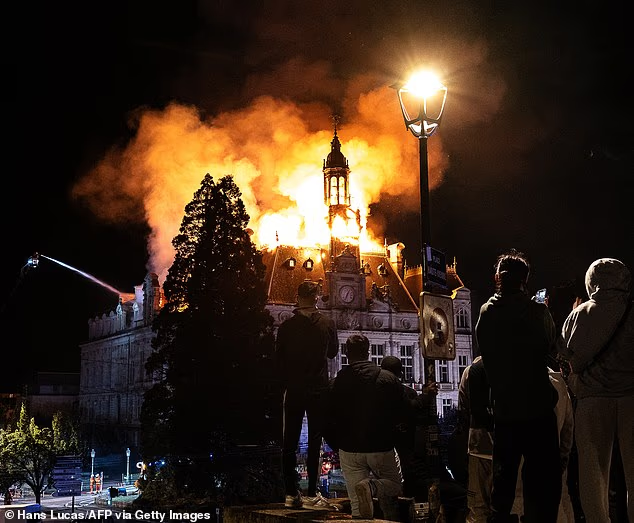
Two men have been arrested in connection with the fire that destroyed Limoges town hall during protests in France, as investigators examine alleged links between the attack and ultra-Left groups operating in rural communities.
Hodei Ciarra Docampo, 34, was detained at his parents’ home in Le Grand Pic, a remote hamlet in the Limousin region. A second suspect, a 66-year-old local man whose name has not been released, was arrested several days later in Gentioux-Pigerolles, about 75 miles away.
Both men were being held in custody under revised laws allowing people suspected of riot-related offences to be detained for longer without charge. Docampo is being investigated for arson and attempting to murder police officers, while the older man is accused of damaging the town hall and endangering life.
The arrests followed the destruction of Limoges’ 143-year-old civic building on October 17. Mayor Guillaume Guerin said about 20 elected officials and police officers were inside when the building was stormed and set alight.
He said those responsible arrived with fuel and a battering ram and appeared to have planned the attack in advance. The mayor also claimed that members of the crowd shouted threats as flames took hold.
“They knew exactly what they were doing,” Mr Guerin said. He added that he had received death threats on social media after the incident.
Suspect arrested in remote Limousin hamlet
Police carrying out the first operation found that Docampo was not in the cottage he shared with his parents. Officers later discovered him asleep in a hut in the garden and took him into custody.
Adrian Maxwell, a retired City of London Police detective and criminal barrister who lives nearby, said he saw heavily armed officers wearing balaclavas and bullet-proof vests during the raid.
Mr Maxwell said he initially understood only that a major police operation was under way. He later learned that the officers were searching for a man suspected of involvement in the Limoges fire.
Le Grand Pic contains around two dozen stone houses and has no shop, church or bus service. The hamlet was once a farming community but is now home to New Age residents, including English people living off-grid in yurts in the surrounding forest.
Docampo’s mother said her son was innocent and described the raid as terrifying. “He is innocent, this is a fit-up – he is a calm, gentle person,” she said.
His father also rejected the allegations, saying: “They don’t want responsible justice. This is all about repression – they just need a scapegoat. Why would my son do this? He is a pacifist.”
Docampo was convicted last year of punching a police officer during a demonstration, according to the account provided. His parents nevertheless said they believed he had been wrongly targeted.
The second arrest took place at Gentioux-Pigerolles, a village of 398 people on the Plateau de Millevaches. Police searched a disused property and a yurt reportedly owned by Docampo after detaining the local suspect.
The plateau has previously been associated with ultra-Left activism. Julien Coupat was accused of leading a group that sabotaged a high-speed railway line in 2008, although he was acquitted after a ten-year legal battle.
Separate attacks in the area targeted a logging company and a cross-country motorbike race. In another case, saboteurs destroyed vehicles belonging to France’s state-owned electricity grid company and an aerial used to transmit television and mobile phone signals.
A 57-year-old school headmistress was among those arrested in that investigation. She was supported by local residents, who protested outside court and daubed anti-police slogans on the school walls.
Her co-defendant was Fernando Ciarra Ramirez, Docampo’s father. Ramirez, now 70, was reportedly a former Basque separatist who moved to France with his wife. He received a three-year suspended sentence for destroying vehicles and antennae and called for “all people to civil resistance and disobedience”.
Wider unrest across France
The Limoges blaze was part of a wider wave of unrest that spread through towns and cities from the Channel to the Mediterranean. Buildings seen as symbols of the state, including banks, public offices and Republican Guard barracks, were targeted.
French intelligence officers, academics and politicians have warned that organised ultra-Left groups may be attempting to exploit anger over the cost of living, public services and school conditions.
President Emmanuel Macron accused organised groups on the radical Left of seeking to bring down the Republic. Prime Minister Sebastien Lecornu also said they were pursuing an agenda intended to destabilise the country’s institutions.
Cannes mayor David Lisnard, who was born in Limoges and is a Right-of-centre candidate in next spring’s presidential election, claimed that secret training camps for ultra-Left activists operated in the sparsely populated region. The claim has not been established.
Jean-Luc Melenchon, leader of the far-Left France Unbowed party, is expected to visit a pacifist war memorial in Gentioux-Pigerolles on Armistice Day, as he did in 2024. His planned appearance has drawn attention because of the area’s history of alleged anarchist activity.
Police said 2,400 rioters had been arrested after the latest disturbances. Authorities estimated that 80 per cent were opportunists or people angered by wider social conditions, while the remainder were hardened anarchists, some of whom had travelled from abroad, including Britain.
Those appearing in court included a chef who travelled to Paris with ingredients for a homemade Molotov cocktail, two students found with a gas mask and knuckledusters, and a music student carrying sulphur and ammonia who said he intended to make stink bombs.
Some suspects were sent directly to prison after judges followed the justice minister’s call for tough exemplary sentences. Others remained free.
Investigators also believe protesters used mobile applications to track the movements of riot police, circulate false warnings and direct crowds towards areas where violence could intensify. A militant Left-wing website claimed that police had failed to regain control during the disturbances.
The Limoges investigation is now focused on whether the attack was carried out by a wider network rather than by isolated rioters. The mayor has said the building was deliberately selected as a symbol of the French establishment, while the arrested men deny responsibility or have not been charged.
