


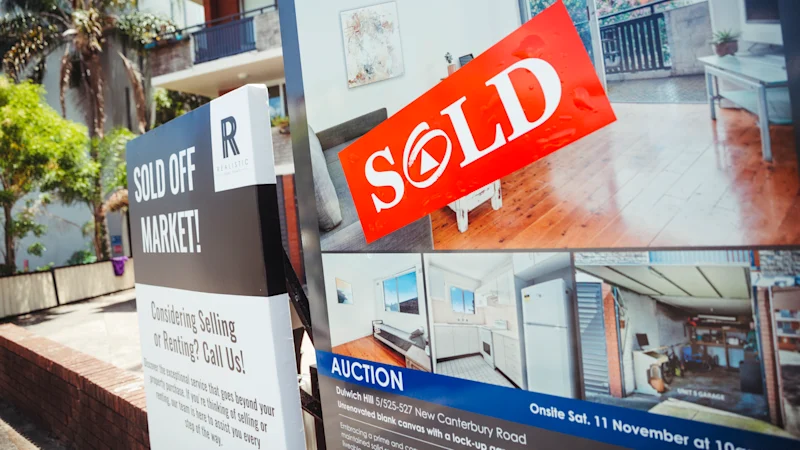
Housing affordability in Australia has fallen to its lowest level on record, despite house prices beginning to decline as higher interest rates erode the borrowing power of would-be buyers.
Separate measures from realestate.com.au and the Housing Industry Association show that the deterioration continued in the June quarter, with Sydney remaining the country’s least affordable capital. Brisbane and Perth have also moved close to Sydney after house prices in both cities rose by more than 20 per cent over the past two years.
The figures cover the period in which the Reserve Bank of Australia increased its cash rate three times, from 3.6 per cent to 4.35 per cent. Mortgage costs have risen faster than incomes, more than offsetting the benefit of softer prices in several markets.
The HIA’s affordability index fell by 3.1 per cent during the quarter, leaving housing at its least affordable level since the organisation began recording the measure in 1994. Its figures show that a mortgage on a median-priced home in a capital city now requires the equivalent of 1.9 average incomes to service comfortably.
Realestate.com.au found that a household earning the median income of $125,000 could afford only 12 per cent of homes sold during the 2025-26 financial year. That was down from the previous year, when affordability improved slightly as official interest rates fell.
Victoria was the most affordable state, but even there the proportion of homes within reach of a median-income household dropped from 19 per cent to 16 per cent. South Australia, where property prices have surged in recent years, overtook New South Wales as the least affordable state, with only 7 per cent of homes considered affordable.
It now takes a typical household slightly more than six years to save a 20 per cent deposit on a median-priced property, compared with three years at the beginning of the century.
Angus Moore, senior economist at realestate.com.au, said the Reserve Bank’s rate rises in February, March and May had added to the pressure on prospective buyers.
“Looking ahead, affordability may improve marginally if home prices continue to soften, but this is unlikely to be a turning point for many buyers,” he said.
Mr Moore said a substantial increase in housing supply would be needed to ease the problem, particularly for households on lower incomes.
Falling prices fail to deliver meaningful relief
Property values have declined for five consecutive months, according to figures from Cotality, while the Commonwealth Bank has forecast that Sydney prices could fall by as much as 13 per cent by April.
But the HIA said the falls had not been large enough to counter the impact of higher repayments. Affordability worsened in every market during the June quarter, including Sydney, Melbourne and Canberra, where dwelling prices had already begun to decline.
Darwin recorded the sharpest quarterly deterioration, followed by regional Western Australia and regional Tasmania. Over the year, affordability declined most severely in Perth, regional Western Australia, Darwin and Brisbane.
Tom Devitt, the HIA’s senior economist, said the latest figures showed the difference between lowering prices and lowering the underlying cost of housing.
“This will not be the makings of a sustainable improvement in affordability because it does not address the fundamental demand-supply mismatch that persists in Australian housing,” he said.
Mr Devitt warned that falling established-home prices could make fewer new housing projects financially viable if the costs of land, labour, materials, infrastructure, finance and regulation remained high.
The pressure appears to be spilling into the labour market. Australian Bureau of Statistics figures showed that the number of people holding more than one job reached a record 1.05 million, with the multiple-job-holding rate rising to 6.9 per cent — about one person in 14.
Secondary jobs increased by 11.7 per cent over the year to June, according to the bureau, as the number of people taking on additional work continued to rise.
The federal government has faced accusations from the Coalition that its housing and taxation policies are intended to push prices lower and damage the wealth of homeowners.
Housing Minister Clare O’Neil rejected the suggestion that the government’s budget measures were responsible for the latest deterioration. She said reforms affecting property taxation, alongside plans to expand public and social housing, reflected the fact that home ownership had moved beyond the reach of too many ordinary Australians.
“The challenge we face is that Australian house prices have increased by around 400 per cent since 2000,” Ms O’Neil said. “If that happens again over the next generation, Australia will become a fundamentally less equal country where home ownership is beyond the reach of too many young people.”
