


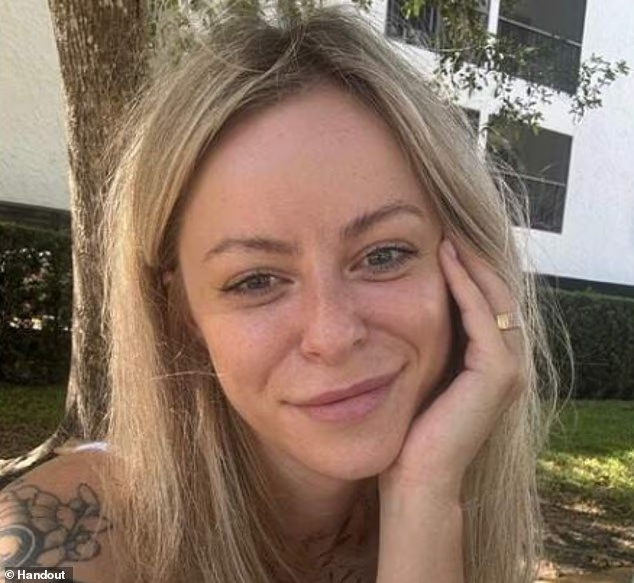
A Belarusian asylum seeker detained by US immigration authorities is facing a medical crisis, with her partner warning that she could die if she does not receive the medication required after cancer treatment.
Katsiaryna Bartko, 33, is being held at a CoreCivic-operated Immigration and Customs Enforcement (ICE) facility in Leavenworth, Kansas. She has no criminal conviction and is due to appear at an asylum hearing on 28 September 2026.
Bartko had her thyroid and parathyroid glands removed during treatment for cancer and has since depended on daily hormone replacement medication and calcium. Her partner, Dmitry Shyshov, said her health had deteriorated in detention.
“It’s very hard to hear every morning her voice fading,” he told the Kansas City Star.
Court records show that Bartko filed a petition for a writ of habeas corpus in the US District Court for the District of Kansas on 7 August, alongside a request for urgent relief over her detention and medical treatment.
The case was assigned to District Judge John W Lungstrum, who ordered the US government to respond. The government filed its response on 11 August, while a hearing on the motion was later scheduled.
According to court documents cited by the Kansas City Star, a blood test taken on 11 August recorded Bartko’s thyroid-stimulating hormone level at 148.77 mIU/L — around 30 times the upper limit regarded as healthy.
Sarah Raza, a trauma and vascular interventional radiologist with Physicians for Human Rights who reviewed Bartko’s medical records, said her hormones were “extremely poorly regulated”. She said the results raised concerns about neglect and warned of the risk of a potentially fatal myxedema coma caused by severe hormone deficiency.
Bartko’s supporters say she was taken to hospital three times in four days, between 6 and 9 June, after allegedly being denied parts of her prescribed treatment while held in Florida. Medical records included in court filings reportedly show that she was later transferred to Kansas on 18 June.
She was arrested in Miami on 5 May over a misdemeanour charge linked to what was described as a domestic dispute. The charge was subsequently dismissed, but ICE took her into custody on 4 June, citing the expiry of her F-1 student visa while her asylum application remained pending.
Bartko entered the US in March 2022 after leaving Belarus, where she had publicly opposed President Alexander Lukashenko’s regime and Russia’s invasion of Ukraine. She initially travelled to New York before going to the University of California San Diego to study English.
A fundraising campaign organised by Shyshov says Bartko belonged to opposition networks that the Belarusian authorities have branded “extremist”. It claims friends with similar political views have been detained and that officials visited her parents’ home looking for her after she left the country.
The campaign alleges that Bartko has repeatedly been denied medication at the Leavenworth facility and was told to “stop making medical inquiries” when she asked for it. It also claims she was billed for hospital treatment which should have been covered by ICE.
Shyshov has told the court that Bartko went for about 72 hours without her full prescribed regimen during her transfer to Kansas. A facility doctor reportedly later confirmed the risk of another life-threatening episode and recommended urgent oncology and endocrinology assessments.
The Kansas City Star reported that ICE acknowledged Bartko had not been examined by an outside specialist since her arrival at the facility. In a sworn filing, an ICE deportation officer said the consultations were considered routine rather than urgent and should take place within 12 weeks under CoreCivic policy.
CoreCivic spokesman Ryan Gustin said the detainee was being regularly monitored and that “all known medical issues” were being addressed. The company has also cited medical privacy laws in declining to respond in detail to the allegations about withheld medication.
Bartko’s bond application was denied on 22 July after a judge found a risk that she might not attend future proceedings, citing her moves between several US states and limited ties to any one community, according to the website set up to support her case.
Shyshov has urged the court to release his partner so she can receive consistent treatment outside detention.
“Katsiaryna came to this country asking for protection. Instead she is sick, alone, and being punished for needing the medicine that keeps her alive,” he said in the fundraising appeal.
