


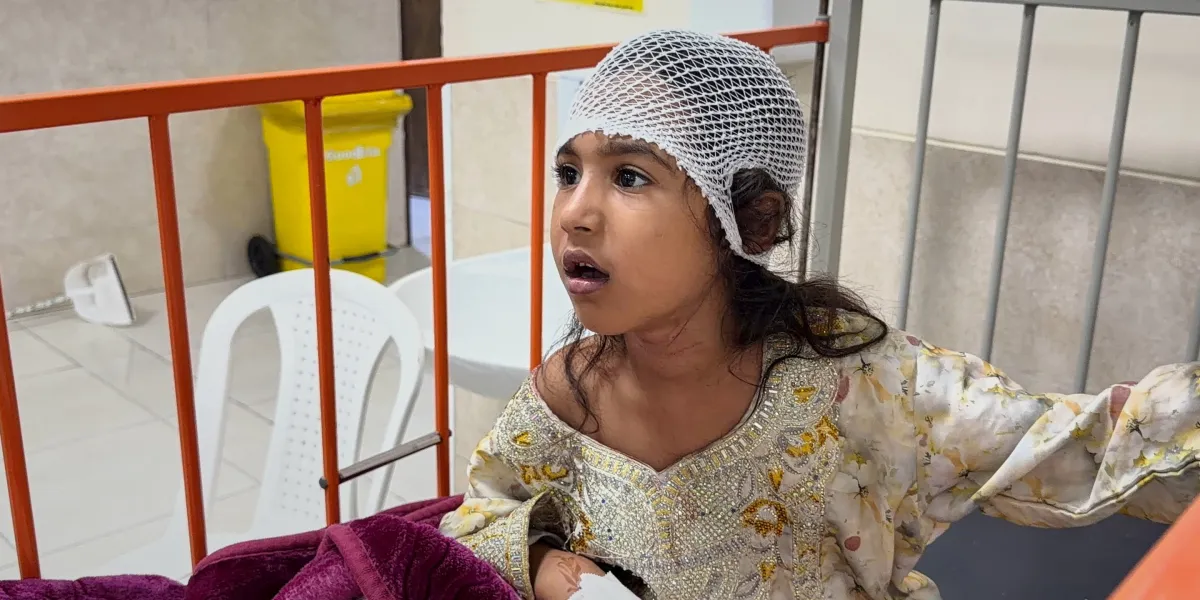
Iran launched missile and drone attacks against US allies in the Gulf on Wednesday after overnight American strikes that Tehran said hit a house hosting a wedding in the coastal town of Kuhestak, killing four people and injuring at least 68.
The exchange marked the sharpest escalation in a month and raised fresh fears that the six-month conflict could develop into a wider regional war. Targets and reported incidents included Jordan, Bahrain, Kuwait and the Iraqi Kurdish city of Irbil.
Iranian state media said the dead in Kuhestak, in Hormozgan province, included two women and two children aged four and 16. The reported death toll was initially given as five by the province’s deputy governor before being revised, without explanation.
Images circulated by Iranian media showed extensive damage to the home, including a hole in the roof, while injured children were treated at a hospital in nearby Minab. The Iranian Red Crescent also released footage of rescue workers searching the wreckage.
The United States has not confirmed that the wedding party was hit. Captain Tim Hawkins, a spokesman for US Central Command, said the military was aware of reports originating from Iranian state media and was looking into them.
Weapons specialist N.R. Jenzen-Jones said fragments shown in photographs appeared to come from an American air-delivered guided weapon. He initially identified the munition as a SLAM-ER cruise missile but later said it was more likely to have been a Joint Standoff Weapon, while cautioning that more than one weapon may have struck the site.
Washington said its latest bombardment was directed at Iranian military infrastructure, including air-defence positions, radar systems, maritime assets, mine-laying equipment and communications sites. The strikes followed an American attack on Iranian rocket launchers on an island in the Strait of Hormuz, which the US said were being prepared for use in laying mines.
Iran responded by firing missiles at American bases in Jordan, with the projectiles intercepted, before reporting further attacks on Bahrain and Kuwait. Jordan said 13 ballistic missiles entered its airspace, while Bahrain said its air defences had destroyed Iranian drones. Kuwait reported confronting Iranian drones and said a fire at a residential complex in the capital had been brought under control.
Kurdish authorities in Irbil said they had intercepted 10 explosive-laden drones. Iranian television reported that US bases in the area had been targeted, although the claims of casualties were not immediately confirmed by American or Iraqi officials.
The United Arab Emirates condemned the attacks, calling them a violation of the sovereignty of neighbouring countries and a threat to regional security. Iran’s recently appointed Supreme National Security Council chief, Mohsen Rezaei, warned that Tehran’s response would undermine the foundations of its opponents.
Strait of Hormuz disruption sends oil higher
The confrontation has centred increasingly on the Strait of Hormuz, the narrow waterway through which about a fifth of the world’s traded oil passed before the war began.
Shipping traffic has fallen sharply despite repeated US assertions that the route remains open. Data cited by The National showed the number of vessel crossings dropping from 23 on Wednesday last week to about five on Tuesday.
Brent crude rose above 95 dollars a barrel on Wednesday, extending a surge of more than 30 per cent since the start of the war. The renewed fighting has increased concern that mines, missile attacks or strikes on shipping could disrupt energy supplies from the Gulf.
Saudi shipping company Bahri said two Filipino crew members were killed when its supertanker Sidr was attacked while passing through the strait on Monday. Saudi Arabia condemned what it described as Iran’s targeting of the vessel.
Iran’s economy has also come under mounting pressure from sanctions and an American naval blockade. Traders in Tehran were exchanging about 2.20 million rials for one US dollar on Wednesday, a further fall in the currency’s value.
US Secretary of State Marco Rubio said Iran would continue to face pressure until it abandoned any ambition to develop nuclear weapons and ended its support for armed groups across the Middle East. Tehran has consistently said its nuclear programme is peaceful.
Analysts warned that the pattern of strikes, retaliation and short-lived pauses could become increasingly difficult to contain. Hamidreza Azizi, a senior Iran analyst at the Crisis Group, said either side could eventually decide that escalation was necessary to break the cycle, risking a move towards full-scale war.
Efforts by Pakistan to revive negotiations have so far failed to produce a lasting ceasefire. President Donald Trump said on Tuesday that he would not force Iran back to the negotiating table, claiming the US had “almost total control” of the Strait of Hormuz while Iran’s economy was collapsing.
