


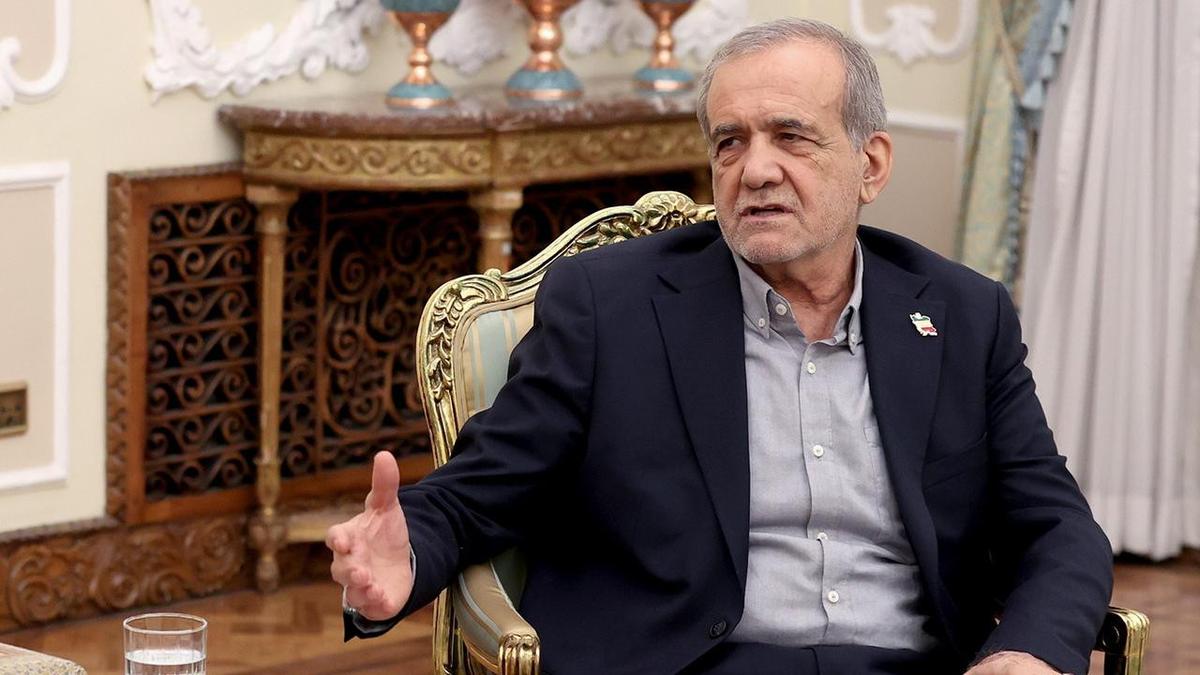
Iran remains open to a negotiated end to its conflict with the United States, President Masoud Pezeshkian said on Monday, after the two countries exchanged fire for the first time since late July and oil prices rose by more than 3.5 per cent.
Speaking to India’s prime minister, Narendra Modi, on the sidelines of a regional security summit in Kyrgyzstan, Mr Pezeshkian said Tehran did not believe further fighting was in the interests of Iran, the region or the wider world.
“Nevertheless, we are still trying to achieve an agreement and understanding,” he was quoted as saying by Iran’s Tasnim news agency. “We believe the solution to the existing issues is dialogue and co-operation and that every capacity must be used to prevent the spread of insecurity and conflict.”
His comments followed overnight US strikes on two Iranian missile launchers on Larak Island, in the Strait of Hormuz. A US official said the operation was carried out after Revolutionary Guard forces were seen preparing to launch rockets carrying sea mines into the strategically important waterway.
Iranian media reported that Tehran responded by striking two US bases in Jordan. Iran’s IRNA news agency said two people had been killed and others wounded in the attack on Larak, quoting the island’s governor.
A senior Iranian source described the exchanges as a “limited and contained confrontation”, but warned that Iran would respond harshly if it came under further attack.
The US Central Command said its forces had taken “limited, precise” action against mine-laying units that posed an “imminent threat” in the strait. The command did not provide further details.
The latest escalation was accompanied by a social media intervention from US President Donald Trump, who posted an apparently AI-generated video purporting to show Iran’s major oil hub at Kharg Island being destroyed.
There was no evidence that Kharg had been attacked. A US official said the island had not been among the targets of the overnight strikes, while Hamid Bovard, chief executive of the National Iranian Oil Company, dismissed the post as “laughable” and said conditions on Kharg were calm.
Vice-President JD Vance said the post was intended to send a message to Tehran, although he acknowledged that Mr Trump did not normally announce military operations through social media.
Kharg is central to Iran’s energy trade and handled about 90 per cent of the country’s oil exports before the conflict began. Any attack on the island could cause serious disruption to Iran’s economy and add to pressure on global energy markets.
The Strait of Hormuz, through which roughly a fifth of the world’s crude shipments normally pass, has been largely blocked since the war began. The disruption has fuelled concern over further rises in oil and shipping costs.
Washington has also stepped up its economic campaign. The US Treasury said on Friday that it was targeting access to UAE banking services linked to Iran, including a proposal to cut Banque Misr UAE off from correspondent banking with US financial institutions.
The European Union said on Monday that it would continue working with the United States and other partners to maintain economic pressure on Tehran, while stressing the need for diplomacy, regional de-escalation and safe navigation through the Strait of Hormuz.
US Treasury Secretary Scott Bessent has said further secondary sanctions are expected to be announced regularly, initially focusing on banks, as Washington seeks to tighten the financial pressure on Iran.
