


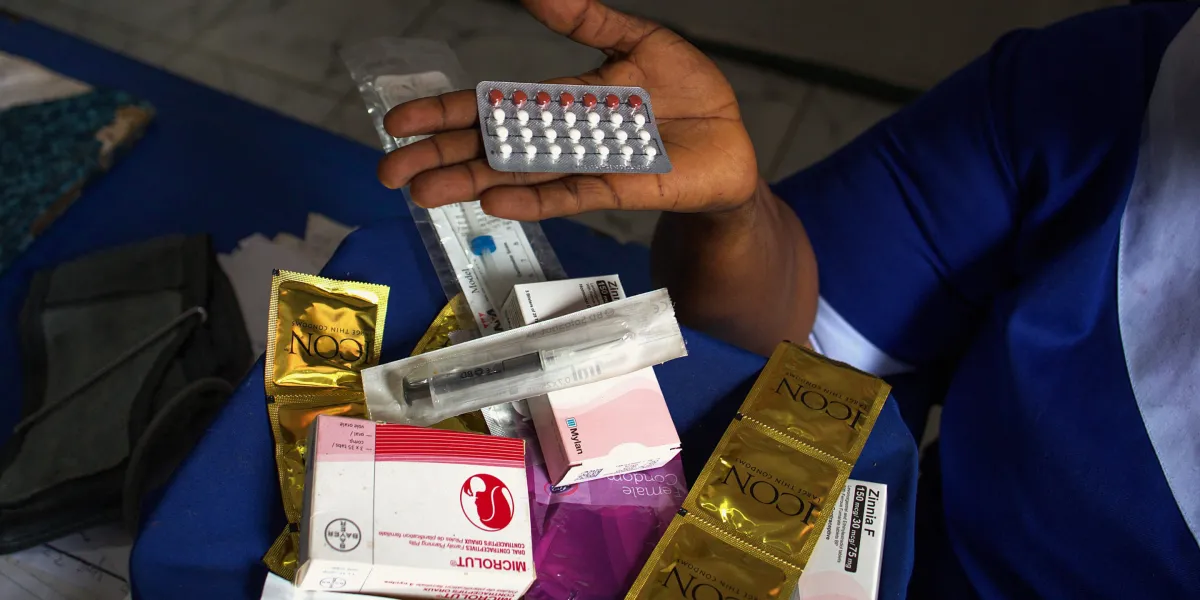
Aid cuts and disrupted shipping are threatening access to contraception in Africa, with clinics warning that girls face growing barriers even where supplies are available. In Zimbabwe, 18-year-old Kelly Nhedega is among those relying on discreet services to avoid another pregnancy and return to education.
Nhedega became pregnant at 16 after avoiding a crowded local clinic, where she feared being judged by other patients or health workers, or having her parents told. She left school and now cares for an 18-month-old child.
She recently obtained contraception from a mobile clinic as she tries to resume her studies.
“That’s a mission I have to complete first. More babies will mean less or no time for school,” she said, with her toddler on her lap.
Her experience reflects a wider problem across the continent, where parental opposition, restrictive policies, stigma and concerns about privacy can prevent adolescent girls from seeking contraception. The obstacles remain even as governments attempt to respond to the withdrawal of overseas support.
The United Nations Population Fund estimates that cuts to aid will create a 185 million dollar shortfall in global contraceptive funding this year. The International Planned Parenthood Federation says nearly 1,400 reproductive health facilities had closed worldwide by December, including 1,175 in Africa, leaving an estimated 5.9 million women without services.
Sub-Saharan Africa accounts for 70 per cent of maternal deaths globally, with about 180,000 pregnancy-related deaths recorded across the continent each year. Experts say contraception is essential in helping adolescent girls avoid unintended pregnancies and the risks associated with childbirth.
Mobile clinics under pressure
For Nhedega, access came through an ageing blue-and-white caravan positioned in a discreet part of a hospital in Epworth, a densely populated settlement outside Harare. The former family travel trailer has been converted into a mobile clinic where adolescents can seek contraception, treatment for sexually transmitted infections, counselling and sexual and reproductive health information away from relatives, neighbours and other patients.
“No one will know, it becomes your own secret,” Nhedega said. She added that community stigma could still feel daunting, even after she and her husband agreed to use contraception.
Since 2021, the caravan has provided services to more than 100,000 adolescents in Epworth and nearby farming communities and informal settlements, according to Pester Siraha, director of Population Services Zimbabwe, which operates the service and other mobile clinics.
But the programme is now under financial strain. Population Services Zimbabwe, an affiliate of MSI Reproductive Choices, lost a five-year, nine million dollar grant awarded in 2023 after the Trump administration dismantled many aid programmes in 2025. More than six million dollars of the grant had not been spent, the organisation said.
Swedish funding helped to cover part of the gap, but that support ended in August after Sweden phased out development assistance to Zimbabwe, Tanzania, Mozambique, Liberia and Bolivia to prioritise Ukraine.
“We were quite excited when Sweden came in,” Siraha said. “Then, suddenly, boom, Sweden said they were leaving.”
She warned that the loss of funding could lead to more unplanned pregnancies and unsafe abortions, and said the organisation could be forced to close its outreach work or even its entire country programme.
Zimbabwe’s Health Minister Douglas Mombeshora said the country had spent 6.3 million dollars on contraceptives since 2022. He has pledged a further 2.25 million dollars a year for contraceptives in 2026 and 2027.
Stigma and supply delays limit access
Having contraceptives in the country does not necessarily mean that adolescents can obtain them. In Zambia, uncertainty over parental consent requirements is another obstacle, said Inonge Wina Chinyama, director of MSI Zambia.
“How many young people can go and say, ‘Mommy, I want to have sex tonight. Can you allow me to go and get a contraceptive method?’” she said. “It doesn’t happen in Africa.”
Some girls who overcome those difficulties may also find that the method they want is not stocked at their local clinic. Chinyama said the loss of US support had particularly affected the “last mile” of distribution, with contraceptives failing to reach rural health centres from central warehouses and provincial hubs.
“Contraceptives sitting somewhere in the country are of little use to a girl living far from the warehouse where they are stored,” she said.
Shipping disruptions have added to the uncertainty. The UNFPA said in March that carriers had rerouted deliveries to avoid waterways affected by conflict. In Zambia, a contraceptive shipment ordered in November arrived more than three months late.
“At first, we thought Zambia was a low-risk country with the Iran war, because it felt like it was very far out there,” Chinyama said. “But we are only just receiving the products this week.”
Demand remains high in rural Zimbabwe
The impact of reduced mobile outreach is particularly clear in remote areas. In Binga, an impoverished and isolated district in north-western Zimbabwe, funding cuts forced Population Services Zimbabwe to slow its clinic visits.
When the service returned briefly in August after a six-month absence, girls rushed towards the vehicle, said Engeline Mawere, the organisation’s operations director.
“Sixteen, 17-year-olds, some with children on their backs, were racing toward us when they saw our vehicle,” Mawere said. “Sometimes we park in the bush so that both married and unmarried young girls can feel safe.”
The response has underlined the importance of confidential outreach for young women and mothers who may not feel able to attend a conventional clinic. For Nhedega, contraception is closely linked to her plans to return to school.
“So here, you just do it secretly and plan better,” she said. “There is no child who should be attributed to a mistake. We should be able to plan and decide when to have a baby.”
