


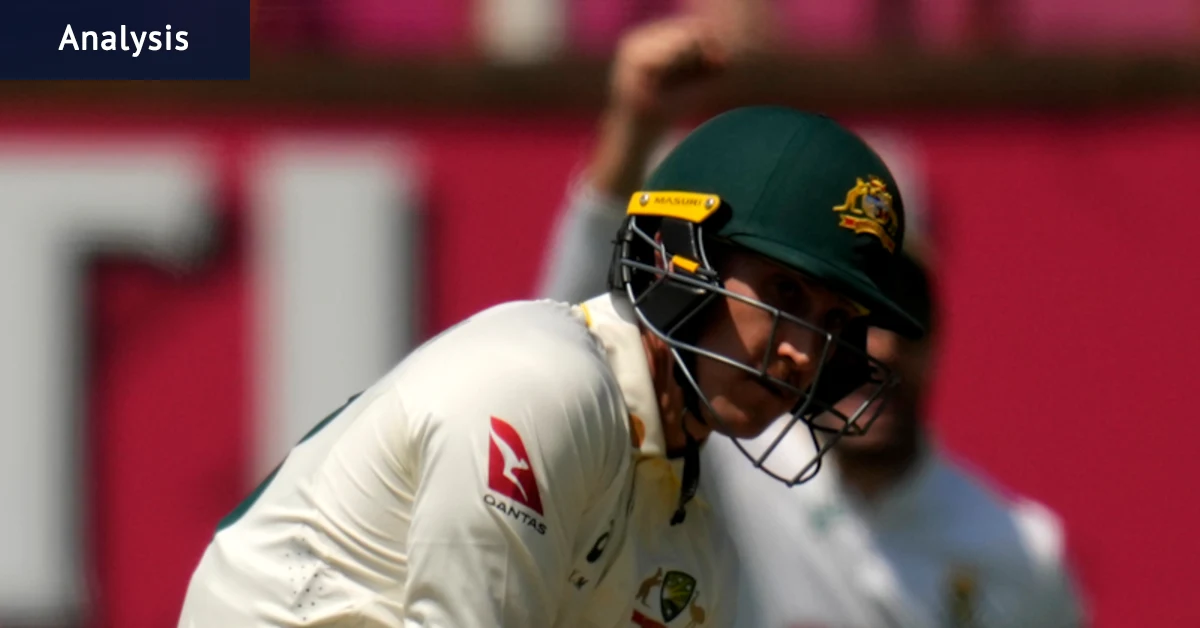
Australia’s decision to recall Nic Maddinson for the first Test against South Africa was exposed as a major gamble when the 34-year-old opener made a 33-ball duck at Kingsmead, while Matt Renshaw offered a more convincing case after being moved down the order.
Maddinson had been told the previous Thursday that he would play in Durban, giving him just over a week to prepare for his first Test in a decade. He had not played a first-class match since recovering from testicular cancer.
He had been supported publicly by coach Andrew McDonald and vice-captain Travis Head, and appeared comfortable within a squad containing several familiar faces. But Maddinson and Renshaw only learned on the eve of the match that they would swap positions, leaving Renshaw to bat at five.
The change did not unsettle Renshaw. He handled South Africa’s pace attack with patience and intent, rotating the strike and responding positively to both fast bowling and spin.
“I look at my one-day game, it’s quite busy, whether that’s against spin or pace,” Renshaw said. “When I first go in, I’ve got a lot of energy … I speak about trying to have good intent against both spin and pace, and that gets my body moving the way I want it to.”
His innings stood in sharp contrast to an Australia batting line-up that again failed to build a substantial first-innings total. Maddinson’s prolonged stay without scoring became a symbol of the wider collapse, rather than an isolated failure.
Australia’s batting problems deepen in Durban
Travis Head may have been unfortunate to glove a Wiaan Mulder delivery down the leg side, but most of Australia’s dismissals followed a combination of disciplined bowling and lapses in concentration.
Marnus Labuschagne had looked fluent before South Africa sensed his growing uncertainty shortly before lunch. A change in the field and a sequence of deliveries from Mulder brought an lbw decision that survived review.
Steve Smith then fell three balls after lunch, struck on the gloves by Marco Jansen before edging a wider delivery to the cordon. Alex Carey followed against Anrich Nortje, who was playing his first Test for three years, while Beau Webster was dismissed after Nortje immediately found a way through him.
Labuschagne and Smith will feel they were capable of avoiding their dismissals, but Australia’s wider concerns are increasingly difficult to ignore. Labuschagne has struggled to remain sufficiently composed for long Test innings, while Carey’s recent returns have also faded.
Renshaw’s contribution suggested that the decision to move him from the opening position may have worked in his favour. He absorbed Nortje’s short bowling and collected runs against pace and spin before Pat Cummins helped carry Australia towards 200, with bad light ending play.
Renshaw also defended Maddinson’s difficult return to Test cricket. “It’s just that’s what opening batters have to deal with,” he said. “I think we all know how hard it is to do that, and unfortunately for Matto, it wasn’t to be today, but we know that cricket’s a weird old game sometimes. He’ll come out the other side of that.”
The questions facing Australia now extend beyond Maddinson’s selection. With Josh Inglis and Cameron Green unavailable, selectors opted for experience interrupted by a lengthy absence, although Nathan McSweeney and Jake Weatherald were among the other possible options.
Australia’s repeated first-innings failures point to deeper issues involving selection, coaching and the domestic pathway. South Africa’s strong opening day has left those concerns more pressing, with Australia facing the prospect of a third defeat in five Tests.
