


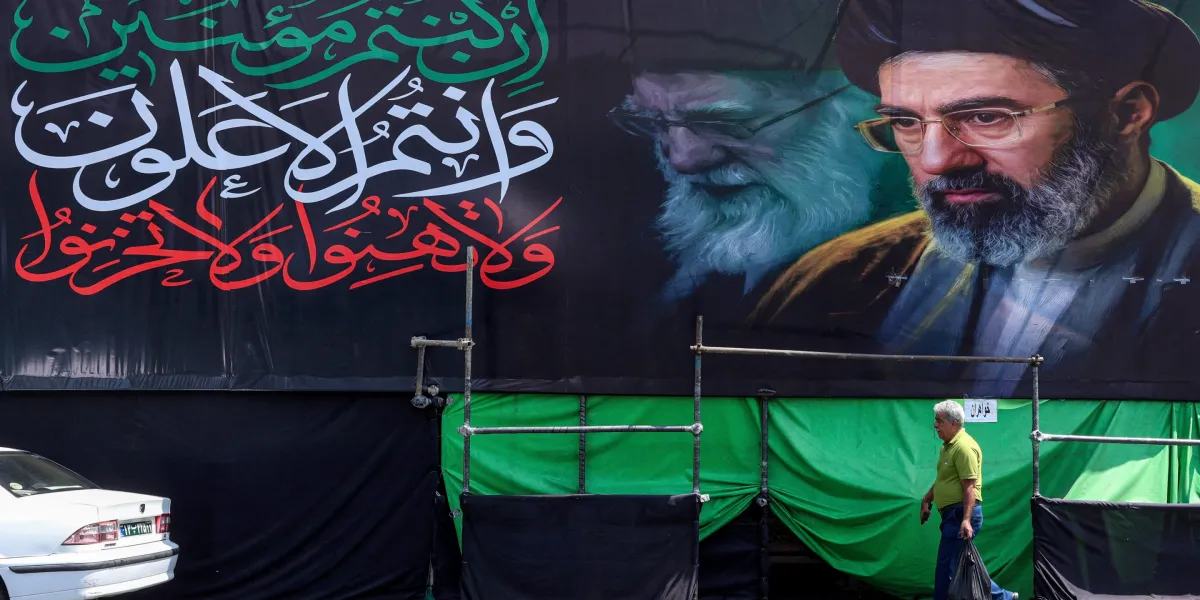
Iran’s supreme leader, Ayatollah Mojtaba Khamenei, has warned officials not to damage social cohesion as worsening economic conditions and tougher US sanctions put renewed pressure on the regime.
In a written statement issued late last month, Mr Khamenei called for action on inflation, unemployment and rising prices, while urging officials to avoid remarks that could weaken public morale. He has not appeared in public since the US-Israeli strike on February 28 that killed his father, Ali Khamenei.
His intervention came as fuel shortages and queues at petrol stations fuelled fresh protests in parts of Iran. The demonstrations have so far been smaller than the mass unrest seen in January, which followed a collapse in the rial and a sharp rise in the cost of living.
“There is the need to seriously address the chain of economic and livelihood challenges, such as inflation, unemployment, management of prices and the market for goods and services,” Mr Khamenei said.
The warning was echoed by President Masoud Pezeshkian, who acknowledged the scale of the country’s economic difficulties in an interview with Iranian state media.
Mr Pezeshkian said Iran’s trade had fallen by between 25 and 35 per cent, with imports declining more sharply than exports. He also rejected claims that American sanctions were having little effect.
“Some people say that sanctions have no effect at all,” he said. “I really don’t know what to tell these people. I just want to say this: Saying that sanctions have no effect is not consistent with these facts.”
Iran’s economic pressure intensifies
The US Treasury has since escalated its campaign against Iran’s ability to generate revenue and move money through overseas networks.
On August 24, Treasury Secretary Scott Bessent announced what he called “Operation Economic Outcast”, targeting financial channels and sanctions-evasion networks used by Tehran. The measures included broader sanctions risks for foreign businesses involved in digital assets, technology, gold, aviation and shipping, as well as action against almost 60 Iran-linked people, companies and vessels.
Iranian officials and senior sources told Reuters that the US naval blockade and the drive to close off international financing routes were becoming increasingly difficult for Tehran to withstand.
One senior source said Iran had only about two months of petrol supplies remaining. The country relies on imports to meet demand because its domestic refining capacity is limited, leaving fuel stocks particularly vulnerable to disruption.
The rial has fallen to around 2.2 million to the US dollar, compared with roughly one million a year ago, while inflation has climbed above 80 per cent. The price of some basic food items has reportedly doubled.
The pressure follows a brutal crackdown on protests earlier this year, when thousands were killed, according to reports cited by Reuters. The deteriorating economy has raised fears that shortages and declining living standards could trigger further unrest.
However, analysts have cautioned that Iran’s leadership may be prepared to tolerate severe hardship rather than yield to American demands. The regime’s calculation is that it can endure economic pain for longer than the US public will accept the financial and military costs of maintaining pressure.
Washington’s strategy also depends on the continued deployment of US naval forces to enforce the blockade and escort oil tankers from Gulf Arab producers through the Strait of Hormuz.
Energy Secretary Chris Wright said the US Navy was improving its ability to defend against Iranian attacks and that other countries had expressed an interest in providing assistance. But he acknowledged that the United States remained the dominant military force in the confrontation.
