


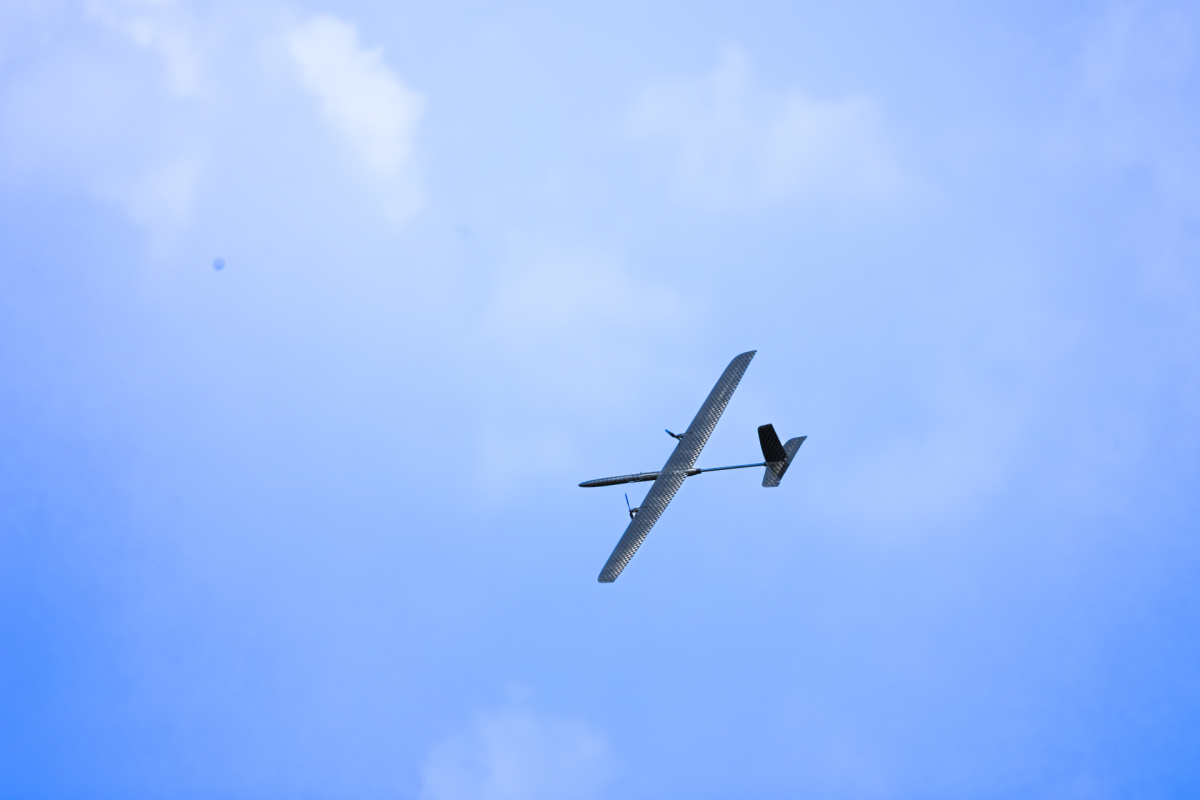
An Indian startup backed by prominent solo investor Lachy Groom is attempting to develop an autonomous aircraft capable of remaining airborne for more than a year by harvesting energy from winds over the ocean.
Alteon, founded in Bengaluru by 20-year-old Samay Sanghvi, has raised $2.5 million (£1.9 million) in a pre-seed funding round led by Groom, with participation from Together Fund. The company plans to use the money to develop small fixed-wing aircraft based on a technique known as dynamic soaring.
Dynamic soaring is used by birds including albatrosses to gain energy by moving between layers of air travelling at different speeds. Alteon is seeking to replicate the process by repeatedly sending an aircraft close to the sea surface before climbing into faster-moving air and turning back through the wind shear.
The company’s initial aircraft is expected to have a wingspan of about three metres. Its intended first use is maritime surveillance, providing governments with continuous visibility over activity in their territorial waters without the aircraft having to land for fuel or battery recharging.
Alteon’s aircraft has yet to achieve energy-neutral flight
Alteon has not yet shown that its aircraft can sustain flight solely through energy harvested from dynamic soaring. Its latest test over the Bay of Bengal saw an autonomous aircraft complete seven O-shaped flight cycles at more than 62mph, while flying within a metre of the water.
The next target is what Sanghvi describes as “energy-neutral dynamic soaring”. In that test, the aircraft would switch off its propulsion system and demonstrate that it could extract sufficient energy from the wind to remain airborne.
Alteon eventually intends to use its propellers as turbines, converting some of the energy generated during flight into electricity to recharge its onboard batteries.
Gabriel Bousquet, a Silicon Valley aerospace and robotics engineer who studied dynamic soaring during his PhD at the Massachusetts Institute of Technology, described the low-altitude test as a “promising first result”. He cautioned, however, that the greater challenge would be proving the aircraft could reliably obtain enough energy from real-world weather conditions over long periods.
Flying close to the sea would expose the aircraft to turbulence, waves, spray, rain and changing light. It would also need to sense and respond continuously to a moving ocean surface while maintaining a precise flight path.
Bharath Swaminathan, whose PhD at IIT Madras focused on the stability of dynamic soaring, said the underlying physics was well established and called the project commendable. But he said keeping an aircraft aloft for several days using the method would itself represent “a very big step, and a big achievement”.
Swaminathan added that local wind shear and turbulence could vary considerably even when broader wind patterns were predictable, meaning some of the problems might only become apparent during testing in real conditions.
Groom said he had decided to invest within the first 30 minutes of his initial meeting with Sanghvi. “Ambitious problems are always going to come with risks,” he told TechCrunch. “For me, it came down to believing Samay and the Alteon team are the ones to figure them out.”
Sanghvi began developing aircraft after leaving school in 2023, learning through the construction and crashes of radio-controlled models. He formally established Alteon in 2025, with early support from Emergent Ventures and 1517.
The company now employs 20 people in Bengaluru and operates from a 10,000-square-foot facility. Sanghvi said the team is producing four or five aircraft a week for testing and has completed more than 200 test flights in the past 30 days.
“Once you build airplanes that can stay in the air for more than a year, there are millions of things you can do with them,” Sanghvi said.
