


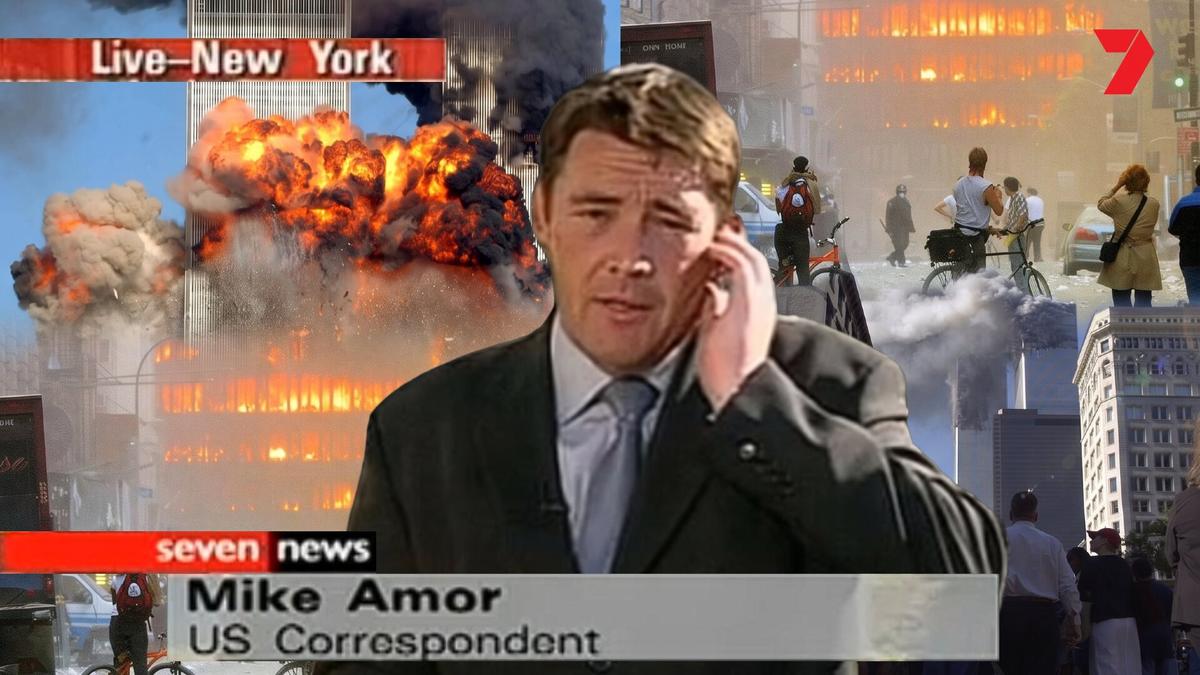
Seven News anchor Mike Amor has recalled the day he witnessed the September 11 attacks unfold in Manhattan, describing memories of Ground Zero that remain with him 25 years later.
Amor was in a taxi with cameraman Jason Blount on the morning of September 11, 2001, after covering Lleyton Hewitt’s US Open victory. They were travelling through a tunnel out of Manhattan when a producer in Sydney called to tell them a plane had struck the World Trade Centre.
As the taxi emerged, Amor looked back towards lower Manhattan and saw one of the towers burning. He immediately understood that the disaster was no accident, while emergency vehicles raced in the opposite direction.
The pair turned back towards the city as reports emerged that a second aircraft had hit the South Tower. Bridges and tunnels were being closed, but they managed to return to Manhattan before access was sealed.
Amor later described the moment as one in which “the whole world had changed”. By the time he reached the area near the World Trade Centre, both towers had collapsed and a vast cloud of dust and ash had engulfed the streets.
People covered in grey dust stumbled away from the wreckage, many appearing shocked and disorientated. Among the scenes that stayed with Amor was a woman clutching a photograph and asking whether anyone had seen the person pictured.
He also remembered the electronic alarms worn by firefighters, which continued to sound amid the ruins. The devices were intended to help locate emergency workers in danger, but after the towers fell, their repeated chirping became an agonising reminder of the lives lost.
Amor and Blount spent the following days reporting from the West Side Highway, alongside exhausted firefighters, police officers and other emergency workers. Lower Manhattan was repeatedly evacuated because of fears that nearby buildings could collapse, while journalists and rescue teams worked amid the debris.
The September 11 attacks killed 2,977 people at the World Trade Centre, the Pentagon and in Pennsylvania. The 9/11 Memorial and Museum continues to honour those victims, while also documenting the long-term consequences for survivors, residents and rescue workers exposed to toxic dust.
The US Centers for Disease Control and Prevention says its World Trade Centre Health Program now serves more than 125,000 responders and survivors, providing monitoring and treatment for certified physical and mental health conditions linked to the attacks.
For Amor, the anniversary is therefore not only a remembrance of the morning the Twin Towers fell, but also of the people who emerged from the dust, those who never came home and the continuing impact on those who were there.
